


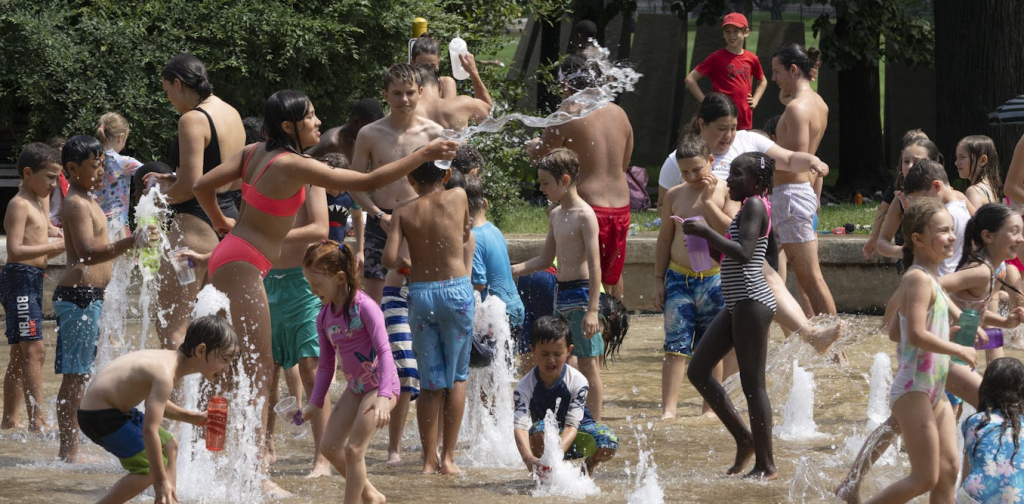

Decades of research in child development confirms that young children’s play is linked to positive outcomes in mental health, cognitive and social development as well as fewer behavioural problems.
Despite this consensus, play is becoming hard to access in everyday life, particularly in cities, due to a combination of spatial or environmental and socio-cultural factors.



Increased traffic, dense housing, limited or constrained access to green space and natural environments and heightened concerns about safety and risky play have reduced children’s independent play opportunities outdoors.
Many families rely on structured programs to compensate for these constraints, but these often come with financial costs, scheduling pressures and limited availability.
Play is shaped by systems
Play depends on a set of conditions that must be created and maintained.
Parks and green spaces may be available but not always accessible, safe or inviting. Community programs can be valuable, but they often require registration fees, transportation and time commitments that not all families can manage.
It’s not only up to parents to create play opportunities — urban planning decisions, infrastructure, policy and politics have significant influence. Who gets to play, where they play and how they play are not neutral questions. They are determined by how cities are designed, how resources are distributed and whose needs are prioritized.
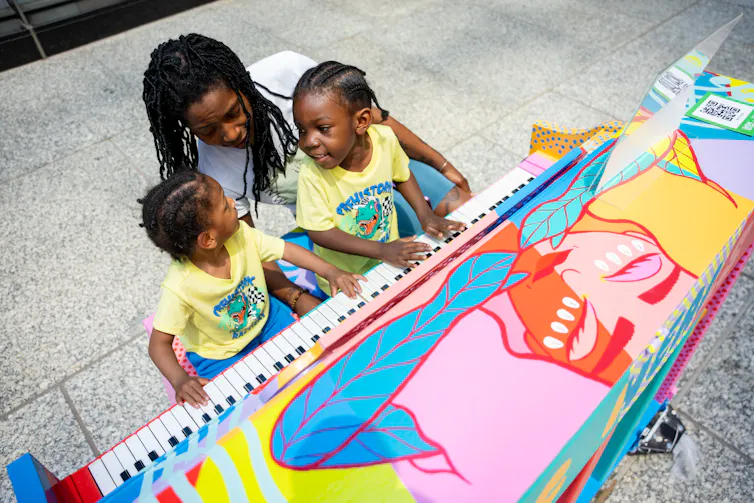
When these systems are uneven, opportunities for play are also uneven. Families living in high-density housing may lack access to nearby outdoor spaces. Neighbourhoods with fewer investments in infrastructure may have limited or poorly maintained play areas.
Caregivers working multiple jobs may have less time to facilitate or supervise play. Cultural and social dynamics and privilege can shape how safe families feel using public spaces.
Girls, racialized children or children from ethnic minority backgrounds may be less likely to participate in outdoor play. Researchers studying the leisure experiences of African Nova Scotian children note that anti-Black racism constrains children’s access to play: Policing surveillance, under-resourced communities and scrutiny of Black families in cases of children’s potential injuries from play are identified as barriers for African Nova Scotian children.
Read more: Where can Black children go in summer? Black families face disparities and need equitable options
This means play is not only a developmental issue, but also an equity issue. When access to play varies, so do opportunities for learning, exploration and social connection. Over time, these differences can accumulate, contributing to broader inequalities in development and well-being.
The central challenge is no longer about recognizing the importance of play. If we want cities where children can thrive, our societies need to create conditions where play is part of everyday life, not something that must be scheduled, supervised or purchased.
Third places in the city
The concept of a third place refers to an environment that exists beyond home and work or school or day care, where individuals can gather, interact, spend time informally and create community.
Child-friendly third places are particularly important because they support spontaneous, self-directed play that is not constrained by rigid rules or structured programming.
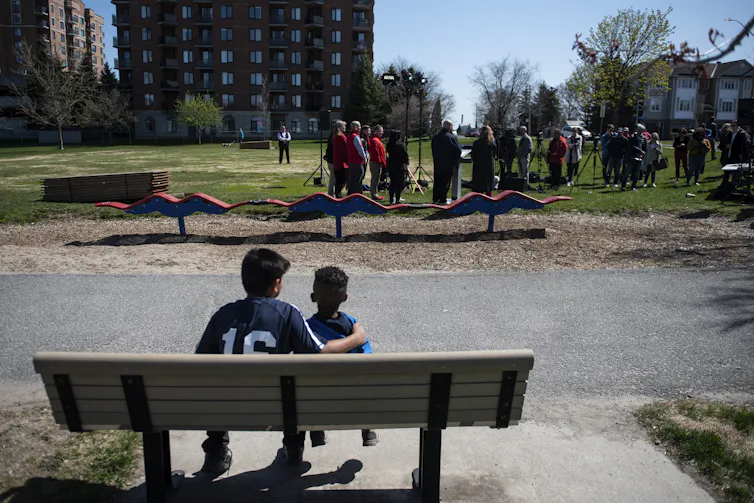
In urban contexts, third places include locations such as libraries, parks, community centres, community gardens and shared public areas that are accessible, low-cost or potentially free and socially welcoming. For example, in Edmonton, StoryWalk at MacEwan University — an outdoor path where children and families can follow pages of a storybook posted sequentially along a campus path — creates a third place at the university for young children.
When thoughtfully planned and resourced, such third places equitably allow children to explore, negotiate social interactions and engage in imaginative activity, all of which are associated with cognitive and social development.
Nature can offer a powerful play opportunity
Natural environments represent a particularly powerful form of third place. Unlike highly structured playgrounds, which often prescribe specific actions (climb here, slide there), settings such as parks, green spaces and wooded areas offer open-ended materials and variable conditions that invite exploration, experimentation and imagination.
Children can manipulate elements such as sticks, water, sand and uneven terrain. Such elements support problem-solving, creativity and physical co-ordination in ways that fixed equipment cannot.
Read more: Wonder and wisdom in a children’s forest nature program
Natural spaces tend to sustain longer and more complex play episodes because they do not limit how materials can be used. Nature-based play environments foster cognitive flexibility and social interaction, whereas structured playgrounds — while valuable for safety and accessibility — often constrain the depth and diversity of children’s play experiences.
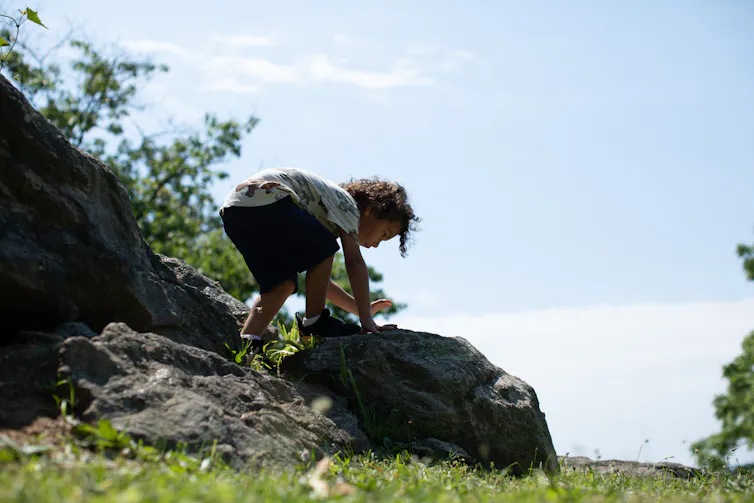
However, inequities in the distribution of wealth within cities directly and indirectly impact how “natural” play spaces are regulated, maintained and used, influencing children’s access to this form of outdoor play.
Research shows that children growing up in marginalized neighbourhoods often have the least access to safe, spontaneous and nature-based play opportunities despite potentially benefiting the most from them.
For parents or caregivers, rather than relying solely on organized programs, it is valuable to identify what third places and outdoor spaces might be available locally. Where feasible, these can be integrated into everyday routines to create consistent and equitable opportunities for play.
Quality indoor play experiences
Another possibility for families can be offering quality indoor play experiences that don’t require expensive or highly specialized toys.
Our recent research shows that children can engage deeply in meaningful play using everyday materials, particularly versatile objects that invite exploration, experimentation and imaginative thinking.
Read more: How children’s play with everyday objects can encourage skills needed for STEM success
Recycled and scrap materials such as cardboard, fabric, containers or other household objects provide flexible opportunities for problem-solving, construction and early STEM thinking at home. Doll play provides opportunities for children to practice social skills by creating imaginary worlds and taking others’ perspectives.
Materials like blocks similarly support reasoning, design thinking and innovation because they allow children to test ideas, revise structures and create without fixed outcomes. The quality of play depends less on the cost of materials and more on the possibilities they afford.
Beyond parents’ and caregivers’ own choices, creating equitable opportunities for play requires cities and communities to invest in flexible everyday environments, as well as accessible third and natural spaces where all children can explore, imagine and belong.



















Comments are closed.