


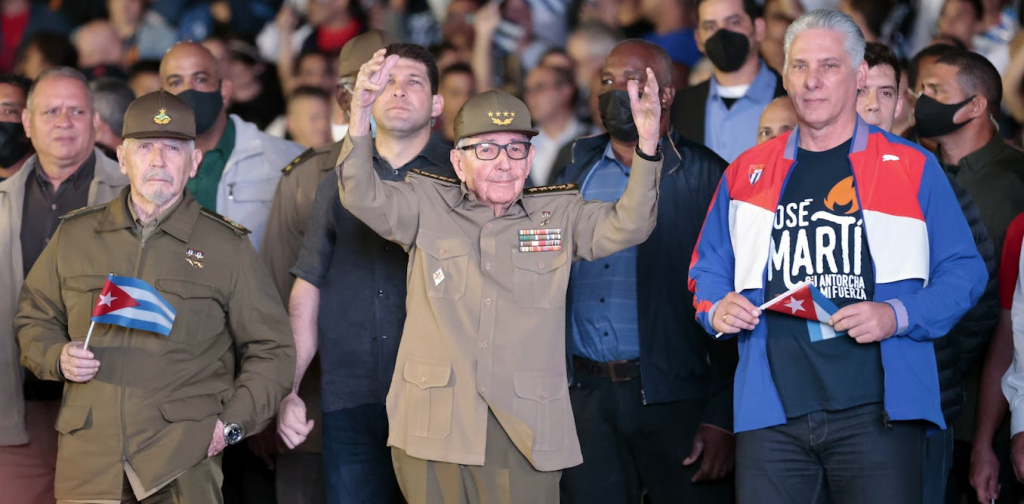

A US court filed criminal charges against Cuba’s 94-year-old former leader, Raúl Castro, on May 20. Castro has been charged with conspiracy to kill US nationals, four counts of murder and two counts of destruction of aircraft. The charges relate to a 1996 incident in which four men were killed after Cuban fighter jets shot down two planes belonging to an exile group from Miami.
The indictment comes at a time when tensions between the two countries are running high, and raises the possibility that the US could try to remove Castro from the country by force, to be brought to trial in the US. We spoke to Anna Grimaldi, a lecturer in global development and Latin American studies at the University of Leeds, about the prospect of military action.

Is there any evidence of Raúl Castro’s involvement in shooting down the aircraft?
Raúl’s brother, Fidel Castro, who was the Cuban president at the time, took responsibility for the 1996 incident shortly after it took place. But US prosecutors argue that, as the then-defence minister, Raúl’s direct orders for Cuban forces to train in tracking and intercepting aircrafts constituted an operational role in the planning phase of the shooting.
In reality, the basic facts of the incident are still unclear. The US maintains the planes were unarmed and flying in international airspace, which would make the downings unlawful. But Cuba argues the aircraft were part of repeated and deliberate violations of its airspace and sovereignty.
Cuban officials continue to frame the attack as a justified act of self‑defence against ongoing provocation. And in any case, Cuban law explicitly prohibits the extradition of its citizens to another country. So unless the US stages an operation to seize Castro, he is unlikely to face trial in the US.
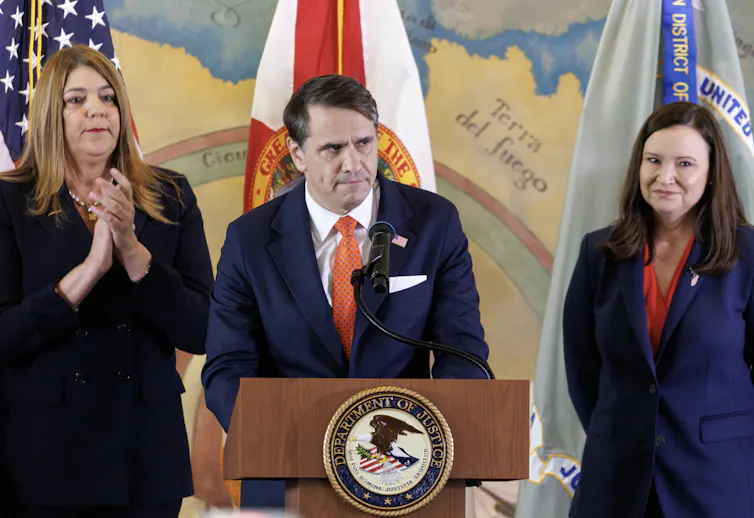
Could the US be using the charges as a pretext for military action against Cuba?
Raúl Castro’s indictment has raised familiar alarm bells. A few months ago, the US carried out a military operation along similar lines in Venezuela which resulted in the capture of the sitting president, Nicolás Maduro. At that time, the US alleged Maduro was involved in drug trafficking and had partnered with cartels designated as terrorist groups.
The US is keeping its options open in Cuba. When asked by reporters following Castro’s indictment whether there could be an arrest similar to Maduro, Trump said: “I don’t want to say that.” Yet he has persistently hinted an interest in carrying out what he calls a “friendly takeover” of Cuba. The Cuban president, Miguel Díaz‑Canel, says this threat alone “constitutes an international crime”.
At least for now, there is little to suggest Washington is actively preparing to intervene in Cuba militarily. In comments to the Associated Press in early May, US officials speaking on the condition of anonymity stated they are “not looking at imminent military action against Havana”.
Cuba’s military doctrine, which is oriented primarily towards territorial defence and in which every citizen is considered a participant, means that military intervention would probably be prolonged. It would also be politically and financially costly.
When fears of retaliation (Cuba lies just 90 miles from Florida) and existing US military commitments elsewhere are also considered, such an intervention looks unlikely in the near term.
The US is much more likely to continue its campaign of indirect pressure, which has intensified in recent years but ultimately stretches back to the Cuban revolution in 1959.
The US regime of sanctions and fuel blockades is crippling Cuba’s economy. Washington appears to be pursuing a strategy of straining the Cuban regime internally, while simultaneously constructing the legal and political justifications for escalation.
Would a Venezuela-style operation in Cuba even be possible?
There are some similarities between the Venezuelan and Cuban cases. By targeting a sitting and former head of state, the US has tried to delegitimise the political leadership of both countries. Cuba and Venezuela have also both faced deep economic crises, heightening their vulnerability to external pressure.
However, there are significant structural differences between the two countries. Venezuela represents a strategically valuable resource for the US, with US policy there closely tied to control over its oil reserves. Cuba lacks comparable material incentives, and has instead been subjected to a long-term embargo and containment strategy.
Cuba’s centralised one‑party system and entrenched institutions also contrast with Venezuela’s more fragmented and weakened state apparatus. And Cuba’s long history of confrontation with the US has fostered a political culture of resistance. Together, these make an operation to impose regime change much less viable.
Is there an opposition movement inside Cuba that would back US military action?
There is no unified political opposition in Cuba. Expressions of dissatisfaction there have frequently taken place through mass emigration, with the island’s one‑party system and other mechanisms of state control constraining the ability of opposition groups to organise and expand.
Rare protests have erupted in Cuba in recent months. But this dissent appears to have be driven largely by material grievances, with reports of demonstrators chanting slogans such “turn on the lights” amid blackouts, rather than an organised political agenda.
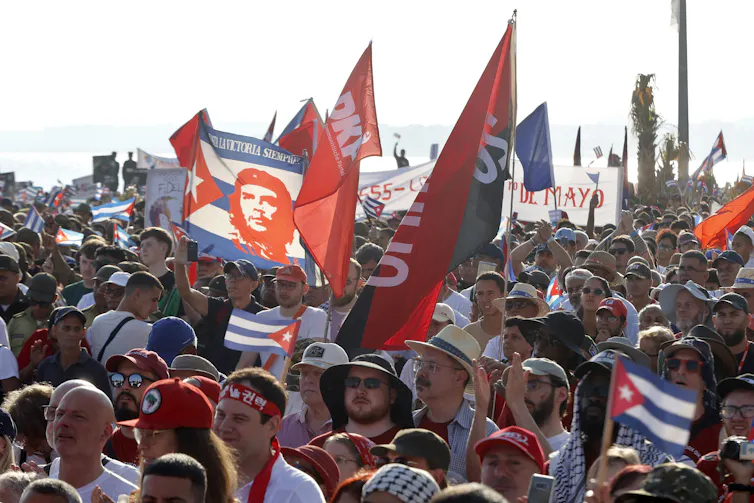
At the same time, the external pressure from the US has produced nationalist mobilisation and demonstrations in defence of Cuban sovereignty. Mass rallies throughout the country have framed US threats against Cuba as imperial aggression, emphasising unity and resistance against external intervention.
Dissatisfaction with the Cuban government does exist. But so far, it seems to remain rooted in economic and domestic concerns, rather than translating into alignment with US objectives or welcoming possible intervention.











Comments are closed.