



The 1845 Franklin Northwest Passage expedition was an unprecedented disaster in the history of British polar exploration, with the loss of all 129 officers and crew and the discovery ships HMS Erebus and HMS Terror. The catastrophe has been the subject of novels, films and television series, as well as active research across several disciplines.

In recent years, remarkable advances have been made, most notably the discoveries of the wrecks of both ships in astonishing states of preservation, which offer great potential for a new understanding of the expedition’s fate. This same period has also seen major advances in the study of the expedition’s human legacy.
On a cold day in late April 1848, having deserted Erebus and Terror a few days earlier, the sailors encamped near Victory Point on northwest King William Island. Captain Francis Crozier penned the words “and start on tomorrow 26th for Back’s Fish River” in the margin of the most important written record of the 1845 Franklin expedition ever found.
Their situation was bleak. The ships had been trapped for 19 months in the ice of Victoria Strait, nearly 30 kilometres from the shore of King William Island.
Nine officers, including the expedition’s leader, John Franklin, and 15 sailors had died, food supplies had declined both in quantity and nutritional value, and many of the 105 survivors were undoubtedly suffering from declining physical and mental health.
The decision to attempt a long and dangerous escape, dragging heavily loaded sleds south over hundreds of kilometres of ice and land, proved fatal. The men stepped onto a path that would lead to their own deaths and into obscurity.
Identifying skeletal remains
The names of the officers and crew of the Franklin expedition are well-known, but their families — like their modern descendants — did not know if distressing reports of scattered bodies of sailors along the route of the retreat and grisly rumours of cannibalism described the fate of their loved ones.
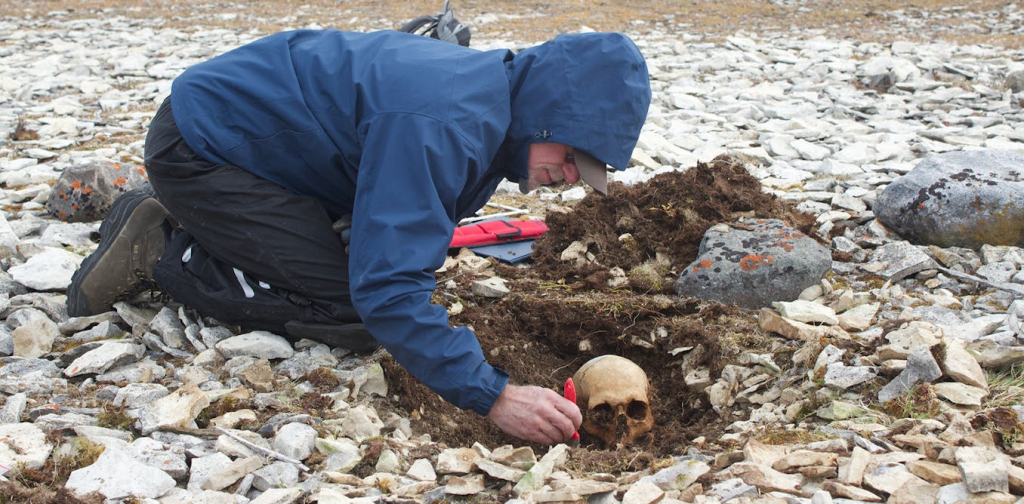
Over the past decade, by combining archaeology, biological anthropology, genetics and genealogy, colleagues and I from the University of Waterloo, Trent University and Lakehead University, working in collaboration with genealogists, have revealed the identities of six of these men. We’ve also shed new light on events that occurred more than 170 years ago during the ill-fated expedition’s final stages.
Our work involved creating two DNA data sets. One is archeological and comprises mitochondrial (maternal) and Y-chromosome (paternal) DNA extracted from teeth and bones found at sites where members of the Franklin expedition perished. The second consists of DNA donated by direct maternal or paternal descendants of Franklin expedition sailors who have been identified through genealogical research.
We analyzed 50 tooth and bone samples from 10 Franklin archaeological sites on King William Island and obtained DNA from descendants of 33 members of the expedition. These data were compared in a search for matching DNA profiles that would reveal a sailor’s identity.
Read more: DNA analysis reveals the identity of a member of the doomed Franklin Arctic expedition
Connecting past and present

We made the first identification in 2019 through a match with DNA from the great-great-great grandson of Warrant Officer (Engineer) John Gregory from HMS Erebus.
Five years later, in 2024, Capt. James Fitzjames, also of HMS Erebus, was identified through a match with a distant paternal cousin.
Fitzjames’ DNA was extracted from a tooth from a mandible bearing several cut marks, revealing that his body had been cannibalized. Fitzjames is not the only member of the Franklin expedition whose body suffered that fate, but he is the only one whose identity is known.
In 2025, we added four more names to the list of identified sailors through matches with second and third great-grandchildren of members of the sailors’ families. Three of the sailors served on HMS Erebus: Subordinate Officers’ Steward John Bridgens, Able Seaman William Orren and Boy 1st Class David Young.
Bridgens died in the same place as Gregory, and his identification means that two of the three men known to have died at that location have now been identified.
A stocking marked “W. Orren,” one of only two labelled articles of clothing found at the Victory Point camp, is a poignant reminder of Orren’s presence there. He later set out on the southward journey on which he would die after walking 65 kilometres.
Young’s identification also has an added element — a fictionalized version of him was the central character in John Wilson’s 1997 novel Across Frozen Seas, which presents the story of the Franklin expedition for a younger audience.
Read more: Inuit folklore kept alive story of missing Franklin expedition to north-west passage
HMS Terror

The fourth identification in 2025, and the only sailor identified to date from HMS Terror, is Henry Peter “Harry” Peglar. He joined HMS Terror in 1845 as a Petty Officer and Captain of the Foretop.
Peglar died near Gladman Point wearing the uniform and presumably working as a steward or officer’s servant, probably the result of having been demoted in rank due to misconduct. His positive identification solved a 167-year-old debate surrounding contradictory evidence found with his skeleton in 1859.
Peglar joined HMS Terror in 1845 as a petty officer and Captain of the Foretop (a senior sailor). His seaman’s certificate was among the papers in a pocketbook found with the body, which pointed directly to the remains being Peglar. However, the dead sailor was dressed as a steward or officer’s servant, a rank or rating that Peglar had never previously held.
Because of the clothing, a narrative emerged that the dead sailor was not Peglar, but a friend who was a steward on the Terror, who was carrying Peglar’s papers back to his family. Our DNA analysis has proved that theory to be incorrect.
So far, we have identified a senior officer, warrant officer, petty officer, able seaman, steward and boy. Five of these men died within two kilometres of each other, and all five served on HMS Erebus.
More data is needed, but these results raise the interesting question of whether the Erebus and Terror crews might have travelled separately by design or, due to unforeseen circumstances, became separated during the retreat.
Our genetic research has opened a new chapter in the investigation of the Franklin expedition that allows people to connect with the story in a more personal way. It is fitting that this chapter is being written with help from descendants of the men who never returned home.



















Comments are closed.