


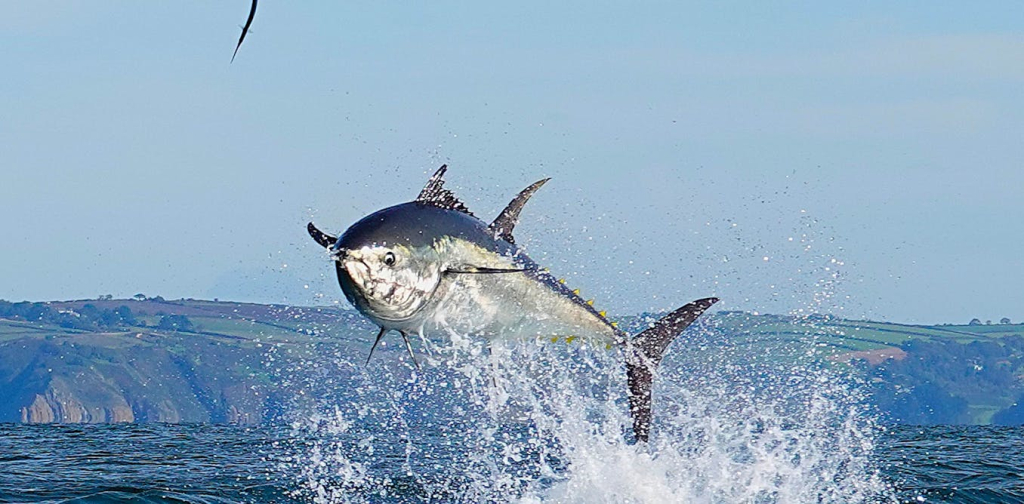

Awesome, unexpected and unforgettable: a sudden bolt of silver as a tuna jumped clear of the sea. Nobody else saw it, and I (Angus Atkinson) almost thought I was hallucinating. But since I first saw one from a boat just off the south Devon coast ten years ago, Atlantic bluefin tuna have steadily increased in the southwest UK. Last year I even saw them from the shore, and tuna now supports a local fishery.
Tuna is not the only species to make a rapid change in the southwest UK about a decade ago. Blue, thresher and porbeagle sharks suddenly increased dramatically. Spiny lobsters suddenly increased. Meanwhile basking sharks and many important fish species like cod and pollack declined. What is going on?



Fortunately, in the southwest UK, help is at hand. Not only does this peninsula host some of the most complete long-term recordings of observations in the UK, we also have a burgeoning network of marine observers.
This was the brainchild of marine consultant Bob Earll, who 15 years ago set up a network called South West Marine Ecosystems. This links scientists, marine charities, fishermen, conservation trusts, managers and citizen scientists many of whom have natural history skills to match the best. This network enables members to more easily share observations and recordings about marine life.
Alongside established high-tech and long-term monitoring such as at the Western Channel Observatory (a set of sampling sites at sea within a 30-mile-radius from Plymouth), many pairs of eyes are looking at the sea along the entire coast of this peninsula. Each year we meet and put data together to report on the status of everything in the marine ecosystem, whether it swims, crawls or flies, and from nutrients right up to the numbers of stranded whales.
South West Marine Ecosystems’ annual reports and annual conferences put the previous year’s observations into the context of all that has gone before. That includes strange new events such as the 2025 octopus outburst. This near-real time reporting, with everyone comparing notes, provided a lightbulb moment: these species shifts were not continuous but seemed to be concentrated into a short intense period of massive change around 2014 to 2016.
In the southwest UK, tuna have increased to the extent that they support a tightly regulated fishery, with a UK catch quota of 230 tonnes for 2026-28. Fishing is always an emotive subject, and some people say we should be leaving these beautiful animals alone.
A recent announcement by the Marine Stewardship Council (MSC) offers some hope that tuna fisheries worldwide are moving in the right direction.
The MSC endorses those seafood sources that have been harvested sustainably, meaning that they abide by the rules of well-managed fisheries based on scientific advice, with minimal collateral ecological damage. This most recent announcement shows an important positive result: the proportion of tuna products available with an MSC endorsement has just risen to nearly 50%, compared to less than 20% only five years ago.
Remarkably, tuna has just overtaken cod as the main seafood bought in the UK. This probably reflects the increasing availability of more sustainably-sourced tuna and sharply declining cod stocks.
A state of flux
Managing these fisheries involves treading that tightrope between allowing livelihoods for the fishing industry, but allowing the whole ecosystem to flourish. The challenges of climate change, shifting distributions and fishing pressure combine into a real headache to manage fisheries responsibly.
Abrupt shifts in ecosystems, as we have witnessed in the southwest of the UK, are critical for fisheries management. In just a few years an ecosystem can lurch into a different operating space with different species and links.
Computer simulation models of ecosystems can broadly project how food webs might respond to the average pace of climate change. Importantly, these models are notoriously poor for predicting abrupt shifts, often known as regime shifts, that punctuate the steadier pace of change.
With these challenges, fisheries managers need all the help they can get to understand abrupt ecosystem shifts. The tuna increase was well documented by South West Marine Ecosystems. The success of this network means that similar programmes are spinning up around the other coasts of the UK.
Similar initiatives are underway elsewhere. The Norwegian Institute of Marine Research provides a data network from public reporting of jellyfish increases, which are important for the management of Norwegian aquaculture.
Joined-up science efforts like South West Marine Ecosystems, alongside long-term scientific monitoring studies and, of course, traditional fish stock assessments, will help us know better whether tuna should stay on the menu.





















Comments are closed.