


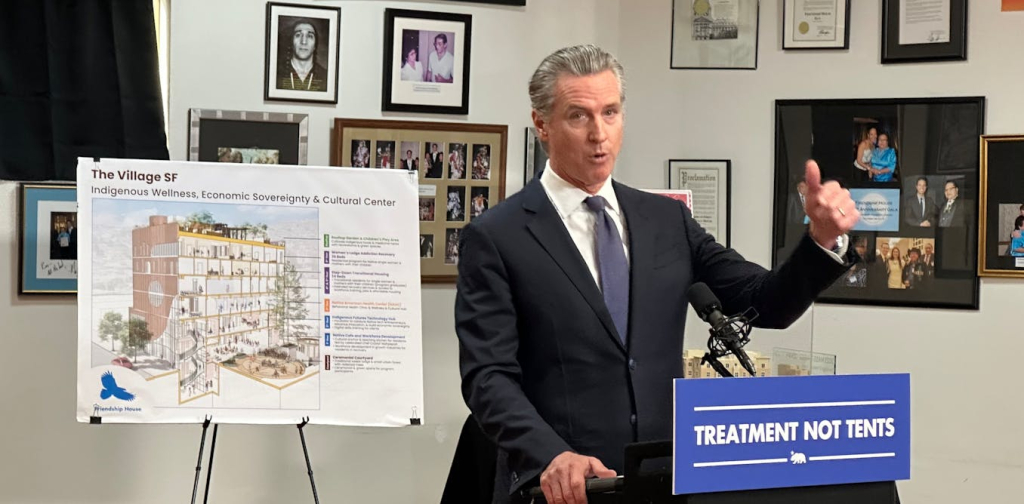

California’s leaders have repeatedly promised to tackle homelessness.
“I know homelessness can be solved,” Gov. Gavin Newsom declared in his 2020 state of the state address. “This is our cause. This is our calling.”


But six years later, his state is spending just a small sliver of its budget, less than 0.5%, on helping the state’s estimated 181,934 people who are homeless on any given night by providing them with shelter, rental assistance and supportive housing. That share is essentially the same as in 2020.
And yet homelessness is also a big priority for the public. In 2023, for example, 22% of the registered California voters told Quinnipiac University pollsters that it was the most urgent issue facing their state – the biggest share for any challenge. In a 2025 Politico and University of California Berkeley poll, 58% of the state’s voters said state government most needed to improve its performance on homelessness and housing – more than any other policy area.
I study what drives homelessness and what reduces it as the director of the University of Southern California’s Homelessness Policy Research Institute. My research team recently analyzed state spending on addressing the needs of homeless people and reducing homelessness to see if state budgets back up that stated political commitment to make the issue a high priority.
Same spending levels as 2020
We analyzed California budget documents and legislative analyses, adding up programs specifically targeted at preventing and ending homelessness for every fiscal year from 2020 through 2026. We found that California is spending approximately US$1.5 billion on homelessness programs in the fiscal year ending June 30, 2026. This amounts to 0.47% of the state’s $321 billion general fund, the portion of the budget over which state policymakers have the most control.
As a share of the general fund, homelessness spending in 2026 is essentially the same as it was before the COVID-19 pandemic.
In the 2020 fiscal year, California devoted approximately $1.1 billion, not adjusting for inflation, to programs targeted at preventing and ending homelessness. That was about 0.46% of its budget – and reflected spending priorities set before the COVID-19 pandemic.
Brief surge in spending
Homelessness spending increased dramatically during the COVID-19 pandemic, when California was running some of the largest budget surpluses in its history.
That extra revenue came from strong tax collections, capital gains windfalls and federal pandemic aid, producing some of the largest budget surpluses in state history.
In the 2022 fiscal year, California devoted approximately $5.8 billion to homelessness programs, equal to 2.1% of its general fund. Spending remained elevated over the following year at roughly $4.7 billion, or 1.6% of the general fund.
As those temporary surpluses faded, homelessness spending fell sharply. It declined to approximately $2.4 billion, or 0.82% of the general fund, in the 2024 fiscal year. It then fell again to about $1.7 billion, or 0.55% of the general fund, in 2025 before returning to roughly 0.47% in 2026.
Homelessness did not immediately decline during the spending surge. However, the pace of growth in the number of homeless people in California slowed substantially compared with the rapid increases seen in the late 2010s. And in 2025, California recorded a modest decrease for the first time in years.
Other funding sources
To be sure, the share of the federal budget devoted to homelessness is far smaller than California’s.
The Housing and Urban Development Department’s national homelessness assistance budget totaled $4 billion in the federal government’s 2024 fiscal year, which ended on Sept. 30. That is less than 0.06% of the $7 trillion the U.S. spent in 2025.
Around $700 million of that federal spending on homelessness flows to California each year through HUD’s Continuum of Care and Emergency Solutions Grant programs. California’s state spending and this federal funding add up to approximately $2.2 billion annually, which is still less than 1% of California’s total budget.
Some Californian local governments, especially the city of Los Angeles, have tried to fill the gap by spending money out of their own coffers to help the homeless and reduce homelessness.
Los Angeles voters approved Measure HHH in 2016 – a $1.2 billion bond for permanent supportive housing — and Measure H in 2017, a quarter-cent sales tax generating roughly $500 million a year for homeless services.
In November 2024, Los Angeles voters replaced Measure H with Measure A, a half-cent sales tax projected to raise more than $1 billion annually. Taken together, these measures have generated several billion dollars in local homelessness funding over the past decade.
Other jurisdictions have pursued similar strategies. San Francisco voters, for example, approved Proposition C in 2018, creating a dedicated business tax to fund homelessness services and prevention programs.
Private philanthropy adds to the mix as well.
Foundations, such as the Conrad N. Hilton Foundation, have channeled tens of millions of dollars into California homelessness initiatives, supporting everything from permanent supportive housing to policy research. These philanthropic contributions are meaningful but small relative to the scale of the problem.
If homelessness is truly one of the defining challenges facing California, then I believe the state must devote resources commensurate with the scale of the problem. Otherwise, we are likely to keep getting what we pay for.






















Comments are closed.