


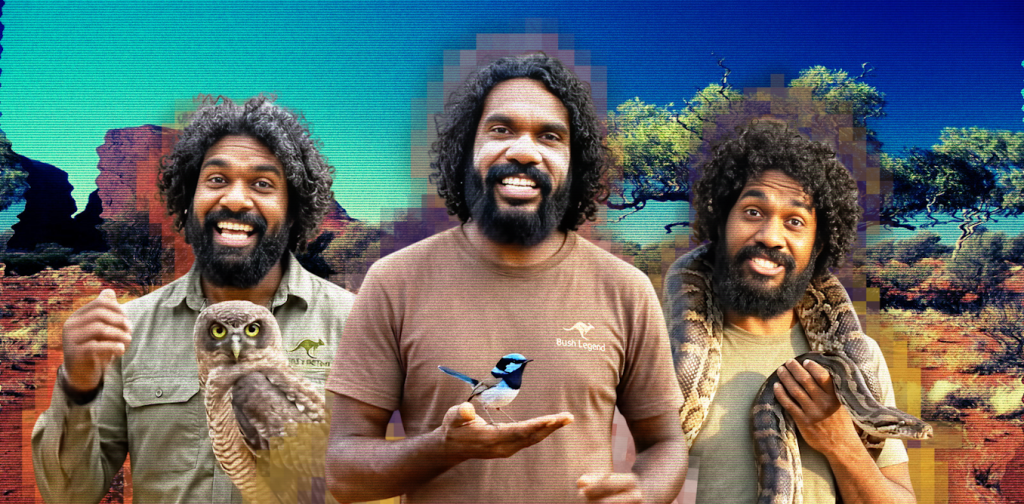

The self-described “Bush Legend” on TikTok, Facebook and Instagram is growing in popularity.
These short and sharp videos feature an Aboriginal man – sometimes painted up in ochre, other times in an all khaki outfit – as he introduces different native animals and facts about them. These videos are paired with miscellaneous yidaki (didgeridoo) tunes, including techno mixes.



Comments on the videos often mention his bubbly persona, with some comments saying he needs his own TV show.
But the Bush Legend isn’t real. He is generated by artificial intelligence (AI).
This is a part of a growing influx of AI being utilised to represent Indigenous peoples, knowledges and cultures with no community accountability or relationships with Indigenous peoples. It forms a new type of cultural appropriation, one that Indigenous peoples are increasingly concerned about.
Do they know it’s AI?
In the user description, the Bush Legend pages say the visuals are AI. But does the average user scrolling through videos on their social media click onto a profile to read these details?
Some of the videos do feature AI watermarks, or mention they are AI in the caption. But many in the audience will be completely unaware this person is not real, and the entire video is artificially generated.
These videos “bait” the audience in through a spectrum of cute and cuddly to extremely dangerous creatures. Comments left on the videos query how close the man is to the animals, alongside their words of encouragement.
One commenter on Facebook writes “You have the same wonderful energy Steve Irwin had and your voice is great to listen to.”
The voice and energy they are referring to is fabricated.
A lack of respect
With any Indigenous content on the internet (authentic or AI), there remains racist commentary. As Indigenous people, we often say don’t read the comments, when it comes to social media and Indigenous content.
While the Bush Legend is not real nor culturally grounded, it too is not immune to online racism. I have read comments on his videos which uplift this AI persona while denigrating all other Indigenous people.
While this does not impact the creator, it does impact Indigenous peoples who are reading the comments.
The only information available on Bush Legend, other than the fact it is AI, is the creator is based in Aotearoa New Zealand. This suggests there is likely no connection to the Aboriginal and Torres Strait Islander communities that this likeness is being taken from.
Recently, Bush Legend addressed some of this critique in a video.
He said:
I’m not here to represent any culture or group […] If this isn’t your thing, mate, no worries at all, just scroll and move on.
This does not sufficiently address the very real concerns. If the videos are “simply about animal stories”, why does the creator insist on using the likeness of an Aboriginal man?
Accountability to the communities this involves is not considered in this scenario.
The ethics of AI
Generative AI represents a new platform in which Indigenous Cultural and Intellectual Property (ICIP) rights are breached.
Concerns for AI and Indigenous peoples lie across many areas, including education, and the lack of Indigenous involvement in AI creation and governance. Of course, there is also the cost to Country with considerable environmental impacts.
The recently released national AI plan offers little in terms of regulation.
Indigenous peoples have long fought to tell our own stories. AI poses another way in which our self determination is diminished or removed completely. It also serves as a way for non-Indigenous people to distance themselves from actual Indigenous peoples by allowing them to engage with content which is fabricated and, often, more palatable.
Bush Legend reflects a slippery slope when it comes to AI generated content of Indigenous peoples, as people can remove themselves further and further from engaging with Aboriginal and Torres Strait Islander people directly.
A new era of AI Blakface
We are seeing the rise of an AI Blakface that is utilised with ease thanks to the availability and prevalence of AI.
Non-Indigenous people and entities are able to create Indigenous personas through AI, often grounded in stereotypical representations that both amalgamate and appropriate cultures.
Bush Legend is often seen wearing cultural jewellery and with ochre painted on his skin. As these are generated, they are shallow misappropriations and lack the necessary cultural underpinnings of these practices.
This forms a new type of appropriation, that extends on the violence that Indigenous peoples already experience in the digital realm, particularly on social media. The theft of Indigenous knowledge for generative AI forms a new type of algorithmic settler colonialism, impacting Indigenous self-determination.
Most concerningly, these AI Blakfaces can be monetised and lead to financial gain for the creator. This financial benefit should go to the communities the content is taking from.
What is needed?
It is concerning to be living in a time where we do not know if the things we are consuming online are real. Increasing our AI and media literacy levels is integral.
Seeing AI content shared online as truth? Let the person sharing this content know – conversations with our communities serve as an opportunity to learn together.
Support actual Indigenous people sharing knowledge online, such as @Indigigrow, @littleredwrites or @meissa. Or check out all the Indigenous Ranger videos on TikTok.
When engaging online, take a moment to consider the source. Is this AI generated? Is this where my support should be?


















Comments are closed.