


On July 13, the residents of Namaygoosisagagun First Nation in Northern Ontario watched a massive wildfire jump the rail line near their homes. Facing an approaching 350,000-hectare fire, just over two dozen people who were in the community at the time could not wait for official evacuation co-ordinates, government transport or provincial emergency alerts.
Instead, they evacuated entirely by boat, carrying only what they could hold. While every member survived, their community was entirely destroyed.



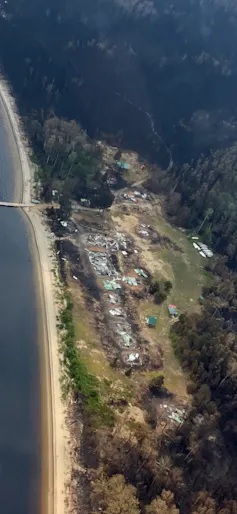
Another First Nation, Whitewater Lake, has also been destroyed as more than a dozen others across Northern Ontario remain under mandatory evacuation orders. The political response is following a familiar playbook, blaming climate change as the sole culprit for the devastation.
But the loss of Namaygoosisagagun First Nation is also the predictable outcome of an emergency system governed by colonial urgency: a design framework that treats raw transmission speed as a substitute for relationships, assumes a universal public and renders local governance expendable under pressure.
Speed is obviously essential when a fire is moving fast, but it’s a hollow metric if the warning arrives in a language a community cannot process or via a communications network that doesn’t work.
Leaving marginalized people behind
Canadian emergency management focuses heavily on speed and centralized command. The dominant assumption is that a fast alert sent to a universal public is the gold standard of safety.
Yet speed is not a neutral variable. As some sociologists have noted, acceleration is a mechanism of power that serves those already supported by robust infrastructure while structurally leaving others behind. When emergency systems measure success purely by how fast a centralized broadcast is pushed out, they shift the burden of survival entirely onto the marginalized communities who may not have received the alerts or are ill-equipped to respond to them.
This creates an authorization gap, systematically separating local knowledge of danger from the authority to act. Under the Indian Act, First Nations leadership is frequently excluded from formal decision-making within provincial emergency chains.
This happened during the 2016 Fort McMurray wildfire, when local Indigenous leadership was forced to wait for provincial authorization even as the fire advanced, and during the 2021 Lytton wildfire, when provincial managers failed to make official contact with the Nlaka’pamux Nation Tribal Council until 12 hours after evacuations began.
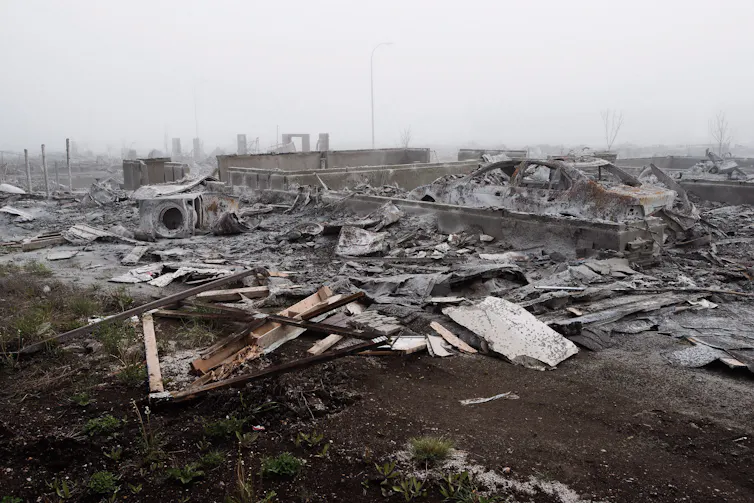
These administrative delays did not cause the fires, but they crippled the capacity of local leaders to deploy safe, orderly and self-directed community evacuations before the chaos of displacement took over.
At Namaygoosisagagun, this gap was compounded by the community’s unresolved federal recognition status, making direct emergency support structurally harder to secure.
Temporal injustice
Emergency alert infrastructure is built long before a fire starts. But in Northern Ontario, the physical and digital infrastructure of remote First Nations has been starved. The Nishnawbe Aski Nation has repeatedly warned that northern airport capacities are not built for large-scale air evacuations, and telecommunications breakdowns common during crises cut off vital health information.
In other evacuations where Indigenous communities were primarily impacted, the absence of alerts in Indigenous languages also leaves people vulnerable. This is known as temporal injustice: a system that forces people to move at a pace they have physically or structurally been prevented from doing.
Issuing urgent alerts only in English and French in regions where Indigenous languages are primary commits a linguistic temporal injustice. During the 2023 Yellowknife evacuation, official alerts were delivered in only two of the territory’s eleven official languages.
Psycholinguistic research shows that processing information in a second language imposes a massive cognitive load. Under acute stress, the human brain naturally sheds the capacity to process abstract, complex instructions, and the nervous system demands proximity to trusted, familiar voices to make decisions. Releasing untranslated, highly technical alerts actively confuses rather than protects.

Tech as a carrier of knowledge
Fixing these failing, top-down transmission systems requires a shift: Canada must view crisis communication as an act of care rather than a command. Indigenous media theory offers a path forward through the concept of the “digital bundle” — a framework where technology isn’t just a tool, but a carrier of sacred knowledge, relationship and accountability.
When the official system fails to provide this care, communities build it themselves. During the Yellowknife evacuations, community radio hosts and informal family networks stepped in to translate and contextualize information in real time. In Kashechewan First Nation, years of recurring spring floods have forced community members to build their own relational checkpoint networks to ensure everyone is accounted for.
This is known as relational emergency system — one that emphasizes trust, human connection and communication among responders and communities during a crisis. It’s the true infrastructure of survival.

The chaotic, unsupported escape of Namaygoosisagagun’s residents by boat was a direct policy choice. While an emergency alert cannot halt a physical wall of fire, a relational emergency system can prevent the structural abandonment that follows it. Reforming traditional emergency response systems can narrow the gap between a planned evacuation and a catastrophe.
If Namaygoosisagagun First Nation Chief Helen Paavola’s localized knowledge had automatically triggered co-authorization for provincial evacuation support, the perilous boat crossings across Lake Collins could have been supported by official rescue craft on standby rather than executed as a desperate, unassisted flight.
Furthermore, resolving federal recognition of First Nations would directly impact funding for basic emergency infrastructure and rehearsed evacuation routes.
Ultimately, a multilingual alert speeds up the time between a threat warning and people moving to safety. At the same time, a community-based check-in system allows outside emergency crews to support a planned evacuation route, rather than wasting critical hours on blind search-and-rescue operations.
The destruction of Namaygoosisagagun and other First Nations now and in the past is a direct policy choice — a failure that is both entirely foreseeable and completely correctable.
Institutional will is lacking
The technical infrastructure for a relational, multilingual emergency system already exists. The Canadian Profile of the Common Alerting Protocol, which powers the Alert Ready system, is fully capable of carrying multiple simultaneous language feeds, attaching pre-recorded audio files spoken by trusted community members and using traditional geographic placenames.
The technology is ready; the wires are waiting.
Canada must stop treating Indigenous languages and governance as optional accommodations and start treating them as essential infrastructure. Until First Nations have direct control over the emergency alert systems on their own lands, these systems will continue to fail them.













Comments are closed.