


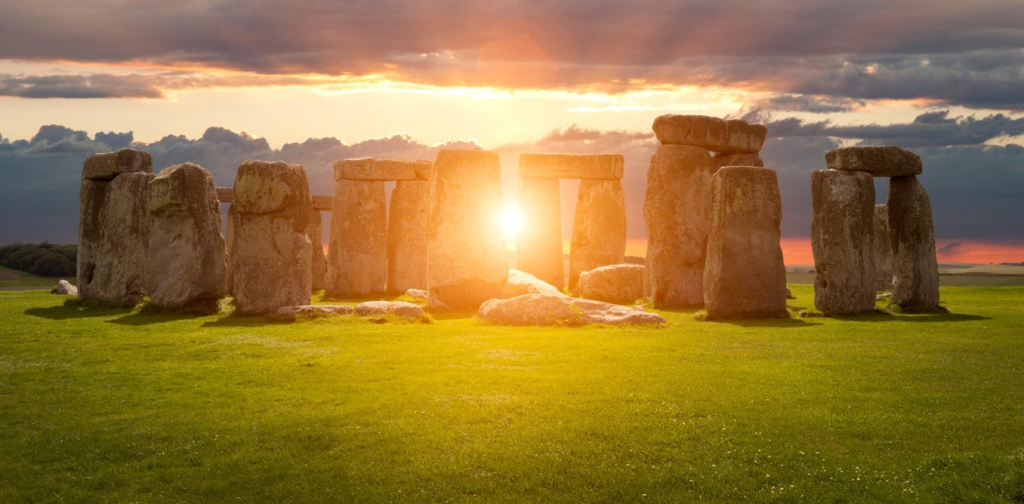

The story of Stonehenge starts around 5,000 years ago. But its famous old stones, some of which were transported all the way from south-west Wales to Wiltshire, are just part of the story.
Close to the beginning of its use, the site was a cemetery, with dozens of people laid to rest. That so many changes have been made to the site since – almost all involving huge commitments of human labour and creativity – is testament to Stonehenge’s significance to countless generations of people.


Its continuing fascination was demonstrated by a 2022 British Museum exhibition that attracted 190,000 visitors to its collection of prehistoric objects from 36 European institutions. Now, that physical exhibition has been brought to virtual life in a new collaboration between researchers at the University of Reading, including myself, and the museum.
Users of The Virtual World of Stonehenge – released to coincide with the summer solstice – can go deep inside Stonehenge and watch it change through time.
They can closely examine one of the bluestones that was very likely brought to Stonehenge from Wales, or an ancient pounder tool used to shape the sarsen stones that were excavated much closer to the site.
With the help of English Heritage, which manages Stonehenge, we have also reconstructed how this megalithic structure might have looked through different phases of its existence.
Users can also travel further afield to view the evolving landscape of ritual monuments around England – for example, to Neolithic flint mines at Grimes Graves in Norfolk. Here are some more of the ancient places and artefacts you can discover today without leaving your armchair.
The Coneybury pit
The pottery, animal bones and flint tools in this display were all excavated from a pit close to Stonehenge – but they pre-dated the stones by almost a thousand years. It was among the less spectacular assemblages in the 2022 exhibition, yet had a fascinating story to tell.
The pit held the remains of a feast enjoyed by hunter-gatherers and the first farmer communities some 5,900 years ago. Those gathered ate farmed beef and hunted venison.
Chemical analysis of the remains shows the cattle and deer consumed came from different places – and that the meat was prepared in different ways. As a coming together of worldviews, languages, customs and traditions, the remains of this shared meal marked the end of thousands of years of a hunter-gatherer way of life.
The virtual experience enables users to watch an animated video telling the story of this meeting, and explains how archaeologists pieced together its story.
Seahenge
In 1998, a well-preserved timber circle emerged from the shores of Holme-next-the-Sea, on the coast of Norfolk. It was soon dubbed Seahenge owing to its similarity to timber circles that had once stood in the Stonehenge landscape.
The Holme circle was originally built on a saltmarsh, between land and sea, and consisted of 55 large oak posts. A narrow entranceway was positioned exactly to align on the Sun’s path, so that the midsummer rising Sun illuminated the interior of the monument.

From a study of the tree rings, it is known that Seahenge was built in the spring or summer of 2049 BC, at a time when stone tools and weapons were rapidly being replaced by metal as the material of choice for social and economic life – and also for offerings to supernatural forces.
During that period, circles of wood and stone were in decline. Seahenge was constructed near the end of a religious tradition that had lasted for almost a millennium.
In the virtual experience, you can listen to the “Seahenge soundscape” created by the artists Rose Ferraby and Rob St John. Their work added a spine-tingling dimension to the British Museum’s display of these ancient timbers.

A 6,000-year-old leaf
A humble object that captured many people’s imagination during the British Museum exhibition was a single elm leaf. This delicate specimen fell around 6,000 years ago near an early farming settlement on the coast of Lancashire.
Deforestation has played a key role in European history ever since then. Hard-won clearances could be filled by trees in a human lifespan, while woodland continued to provide vital resources to support the farming way of life.
Near this ancient leaf, we displayed a wall holding 89 stone axes – each representing a generation of human lives during the primary period covered by the exhibition (circa 4000-1500 BC). Many would have been used to chop down trees thousands of years ago – clearing land for crops and monuments, as well as providing wood for building.
Folkton chalk ‘drums’
These three carefully-carved chalk treasures accompanied the body of a small child buried 5,000 years ago in Folkton, North Yorkshire. The eyes peering out from above abstract motifs on the largest and smallest of the sculptures might have been created with the fate and protection of a loved and vulnerable child in mind.
This enigmatic group of objects was excavated in the 1860s. The drums, placed carefully along the line of the child’s back, work well as a set: their size is incremental and all three have similar decorative schemes.

The patterns share the same repertoire of concentric circles, lozenges, zigzags, chevrons and parallel lines found elsewhere across Britain and Ireland. But intriguingly, two of the drums have a motif of eyes with eyebrows insinuated in the design – hinting at a daring, possibly dangerous, reference to a person or spirit embodied within.
In The Virtual World of Stonehenge, you can explore these fascinating and intricately carved objects in 3D, along with a similar drum found much more recently at Burton Agnes. This one was placed with three children of different ages buried close together, the two youngest poignantly holding hands.
















Comments are closed.