


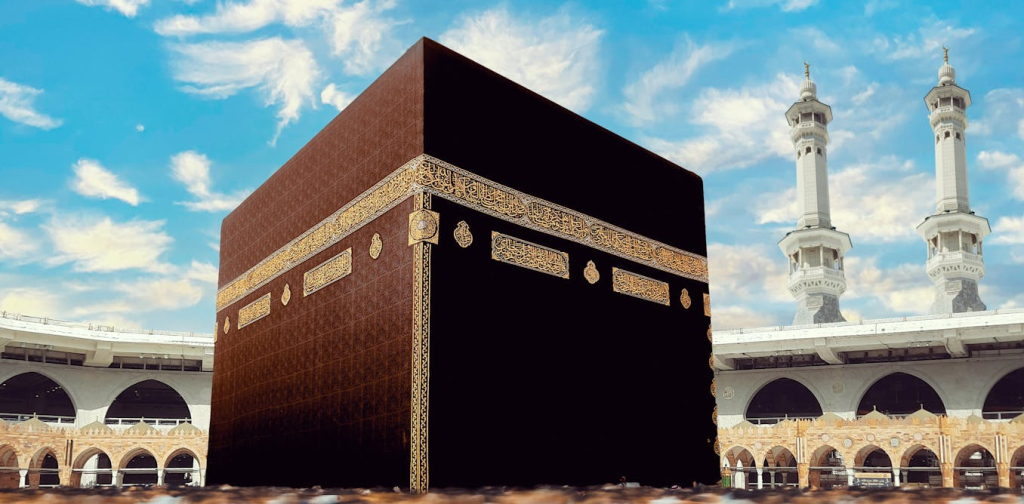

As Muslims gather for the annual pilgrimage of Hajj in Mecca, Saudi Arabia, they will circle around the “Kaaba,” a black cube draped in gold-embroidered cloth. A ceremonial textile – known as the “kiswah” – covers the Kaaba, around which Muslims will walk seven times in a ritual known as “tawāf.” It is the central act of the annual pilgrimage.
The Kaaba itself is a roughly cubic gray granite structure about 43 feet tall, which Muslims believe was established by the Prophet Abraham – Ibrahim in Arabic – and his son Ishmael as a place of monotheistic worship in antiquity. The Kaaba is empty inside, with no altar, idol or relic on display.



Yet, it is the geographical and spiritual center of the Muslim world. Muslims across the globe turn toward the Kaaba during their five daily prayers. The kiswah is what they actually see when they get there.
As a scholar of Islam, I study how spiritual objects carry meaning across generations. For all Muslims, the black cloth covering the Kaaba is deeply sacred as it touches Islam’s most sacred site and is believed by many to perform miracles simply through a touch.
The history of the kiswah
The earliest documented covering, recorded in ninth-century Arabic chronicles, is attributed to a Yemeni king named As’ad Abū Karib who reigned around 400 C.E. He is said to have draped the shrine in striped red wool.
For centuries afterward, successive coverings were laid one on top of another. As a result, by the eighth century, the accumulated weight threatened to collapse the structure.
Al-Mahdi, an Abbasid caliph, the dynasty which governed from Persia to Spain between the eighth and 13th centuries, performed the pilgrimage in 777 C.E. He ordered everything stripped down and replaced annually with a single cloth. This cycle has governed the practice for nearly 1300 years.
The color wasn’t black, as it is today. For most of Islamic history the kiswah was white, red, green, yellow or striped. White linen came from Coptic Christian weavers in the Nile Delta during the seventh century. The Mamluk sultans of Egypt, who ruled from 1250-1517, favored a saffron-yellow silk.
The transition to black happened only around 1224 C.E. under an Islamic ruler in Baghdad. The transformation has become so complete that most Muslims would be startled to learn it was ever otherwise.
What is the cloth made of, and where does it come from?
Today the kiswah is woven at a state factory called the King Abdulaziz Complex in Mecca, in a neighborhood called Umm al-Joud. It uses about 1,500 pounds of high-grade silk dyed black. Roughly 260 pounds of gold-plated and pure silver thread are embroidered into Quranic calligraphy along a wide belt that runs two-thirds of the way up the cube. A separate, even more ornate curtain covers the door.
The whole assemblage costs over US$5 million annually, paid from the Saudi treasury; the covering is replaced once a year on the first day of the Islamic calendar. Previously, it was replaced during the Hajj.
But the kiswah is not only an artifact. It is, and has always been, a political object. For roughly a thousand years, the right to manufacture and ship the cloth from Cairo to Mecca was symbolic of who claimed legitimate rule over the Muslim world.
Egyptian sultans sent it under the Mamluks; Ottoman sultans sent it from Cairo for four centuries beginning in 1517. The cloth traveled in a ceremonial caravan accompanied by a richly draped, empty palanquin called the “maḥmal” — a sort of mobile throne announcing the absent sultan’s protection of the holy cities.
In 1926, when the founder of modern Saudi Arabia conquered Mecca, his religious militia attacked the Egyptian caravan in a clash known as the Maḥmal Incident.
Saudi Arabia’s founder had just taken control of Mecca with the help of a fiercely puritanical religious militia. When Egyptian pilgrims arrived with the ceremonial caravan, accompanied by music and public celebration, the militia viewed the displays of reverence as contrary to “true Islam.” They attacked the Egyptians, killing dozens of people.
The clash marked a deeper shift in the Muslim world’s center of gravity. Religious authority and prestige, long anchored in cosmopolitan Cairo, were moving toward the Arabian heartland, where a rising Saudi order was reshaping Mecca through a far more austere version of Islam.
The Saudi state has manufactured the kiswah itself ever since.
When the old kiswah comes down each year, it is cut into pieces by the Banū Shayba, a family that has carried out this duty for generations. The fragments are then distributed as gifts to heads of state, museums and ordinary pilgrims who happen to be present at the right moment.
In Muslim belief, whoever holds a fragment is holding something that connects the earthly world with the divine.
















Comments are closed.