


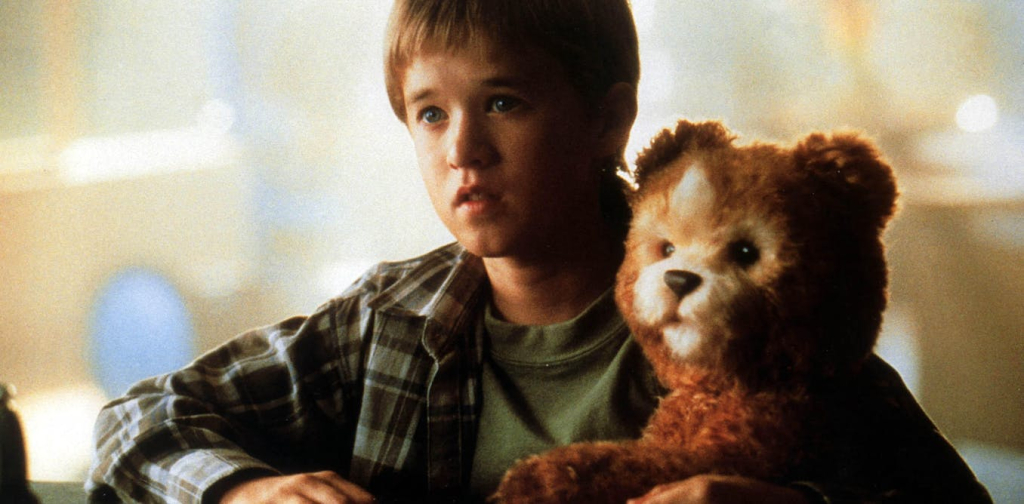

A quarter of a century ago, Steven Spielberg released one of the most unusual films of his career: A.I. Artificial Intelligence, a futuristic fairytale about a robot boy programmed to love.
Yet the movie’s origins lay not with Spielberg but another giant of cinema. For more than two decades, Stanley Kubrick had wrestled with the project, convinced it contained questions about technology, humanity and what it means to be loved. He never managed to bring it to the screen, though.



Released in 2001, A.I. arrived years before smartphones, social media and the boom in artificial intelligence. Yet today, as AI systems become woven into everyday life, the film feels newly relevant – not because it accurately predicted ChatGPT or generative AI, but because it explored the emotional and ethical questions that emerge when people form relationships with machines.
The story began with a 2,000-word short story, Supertoys Last All Summer Long, written by British author Brian Aldiss in 1969 for a special issue of Harper’s Bazaar.
It was set in a dystopian future where, because of overpopulation, reproduction was strictly controlled by the government and childbirth was granted through a lottery scheme. As they wait for their number to come up, Henry Swinton brings home a synthetic robotic child called David and a robotic teddy bear to keep his wife, Monica, company.
Although David is supposed to behave like a real child, there is a failure in communication between the robots and the couple. “Nobody knows what ‘real’ really means,” the teddy tells David. Despite the bear’s coaching, David is unable to please the childless couple.
Kubrick was attracted to the lyrical fairytale, mythic and cosmic qualities of Supertoys. He saw in it a modern version of Pinocchio, the story of a child who longs to become real.
The director began working on it in 1976 and, over the next two decades, kept returning to the story, engaging many writers to adapt it into a workable film. But rarely were they able to supply the necessary fuel to feed his imagination.
Technology presented another obstacle. Kubrick imagined David as an artificial child who would be indistinguishable from a real boy. But visual effects in the 1980s and early ’90s were not advanced enough to create such a character convincingly.
Using a child actor posed a different problem: Kubrick’s famously lengthy productions meant David might visibly age during filming. “The way we worked, the boy would be a teenager,” Kubrick’s brother-in-law, Jan Harlan, quipped.
Read more: 2001: A Space Odyssey still leaves an indelible mark on our culture 55 years on
Faced with an impasse, Kubrick approached his friend Spielberg with an unexpected suggestion: perhaps he should direct the film instead. Spielberg initially resisted – but Kubrick continued to champion the idea, believing Spielberg’s emotional sensibility was better suited to the material.
By then, the project had been renamed A.I. Artificial Intelligence. Kubrick intended it to follow his film Eyes Wide Shut, but he died in 1999 before that film’s release. Only afterwards did his family and longtime collaborators ask Spielberg to take the project forward.
The finished film was a fascinating mix of Kubrickian irony and Spielbergian sentimentality. The odyssey of a robot boy who longs for the love of his human mother across aeons of time ends in a symphony of yearning and sadness. Robots of the future bring the boy’s mother back to life for a brief time, which no other Kubrick film had attempted. Spielberg insists he was faithful to Kubrick’s intent.
What was A.I. really about?
Don’t be fooled by the title. The film isn’t exactly a prediction of the rise of generative and agentic AI (for that, you should watch Kubrick’s 2001: A Space Odyssey).
In fact, today’s AI systems are very different from David. ChatGPT, Claude and Gemini can generate convincing text and images, but they don’t experience loneliness, desire or love. David, by contrast, is imagined as a conscious being capable of suffering.
But this is precisely why the film feels so contemporary. As people increasingly interact with AI assistants, companion chatbots and emotionally responsive technology, questions once confined to science fiction are becoming part of everyday life. How easily do we form attachments to machines? What responsibilities do creators have towards intelligent technology? And what happens when a machine appears to need us as much as we need it?
Read more: Stanley Kubrick redefined: recent research challenges myths to reveal the man behind the legend
The film also reflects on the disastrous effects of man-made climate change, responding to the rapidly intensifying public debate about global warming in the late 1980s and early ’90s.
The most unsettling part of the film is the role of sex robots designed to pleasure lonely adults. Kubrick’s vision of the future blended suggestive pornographic imagery with technology. It was a futuristic Sodom and Gomorrah too hardcore for a family movie, even if Spielberg softened this when the film became his.
Rather than predicting the types of technology we use today, A.I. anticipated something more fundamental: the human desire to find companionship, meaning and connection through machines.
Twenty-five years after its release, the film remains unsettling not because its future arrived exactly as Kubrick and Spielberg imagined, but because many of its deepest questions remain unanswered.












Comments are closed.