


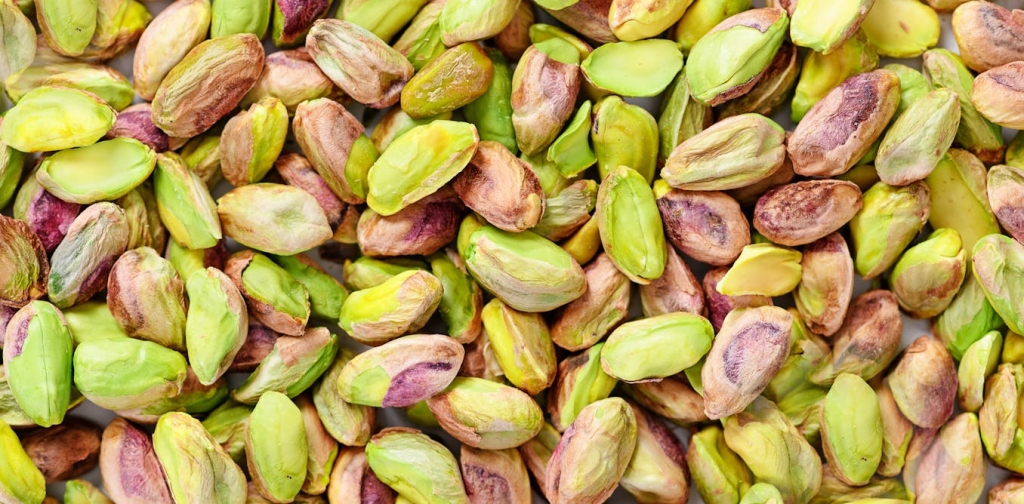

Pistachio production has more than trebled in the last 20 years. In 2024, more than 1.4 million tonnes were produced globally. Their popularity has only increased in the last two years, with a growing status as a trendy, luxury food item.
However, this rise in popularity has come with concerns around the pistachio’s environmental impacts. There are also questions around whether their production can withstand changing climate conditions.



Pistachios originated in modern-day Turkey and Iran. Despite being considered a nut, they are actually the seeds of pistachio trees. These trees thrive in a hot summer climate but require relatively cold winter temperatures to ensure the trees flower at the right time in spring. They also require dry conditions, as high humidity can reduce yields and leave the trees susceptible to fungal disease.
In the late 19th and early 20th century, pistachios were popularised in the US by migrants from the Middle East. By the 1930s, pistachio orchards were established in California. The warm, dry climate of California provided ideal conditions for pistachio trees, so much so that the US has now overtaken Iran and Turkey as the world’s largest producer of pistachios.
The estimated carbon footprint for pistachios is around 2.5kg of CO₂ equivalent (kg CO₂e). That’s all the greenhouse gases resulting from growing, processing and transporting pistachios, including methane and nitrous oxide, rolled into the CO₂ equivalent of warming.
That puts their footprint around the same as avocados, at the higher end of plant-based products. Part of the reason for their relatively large footprint is the intensive nature of production and the amount of post-harvest processing involved, such as drying, roasting, and sometimes shelling and salting. However, their footprint is still lower than animal-based products like eggs (4.6kgCO₂e per kg) and chicken (9.8kgCO₂e per kg), and much lower than beef (85kgCO₂e per kg).
The larger concern from a sustainability standpoint, however, is the amount of water used in pistachio production, especially as pistachios are predominantly grown in areas susceptible to drought. Pistachios require over 7,600 litres of irrigated water per kg according to one study published in 2020. That is more than almost any other food source. Only beef and lamb are more water intensive, but they generally consume mostly rainwater, which doesn’t deplete as much groundwater as irrigation typically does.

Intensive pistachio production, along with much of California’s agriculture, is accelerating groundwater depletion in the region. In the San Joaquin valley, where much of California’s pistachio production occurs, excessive groundwater pumping is even causing the land to sink, causing huge infrastructure damage and permanently shrinking the capacity of the underground aquifers.
This is compounding the effects of climate change in California, where drought conditions are already becoming more frequent and severe. California is also experiencing greater swings between wet and dry periods, with short, sudden downpours between droughts. Intense rainfall often overwhelms water infrastructure, preventing the effective replenishment of any water lost during the dry periods.
Read more: A rollercoaster of weather extremes: drought and heatwaves are creating UK’s climate whiplash
Iran is facing similar problems. A combination of climate change and poor management is depleting groundwater and threatening agricultural production throughout the country. In Rafsanjan, historically one of the world’s largest pistachio-producing regions, excessive pumping has almost completely depleted the groundwater. Wells are being dug hundreds of meters deep to extract what little water remains, which is often of poor quality and high salinity. Like the San Joaquin Valley in California, Rafsanjan is also sinking as a result of its groundwater overconsumption.
More worryingly, pistachio production will require even more water use by 2050 if temperatures and CO₂ levels continue to rise. This casts serious doubts about the future of pistachio production globally. In both Iran and California, winter temperatures are also increasing. This affects the flowering of pistachio trees, reducing yields and increasing losses to pests.
Drought-tolerant solutions
So, what is the future for pistachios? One solution could be to switch to less intensive farming methods, which reduces both energy usage and greenhouse gas emissions. Another could be to select for more drought-tolerant rootstocks.
Pistachio production may be forced to move to more suitable climates as California and Iran become hotter and more drought stricken. However, current producers will still lose their livelihoods. And the climate of any new region might not remain stable long enough for production to establish, especially as pistachio orchards require several years to become productive.
The easiest way to continue enjoying pistachios is to drastically reduce greenhouse gas emissions to limit future environmental consequences. Switching to more diverse, less intensive, and more water-efficient agricultural practices will help. But given their current environmental effects and precarious future, perhaps it’s best to consider this luxury food as a treat rather than a staple for the time being.























Comments are closed.