




Canada’s run at the 2026 FIFA World Cup made history, making a first-ever trip to the round of 16, the country’s best-ever men’s World Cup result.
The Canadian men’s team, playing in just its third World Cup after 1986 and 2022, won its first-ever men’s World Cup match on June 18, defeating Qatar 6-0 during the group stage. Canada then beat South Africa 1-0 in the Round of 32 before its run ended July 4 with a 3-0 loss to Morocco.



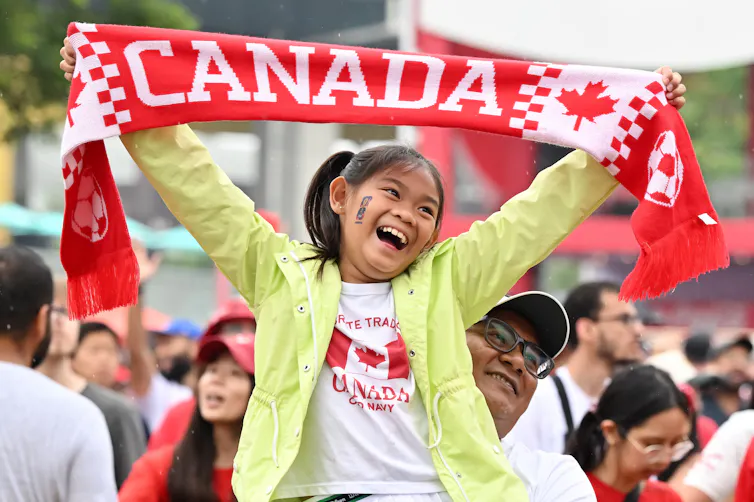
However, Canada’s run may have been more about what happened off the field than on it. Families watched games together, fans gathered in public spaces, jerseys appeared in schoolyards and clips circulated across social media. These are the moments where casual interest can turn into fandom and a sporting event can become a broader moment of national connection.
Hockey has long been central to Canadian sport identity. However, the participation numbers tell a more complicated story, one shaped by cost, accessibility and Canada’s cultural mosaic.
Surge in World Cup viewership
A pre-tournament poll found that only 28 per cent of Canadians planned to follow the World Cup closely. However, the emotional capital generated by hosting translated into a significant surge in viewership.
Canada’s group-stage victory against Qatar became the most-watched group stage match, drawing an average audience of 5.3 million viewers. Canada’s round of 32 win against South Africa attracted 5.2 million viewers, followed by 5.4 million viewers for the round of 16 match against Morocco.
This growth appears to extend beyond the World Cup itself. Major League Soccer reported an average of 7.9 million live match viewers per week across streaming and linear platforms during the first three months of the 2026 season, a 62 per cent increase from 2025, which MLS said was their strongest three-year period of fan growth.

However, Canadian soccer consumption does not necessarily mirror that of traditional soccer nations. Soccer fandom in North America grew by approximately 11 per cent between 2020 and 2025, while 33 per cent of Canadian fans prefer short-form content such as highlights and social media content.
Soccer is Canada’s most-played sport
A 2026 national report by Canadian Tire Jumpstart Charities identified soccer as the most played youth sport in Canada, with 50 per cent of youths reporting that they participated.
This is consistent with data from the Canadian Fitness and Lifestyle Research Institute, which has also shown soccer consistently ranking first in youth sport participation.
According to the Jumpstart report, the popularity of soccer is attributed to cost, broader accessibility and its connection to community roots. At an average cost of $450 to participate in soccer, they found hockey to be almost five times more expensive.
Across youth leagues, community fields, immigrant communities, school programs and recreational sport, soccer has had a strong presence in Canada. With nearly one million registered participants across 1,200 clubs, soccer is the most played sport in both Canada and the world.
From participation to fandom
While Canada may be a soccer playing nation, participation does not automatically make it a soccer-fandom country.
Exposure through participation can support awareness and attraction to a sport, but lasting fandom requires a deeper movement toward attachment and allegiance. That shift happens when a sport or team becomes personally and socially meaningful.
Historically, Canadian soccer suffered from a participation paradox. While many played the sport, viewership was not matched, compared to a sport like hockey. Co-hosting the 2026 World Cup has highlighted how that paradox has changed.
For World Cup interest to become lasting fandom, Canadians need repeated opportunities to attach meaning to the sport through recognizable players, media visibility, community rituals, shared memories and identity-based connections.
Building on women’s soccer success
Canada’s current soccer moment builds on decades of success by the women’s national team. Canada won Olympic bronze in London 2012 and Rio 2016, then gold at Tokyo 2020, the country’s best-ever Olympic soccer result.
The women’s team also produced Canada’s best World Cup performance, finishing fourth at the 2003 FIFA Women’s World Cup.
Read more: The FIFA Women’s World Cup is closing its gap with the men’s tournament
Athletes like Christine Sinclair, Karina LeBlanc and Diana Matheson became nationally recognizable names, helping build the visibility and credibility of the game in Canada. Sinclair’s legacy is especially significant: with 190 international goals, she remains the all-time leading goal scorer in international soccer, across both the men’s and women’s game.
That legacy is now reflected in the creation of the Northern Super League, founded by Diana Matheson, which signals a growing market for professional women’s soccer in Canada.
Men’s professional soccer has also helped build this momentum. Toronto FC’s 2017 MLS Cup victory made it the first Canadian club to win the league title, while the launch of the Canadian Premier League in 2019 created a domestic professional pathway for men’s players across the country.
A broadening Canadian sport identity
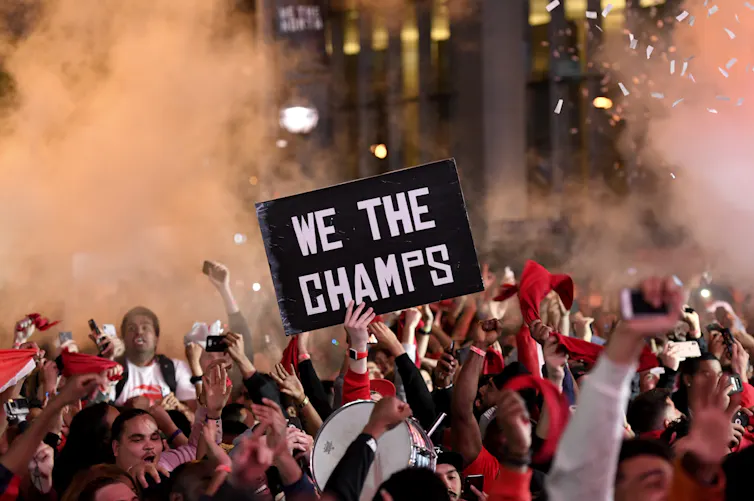
Soccer’s rise is perhaps a reflection of a shift toward a more diverse sport identity in Canada. Basketball offers a useful comparison. The Toronto Raptors’ 2019 championship and “We The North” campaign showed how a sports moment can become a national identity moment, while youth participation and Canadian representation in the NBA point to basketball’s continued growth.
Rugby and cricket also reflect this changing landscape, through women’s rugby success, grassroots rugby development and cricket’s growth in immigrant and community sport spaces.
Soccer’s rise does not erase hockey’s place in Canada; rather, it broadens the story of what Canadian sport identity can look like.
From a fandom perspective, Canada’s historic run matters because it gives people a reason to care. It creates emotional entry points: moments when casual viewers begin to say “we,” wear the jersey, follow the players and feel that the team’s success reflects something about them too.
This is especially powerful in national-team sport, where fans are seeing a version of them represented on a global stage. Canada’s World Cup run may therefore be strengthening the link between soccer and Canadian identity by giving people shared memories, recognizable players and repeated emotional moments around which fandom can form.
However, lasting fandom depends on what happens next. If media coverage, youth pathways, domestic league visibility and access to Canadian soccer continue, this World Cup run could help turn a long-standing soccer participation culture into a more lasting national soccer fandom.




















Comments are closed.