


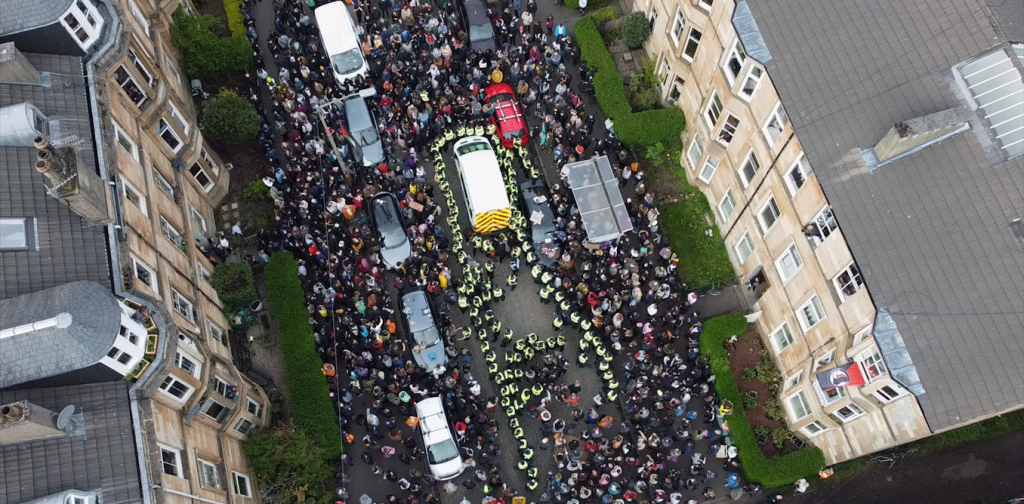

The kind of protests that loom large in the collective imagination tend to be compact and dramatic. Everybody to Kenmure Street, Felipe Bustos Sierra’s energising and inspiring film about a spontaneous act of collective civil disobedience in Glasgow, documents just such an event.
At a time when mobile phone footage shared by citizen activists is proving increasingly vital in holding authority to account, it also feels extraordinarily prescient. Most obviously in the US, where the film recently won the world cinema documentary special jury award for civil resistance at the Sundance Film Festival.


Bustos Sierra’s debut was the 2018 documentary Nae Pasaran, about a group of Scottish Rolls-Royce workers who, in 1974, refused to repair jet engines for the Chilean air force in protest against the violent Pinochet regime. It won a Bafta for best feature film. Unsurprisingly, Bustos Sierra handles his material with confidence.
Everybody to Kenmure Street begins with a black and white montage. Children play in the back courts of tenement slums. Suffragettes demand the right to vote. The intense heat of the Glasgow’s blast furnaces sends sparks flying. Crowds march against the installation of a nuclear deterrent on the Clyde. Riveters raise their hammers in synchronised rhythm in the city’s famous ship yards. Glasgow’s industrial heritage and its proud history of protest are established as the film’s backdrop.
As the film moves from black and white to colour, we find ourselves on a tenement-lined street in the Pollokshields area of the city. It is early morning on May 13 2021. An immigration enforcement vehicle has just pulled up on Kenmure Street, and two Indian men have been arrested for possible infringements.
Priti Patel, the UK home secretary, had been aggressively doubling down on the hostile environment promoted by her predecessor Theresa May. The dawn raid had been approved without the knowledge of the Scottish government in Holyrood because immigration legislation and policy are reserved to Westminster. Among other things, then, Everybody to Kenmure Street exposes some of the tensions in the devolution settlement.
This intrusion into one of Scotland’s most ethnically diverse areas, with a large Muslim population, on what also happened to be Eid al-Fitr – the feast day that celebrates the end of Ramadan – was understandably experienced by many as a deliberate provocation.
As Bustos Sierra’s evocative film documents, it quickly becomes the trigger for an extraordinary act of communal resistance. A kind of social media-enabled mass sit down, it results in an eight-hour stand-off with immigration officials and the police, and the eventual release, without charge, of the two men.
Making extensive use of donated mobile phone footage, Bustos Sierra documents the heartwarming combination of improvised tactics and community-based solidarity that won the day from the level of the street itself.
As the day progressed, the number of protestors grew from a handful to dozens, to hundreds and eventually a couple of thousand. Word spread and a number of well-known figures arrived on the scene, perhaps most significantly, the activist and human rights lawyer Aamer Anwar who eventually negotiated the men’s release.
The power of ordinary people
At its most affecting though, Everybody to Kenmure Street is a film about the decency and moral courage of ordinary Glaswegians. Having looked out of their windows and spotted the immigration van, a small number of residents decided to act.
They came out into the street, challenged the officials present, created an obstruction by sitting down, and began texting and posting on social media. Crucially, just after 9am an activist, known only as “Van Man”, crawled under the police vehicle and attached himself to the axle preventing the immigration officers from driving away.
His timely action allowed others to gather, and he was described by many as the hero of the day. Because he wishes to remain anonymous, his words are spoken, here, by the film’s executive producer, the actor and activist Emma Thompson, who looks directly to the camera while adopting a position that echoes the cramped conditions Van Man endured for eight hours.
The Scottish actor Kate Dickie similarly gives voice to the off-duty NHS worker who tended him for most of the day. “The fact that I’m a nurse,” she explains, “gives me a level of protection that other people wouldn’t experience”. It’s difficult to hear her words without thinking of Alex Pretti, the 37-year-old intensive care nurse shot and killed by an ICE agent in Minneapolis, in January of this year.
The absolute horror of events in that city make the dénouement of Bustos Sierra’s film all the more remarkable. Police Scotland, who by the end of the day were in attendance in high numbers, simply agreed to let the men go in order to avert any kind of violent confrontation.
If all this sounds wildly utopian, Bustos Sierra is careful not to allow his adopted home town to become too pleased with itself. Picking up on some of the threads laid down in the opening montage, he uses the middle section to stress Glasgow’s mixed legacies.
While the city’s radical tradition is certainly honoured, from its early opposition to apartheid to its proud history of trades unionism, the film also stresses that its mercantile and industrial wealth, like that of Bristol, Liverpool and London, was built on the labour of enslaved people.
In this way a connection is made between the brown men held in the van, who are victims of an aggressive immigration policy, and the historical victims of colonialism who were also predominantly people of colour.
Given that our news feeds are currently full of images reinforcing the reality that black and brown lives are less grievable than white ones, this connection seems an especially vital one to make. An important film, everybody should see Everybody to Kenmure Street.

Looking for something good? Cut through the noise with a carefully curated selection of the latest releases, live events and exhibitions, straight to your inbox every fortnight, on Fridays. Sign up here

















Comments are closed.