


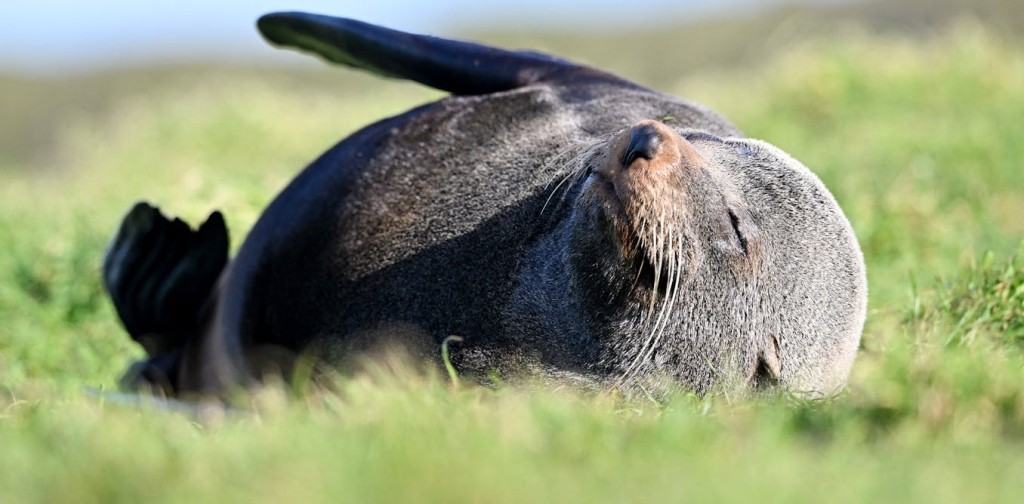

Australia has crossed another grim threshold in its H5N1 bird flu outbreak. For the first time, the virus has infected an Australian mainland mammal: a long-nosed fur seal found dead at Beachport on South Australia’s Limestone Coast, about a four-hour drive southeast of Adelaide.
This is a devastating development, although sadly not an unexpected one. H5N1 is already circulating in wild seabirds along the Limestone Coast, with many infected greater crested terns found at Beachport itself.


This seal likely caught the virus through contact with either infected birds or the environment they share. As of today, there is no evidence that it is part of a wider marine mammal outbreak.
One infected seal is not a seal outbreak. But we know from overseas just how quickly that can change.
We know how bad this can get
When H5N1 reached southern elephant seals in Argentina in 2023 more than 17,000 pups died. At one intensively monitored colony, mortality eventually reached 95%. Genetic evidence strongly supported transmission between mammals, rather than thousands of seals independently becoming infected from birds.
The devastation followed the virus into the Southern Ocean.
On South Georgia island (east of the Falkland Islands), the number of breeding female southern elephant seals fell by 47% between 2022 and 2024, following the arrival of H5N1.

Then, at Australia’s Heard Island (about 1,700 km north of Antarctica), an estimated 13,359 elephant seal pups are believed to have died during the 2025 outbreak.
Antarctic fur seals have also been hit extremely hard. Field observations suggest they may have suffered the greatest number of deaths of any species, although the scale of the outbreaks makes a reliable total impossible.
These are not isolated animal deaths. For already threatened species – such as the Australian sea lion, the Antarctic fur seal and the southern elephant seal – losses on this scale can push species closer to extinction.
What is a long-nosed fur seal – and what happens next?
Long-nosed fur seals, formerly known as New Zealand fur seals, occur in Western Australia, South Australia, Tasmania and New Zealand. The South Australian population is estimated at around 100,000 individuals.
We do not know exactly how the Beachport seal became infected, but infection could occur through direct contact with infected birds or other seals, or exposure to contaminated beaches or water.
Australia is also home to Australian fur seals and the endangered Australian sea lion, a species found nowhere else on Earth. Its entire population is estimated at fewer than 12,000 animals, around 85% of them in South Australia.
H5N1-infected birds have already been found at Seal Bay on Kangaroo Island, while mass bird deaths are occurring at the South Australian island group The Pages – both important Australian sea lion breeding locations.
Australia’s Macquarie Island (about 1,500 km southeast of Tasmania) is also home to southern elephant seals and endangered Antarctic fur seals – both species that have faced huge losses from H5N1 in other parts of the world.
Seal populations now need urgent surveillance. We can’t stop H5N1 spreading through a colony, but we need to know where it is, how quickly it is spreading and which populations are being hardest hit.
Why are seals so vulnerable?
Seals gather on the coast in dense colonies, in close contact with each other and in contaminated ground and water, creating opportunities for rapid transmission.
But the biology of the virus matters too.
H5N1 is fundamentally a bird virus, but the lineage that spread through marine mammals in South America acquired mutations that improve its ability to replicate in the cells of mammals.
Our recent research (yet to have been peer reviewed) found that H5N1 continued to evolve as it spread through seals, including more changes that help it replicate in mammals. But severe outbreaks in seals also occurred without these changes, suggesting seals may be particularly vulnerable to the virus.
We do not yet know which viral lineage infected the Beachport seal. Rapid genome sequencing will be important to determine whether it carries the mammalian-adaptive mutations seen overseas.
Australia needs a seal plan now
There are currently no commercially available H5 vaccines suitable for mammals available in Australia.
But there is promising overseas work.
In the United States, researchers tested a vaccine – originally developed for dairy cattle – in northern elephant seals. The vaccine was well tolerated and produced a clear, measurable antibody response. Researchers then extended the trial to endangered Hawaiian monk seals in rehabilitation.
This does not yet amount to a vaccination program for free-ranging seals, and the vaccine does not have regulatory approval for use in Australia.
Vaccinating every seal colony would also be impossible. Fur seals typically enter the water as soon as people approach, making vaccination infeasible for this species.
But Australia should urgently investigate whether targeted vaccination could protect select populations where intervention is both feasible and worthwhile – particularly endangered Australian sea lions, and southern elephant seals on Macquarie Island, which remains an enormously important Australian breeding population.
Vaccination will never stop H5N1 spreading through wildlife. But it may help prevent catastrophic losses in the species we can reach.
The Beachport seal is one animal – for now.
But this virus has already shown us what can happen next. Australia should use that warning while we still have time.
Please do not touch sick or dead birds or marine mammals. Record the location, take photographs from a safe distance, keep pets away, and report the sighting to the Emergency Animal Disease Hotline on 1800 675 888.




















Comments are closed.