


Weaving is an ancient craft that is still practised as a hobby by many people around the world. In recent years, it has found new life as more people have returned to hands-on making as a way to slow down, reconnect with materials and step away from screens.
During the COVID-19 pandemic, many people turned to crafts and DIY hobbies — including sewing, baking and gardening — to support their well-being. I remember trying to buy a sewing machine in 2021 and finding none available in stores.



More recently, textile crafts have become popular among Gen Z, with so-called “grandma hobbies” such as crochet, knitting and quilting seeing a resurgence. These slow, tactile, screen-free pastimes have become a form of digital detox from screen burnout.
It has also become a social media trend to share handmade projects through #WIP (“work in progress”) posts as part of the cozy “grandmacore” lifestyle aesthetic.
What most hobbyist weavers may not realize, however, is that their craft helped shape modern computing. Today, makers are once again using textiles to imagine the future of technology.
Hobbies can bring joy, wellbeing and focus to our busy lives, but so many of us don’t have one. If you’re ready to replace scrolling with stitching, or hustle with horticulture, The Hobby Starter Kit (a new series from Quarter Life) will help you get going.
The invention of the jacquard loom
In 1804, a French weaver named Joseph-Marie Jacquard patented a loom that could weave intricate patterns using punch cards — paper cards with encoded holes.
Once they pass through the loom, the presence or absence of a hole tells the loom which warp thread to raise or lower, acting as the earliest form of binary code programming. Weaving that once required a master weaver and an assistant could now be done by craft hobbyists.
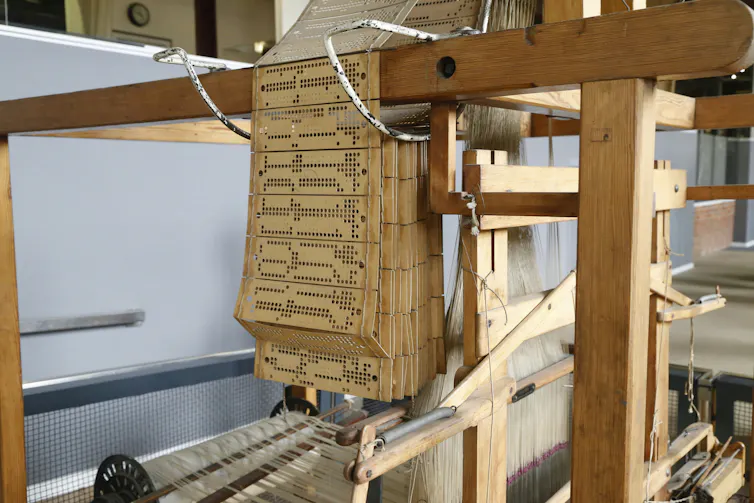
This same concept later influenced early computers, inspiring us on how such a craft can be a source of a technical revolution. In the 1830s, Charles Babbage drew directly on Jacquard’s punch-card mechanism by realizing he could apply the same concept to algebric patterns, instead of textiles, to program his Analytical Engine.
Mathematician Ada Lovelace advanced his work beyond maths to envision programming any information represented by symbols, including musical notes or graphic designs. By doing this, she brilliantly split the logical instructions or software (punch-cards) from the hardware (physical machine) for the first time.
Read more: Mathematical winters: Ada Lovelace, 200 years on
User interfaces in websites and mobile apps (also known as graphical user interfaces) evolved from command-line interfaces, which in turn, was a revolution over its predecessor: the punch cards.
My mother-in-law told me stories about how, as an undergrad in electrical engineering in the 1960s, she used to write programs’ code by punching stacks of cards. I teach undergraduates today the history of user interfaces, and how we went full circle to have digital looms now that create smart e-textiles.
Weaving is still shaping technology
Weaving and other textile crafts are still influencing how people build technology today, often through hobbyists and makers as well as trained engineers.
As a professor of physical computing and e-textiles, I lead a research group that uses a computational weaving machine to create smart fabric using both natural and conductive yarns, in what we call hybrid craft. We prototype future wearables and soft furnishing that have sensing and electronic capabilities literally woven as threads within.
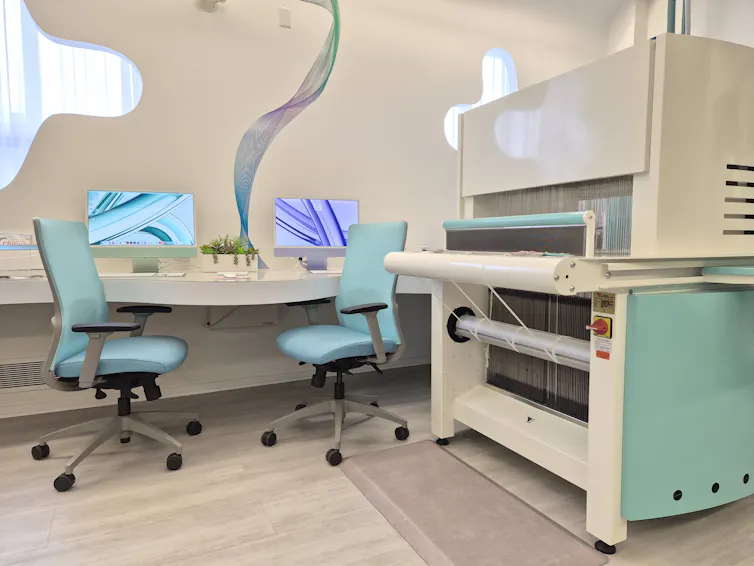
Some of our designs aim to cut down on e-waste using hybrid crafts and digital fabrication. Our most recent work uses computational looms and knitting machines to build fabric-based electronic breadboards designed by and for women in e-textiles. Another recent study used hybrid crafting to make prototyping more inclusive, with a focus on women and people with physical disabilities.
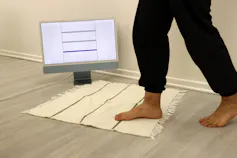
When we run workshops in our community, people are excited to stitch their own e-textile circuits using needles and conductive thread. These experiences show how hands-on STEM outreach and maker culture can bring diverse individuals into technology and give them a role in shaping its future.
Why this matters for crafters
This kind of work is part of a wider shift. Open-source tools such as Arduino, Raspberry Pi and the BBC micro:bit have lowered the cost of entry to physical computing, while makerspaces and fablabs have opened technology development to people who do not see themselves as programmers or engineers.
The same spirit that draws people to textile hobbies — experimenting with materials, learning through making and adapting designs through trial and error — is also transforming how we create technology.
Craft knowledge, open-ended experimentation and lived experiences can all become sources of innovation. This approach also gives people who are often excluded from mainstream technology a greater voice in creating it.
A Newcastle University project called Empowering Hacks is one example: two co-researchers who identify as disabled worked with the university’s Open Lab to design a set of 3D-printed handles for powered wheelchairs.
Another project at Queen’s University experimented with 3D-printing on textiles and invented Fabric-Lego for assistive wearables to customize and personalize the medical aesthetics of finger braces and arm slings.
The same way weaving looms paved the way for modern computers, other hybrid crafts can inspire innovation and practical inventions. So the next time you pick up a weaving, crochet, knitting or sewing project, you are not just making something — you are experimenting, problem-solving and creating the possibilities for new ideas.












Comments are closed.