


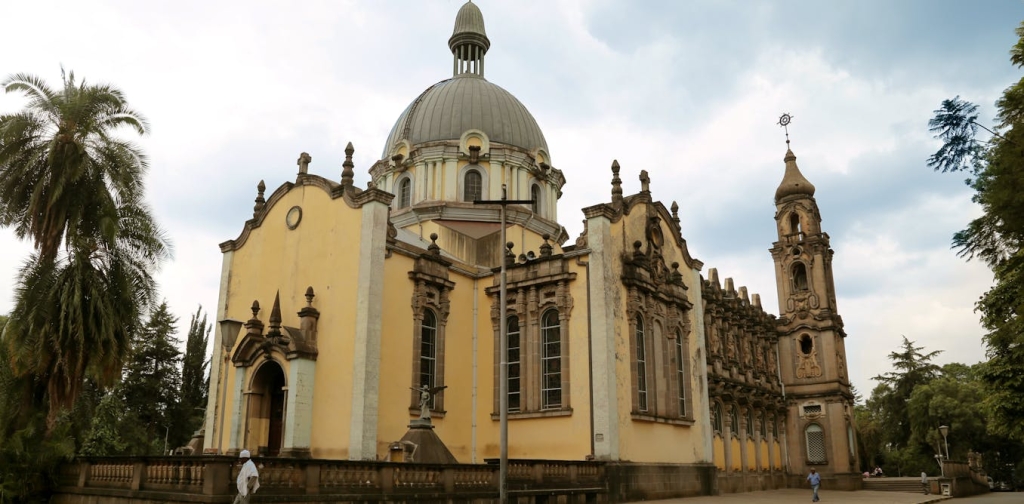

The Ethiopian Orthodox Tewahedo Church has been one of Ethiopia’s most influential institutions for more than 1,600 years. Church and state were closely intertwined from the official adoption of Christianity in the 4th century until the overthrow of the imperial regime in 1974.
The church has shaped the political order, education systems and cultural identity. It remains one of the country’s largest religious institutions, along with Islam and protestant Christianity. About 43% of Ethiopians identify as Orthodox Christians in a national population estimated at 135.5 million.

The 1974 revolution marked a turning point in the relationship between the state and religion. The military junta (called the Derg) introduced secularism. The church’s status as the official state religion was abolished and its property confiscated by the regime.
The church’s influence and role in national life subsequently declined.
Since Prime Minister Abiy Ahmed assumed power in 2018, a significant trend has emerged. It’s marked by an increase in hostility seen in verbal and physical attacks against the institution. Attacks against Orthodox churches, monasteries, clergy and worshippers have been documented by human rights groups, religious institutions, international observers and scholars.
I am a political science researcher specialising in peace and security, state-religion relations, and political dynamics in the Horn of Africa. In a recent paper, I explored why one of the oldest and most influential institutions in Ethiopia had become a target of public hostility.
My study is based on interviews with church scholars, government officials, religious leaders and peace and security experts. There were also focus group discussions with church members.
A central theme of my findings is that violence against religious communities does not start when churches are destroyed and attacks are made against worshippers. Typically it is preceded by the systemic dissemination of hostile historical narratives.
These narratives against the Orthodox church are propagated by political elites, activists and media figures. For example, revisionist stories focus only on the Church’s historical role in seizing land and power in southern regions. But they downplay or erase its legacy as a pillar of Ethiopian literacy, architecture, and sovereignty.
My findings show that hostile stories set the stage for violence by destroying an institution’s reputation. When a group is stripped of its legitimacy, attacking its buildings and followers starts to look justifiable or even politically necessary.
My findings matter because in Ethiopia, where 98% of the population identifies as religious, managing religious affairs is crucial for national cohesion and the broader peace-building process.
Dangerous labelling and violence
The negative image of the Ethiopian Orthodox Church as a symbol of domination, exclusion or ethnic privilege has been gaining traction in influential political and intellectual narratives. For five decades, these portrayals have circulated through political speeches, traditional media and social media.
These narratives have used historical reframing of the Orthodox church as imperial domination. They have also represented the church as an institution associated primarily with Amhara identity. The link to Amhara identity draws on the historical dominance of Amharic-speaking elites in the imperial state. Critics brand the church as a symbol of historical Amhara hegemony rather than a multi-ethnic spiritual body.
Since the 1970s and more prominently after 1991 the church has been portrayed as an instrument of imperial state expansion and cultural domination. In these narratives, the church is associated with the spread of Christianity, Amharic language and imperial political authority in newly incorporated areas. It is then presented as part of a broader process of cultural and political domination.
Some of these negative portrayals distort or selectively interpret the church’s history. At the same time they overlook its contributions to Ethiopian society. By marginalising or excluding these aspects of the church’s historical experience and contributions, such representations can be understood as a form of epistemic violence.
The danger is that these kinds of narratives can make physical violence seem acceptable, justifiable or unremarkable.
Religion, ethnicity and the state
A second important discovery from my research relates to the increasing confluence of ethnic and religious identities in current-day Ethiopia.
The study focuses on the tendency to identify one religion with one ethnic group. In Ethiopia, Orthodox Christianity is often depicted as a religion of certain ethnic groups and not a multi-ethnic religion.
This matters because ethnicity has become a major part of political identity in Ethiopia. This makes the linking of religion to particular ethnic groups politically loaded. Tying religious institutions to ethnic contestation risks tying them up in wider identity and power struggles.
This was evident in 2023 when Ethiopian Orthodox Tehahedo church bishops in Oromia region sought greater use of Afaan Oromo in worship. The language is one of Ethiopia’s most widely spoken languages. They also call for greater Oromo representation in church leadership. Questions of language and ethnic representation have become linked to disputes over church authority and regional politics.
As a result, religious institutions have become targets in ethnic, political and armed conflicts that are not primarily about religion. It also raises questions about whether the state has done enough to protect churches and clergy from such attacks.
What needs to be done
My study does not attempt to present the church as a flawless institution. Like other institutions, the Ethiopian Orthodox church has tended to have complex power dynamics and has struggled with governance issues of its own. It has experienced leadership divisions, struggles over representation and authority, and internal conflicts.
But denying the institution’s history and identity or its contribution to society has gone beyond rhetoric. The exclusion and marginalisation of the Ethiopian Orthodox Tewahedo Church can deepen social fragmentation and leave its adherents more vulnerable to discrimination and violence.
I conclude from my findings that stopping physical attacks is only part of what’s required. There also needs to be an effort to dismantle narratives that conflict with the legitimacy, dignity and history of specific communities.
Understanding the relationship between narratives and violence can help to prevent harm. It can also help contribute to building a more inclusive and peaceful future for Ethiopia.










Comments are closed.