


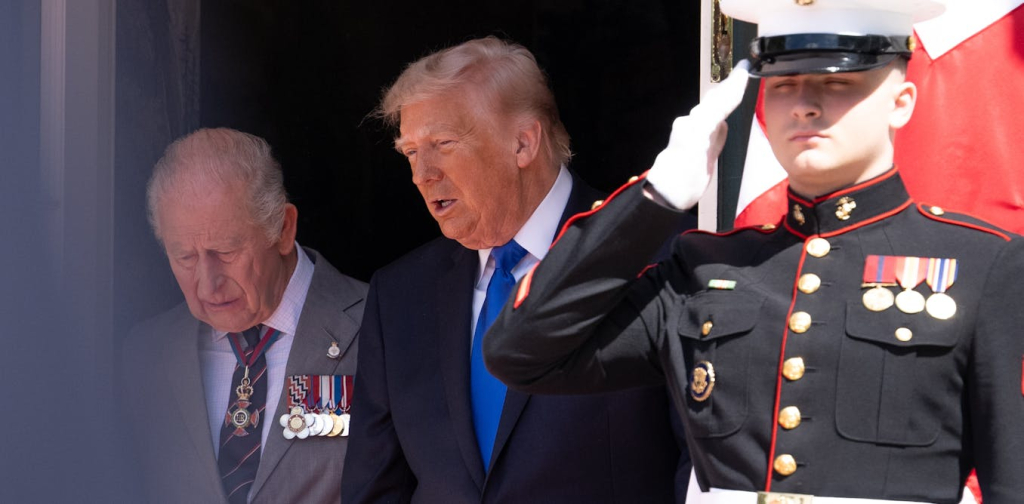

As King Charles concludes his transatlantic travels with a visit to Bermuda, a British Overseas Territory, he can take pride in a job well done. His four-day state visit to the US – which concluded with a wreath-laying at Arlington National Cemetery and a block party in Virginia – appears to have been a success.
Amid a period of heightened tension between President Donald Trump and Prime Minister Keir Starmer, the king’s carefully calibrated speech to a joint session of Congress has secured praise on both sides of the Atlantic (and on both sides of the Congressional aisle).


It was a remarkable performance: careful, diplomatic, occasionally pointed and at times both charming and witty. Perhaps we should not be that surprised. The king is a highly experienced diplomat, and while this was his first address to Congress, it was his 20th visit to Washington – as he himself noted.
Read more: How King Charles charmed the US while taking digs at Trump
But what does the undoubtedly warm American response to the king’s visit mean for the future of the US-UK “special relationship”?
On its own, no act of royal diplomacy, however well executed, can deliver an instant reset in US-UK relations. Nor can it force an American president of any stripe – let alone the current incumbent – to change tack or alter approach.
On this, history offers a salutary lesson. For all the positive impact of King George VI’s June 1939 visit to the US, when war broke out just a few months later, it did not lead to instant American intervention.
The queen’s visit in 1957 was similarly well received. But the work of rebuilding transatlantic trust – so damaged by the Suez crisis – remained ongoing in the months that followed.
This latest state visit will similarly offer no quick fix. But like its predecessors, it might shift the dial on the current US-UK dialogue – and perhaps help to temper the tone, at least for a while.
For the UK, there has already been one immediate win: Trump has decided to remove whisky tariffs in honour of the king’s visit. This will be very much welcomed by the Scottish whisky industry.
The potential long-term impact of the king’s visit is harder to ascertain. Not least because this will be determined by variables well beyond either his or Starmer’s control: contemporary geopolitics, especially as affected by the wars in Iran and Ukraine. Despite this week’s mutual exchange of praise and platitudes, the distance between London and Washington on these matters remains substantive.
Worlds apart
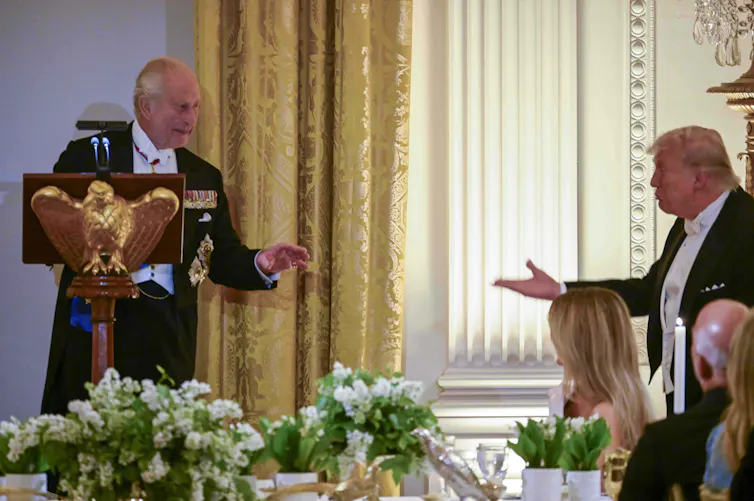
There was a brief glimpse of these differences in two of the speeches: the king’s to Congress and, on the same day, the president’s at the White House.
The king’s speech lingered on the shared ties of history and, especially, on democratic values and ideals. It included references to the importance of compassion and interfaith dialogue, and celebrated the strength of what the king called “our vibrant, diverse and free societies”.
President Trump’s speech at the White House a few hours earlier similarly featured references to the transatlantic connections born of history. But elsewhere, his tone and intent seemed rather different.
Trump celebrated “the blood and noble spirit of the British” – qualities which had provided American revolutionaries with a “majestic inheritance”. At one point, he even declared that the patriots of the American Revolution had been animated by the “Anglo-Saxon courage” in their veins. This is a claim on American history that one commentator has suggested “walks up to the edge of white nationalism”.
There are indeed echoes here of an early 20th-century diplomatic discourse known as Anglo-Saxonism. Once popular and pervasive among transatlantic writers and diplomats (including those of a nativist bent), it largely fell out of favour in the years between the world wars – its racial assumptions increasingly untenable.
As long ago as December 1918, President Woodrow Wilson explicitly told an audience of British dignitaries – including King Charles’s great-grandfather, George V – that they must not “think of us as Anglo-Saxons, for that term can no longer be rightly applied to the people of the United States”.
Wilson was the first serving US president to visit Britain, and, like Trump, had a British mother (Trump’s was from Tong on the Isle of Lewis, Scotland). Wil point – made in advance of the Paris Peace Conference – was that the US was a melting pot, not a monoculture.
King Charles’s speech hailed the importance of alliances (Nato), of multilateral institutions (the UN), and of the rule of law. These, he argued, are what has delivered eight decades of transatlantic peace and prosperity.
From the president, meanwhile, came a celebration of Anglo-American blood brotherhood. It was at times reminiscent of thinking (and language) which his predecessor Wilson – no “woke” radical – had called into question well over a century ago.
These two visions of the US-UK relationship, distinct in their underlying assumptions, reflect a broader geopolitical shift – one which has increasingly strained the transatlantic relationship in recent months.
The king’s vision, indicative of widespread sentiment in Europe, represents an affirmation of the post-1945 world order. The other, with its echoes of the early 20th century, is disruptive. Between them lies a chasm of significant proportions, and bridging it will be the task of today’s transatlantic diplomats.
















Comments are closed.