


As war threatens to erase everyday life in Ukraine, artists have turned to puppetry, one of the oldest forms of storytelling. Light enough to travel, intimate enough to gather a crowd and able to capture the attention of children, puppet shows have become resilient tools of resistance, support and relief for the people of a country at war.
Contemporary Ukrainian puppetry is part of a long tradition, from the 16th-century travelling folk theatre known as vertep, to the establishment of theatres in Kyiv and Odesa in the 1930s. Although later repressed and censored for satirising Soviet leaders, puppetry survived these periods of repression and is now enjoying a comeback in a time of conflict.

Meaning “secret place” or “cave”, vertep historically staged nativity scenes, secular tales and satirical folk performances. It emerged around the time that Ukraine’s early national liberation movement was gaining traction in the late 16th and early 17th centuries, as it sought to gain independence from Poland and Lithuania.
Much of the puppet theatre from this period reflected society at the time, with Zaporozhian Cossacks dominating the stage, portrayed as protectors of the people against foreign powers and enduring symbols of resistance. Later, during the early Soviet rule – which sought to crush expressions of national Ukrainian identity – puppetry faced severe restrictions for popularising folk traditions and political satire.
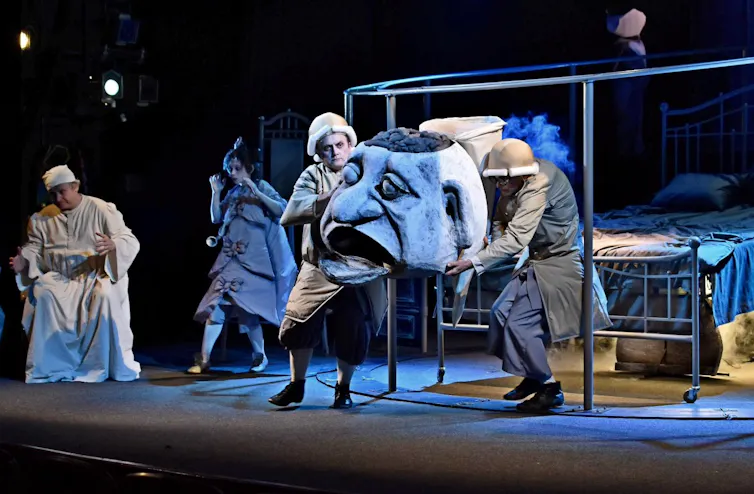
Today, this legacy continues underground in basements, metro stations and bomb shelters in cities and towns across Ukraine. Puppet theatres like the Karpenko-Karyi Kyiv National University (below) are staging contemporary interpretations of vertep, reflecting on the events and effects of Russia’s war against Ukraine.
As a frontline city, Kharkiv has seen the deaths of hundreds of civilians and the wide-scale destruction of infrastructure. This has forced many people to seek shelter from bombing in underground shelters.
My work as an anthropologist considers how cultural heritage and art are used as forms of resistance and resilience by communities both during and after conflict. In a new ongoing study, this work examines how Ukrainian artists and cultural institutions continue to use puppetry and its rich traditions to sustain cultural life under extreme conditions, and for those among the Ukrainian diaspora.
I have examined images, videos and archival collections and conducted interviews with puppeteers, theatre directors, museum curators, artists and audience members. This work shows how Ukrainian artists have turned to a traditional form of storytelling using humour, folktales and performance to recall their history and heritage. For them it is a constructive way of fostering hope and keeping spirits up in difficult times.
How art and culture brings hope
During Russia’s initial full-scale invasion in February and March of 2022, intense shelling followed displacing thousands. Conscious that large numbers of children were having to shelter for extended periods, Oksana Dmitrieva, director of the Kharkiv Academic Puppet Theatre, decided to stage puppet shows in the city’s underground metro stations.
She developed stories that addressed the experiences of communities living through the fear and uncertainty of war. This included Giraffe Mons, the story of a giraffe living in Kharkiv Zoo during the second world war, a tale that examines the dislocation caused by conflict that young children can relate to.
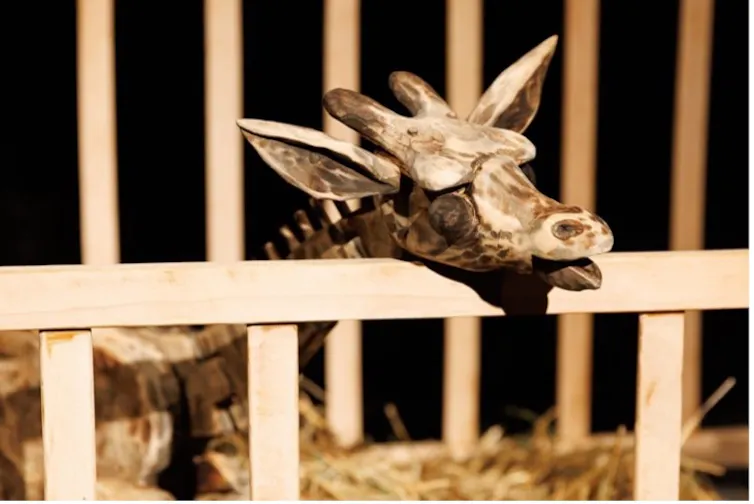
The parable nature of the story makes it possible to create a performance that deals with painful topics, but does not traumatise the viewer, framing war from a child’s perspective, foregrounding fear, compassion and mutual support.
Dmitrieva emphasised the importance of sustaining cultural work during conflict, saying: “Where there is a puppet there is always mystery and beauty.” For her the performances are mechanisms of resilience, an “important experience that allows us to see how important art is – an opportunity to distract, to feel, to be together”.
Mykhailo Urytskyi, puppet director and lecturer at the Karpenko-Karyi Kyiv University also stages performances with his students in shelters and metro stations. During power outages, performances are lit with battery-powered lamps and supported by power banks, attesting to the persistence of art even in precarious circumstances.
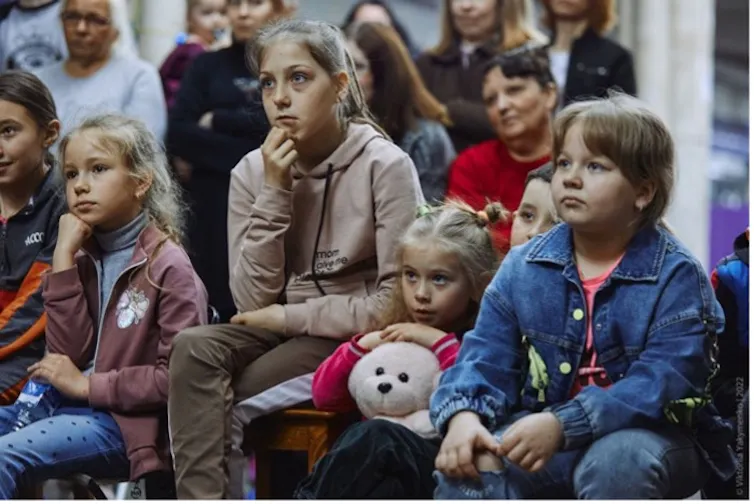
Urytskyi told me that in times like these, this kind of performance is “not only relevant but necessary”. His work engages with the topic of war, exploring what it means to be human and questioning whether forgiveness is possible.
In a show called Vertep Hope, he reinterprets the nativity as a story about the birth of Ukraine, which a modern-day Herod seeks to destroy. This he said, “is our way of shouting about the tragedy in Ukraine through the language of art”.
When Kherson was occupied in March 2022, the Kherson Puppet Theatre set off on tour on a bus flying the national blue and yellow flag. The company drew on Ukrainian history for a show inspired by the life of Taras Shevchenko, the revered poet and painter whose writing and political activism helped shape modern Ukrainian identity. Born into serfdom in 1814, Shevchenko took part in the struggle against Russian imperial oppression, becoming a fierce critic of Tsarist Russia and a national hero.
Beyond Ukraine’s borders where the diaspora has spread out across Europe and further afield, puppetry offers cultural preservation and a sense of connection for displaced people. The Ukrainian-Slovak Hub, for example, established in Kežmarok, eastern Slovakia, provides a space where refugees can find support. The hub’s puppet workshops have helped traumatised children articulate emotions that can be difficult to express.
But these shows do not only help support people in difficult times such as war. Stemming from a rich national heritage that bolsters feelings of unity and belonging, this deceptively simple storytelling medium helps to sustain cultural life as Ukraine’s 21st-century war rumbles on.















Comments are closed.