


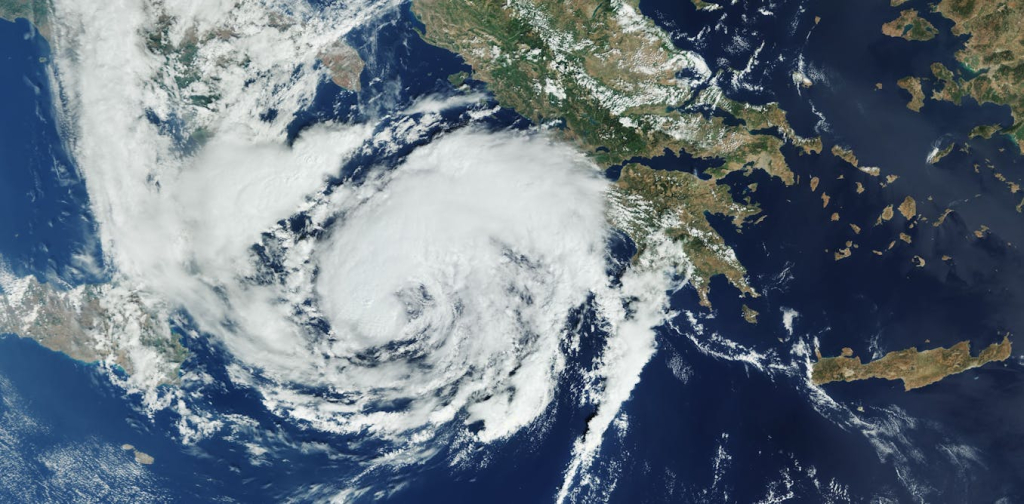

In March 2026, a tropical-like cyclone named ‘Jolina’ produced significant damage across North Africa. In 2020 and 2023, storms Ianos and Daniel both caused severe damage in Greece, and the latter triggered a humanitarian disaster in the city of Derna, Libya, where thousands were declared dead or missing.
These tropical-like cyclones occur in a non-tropical region. They are known as ‘medicanes’ – a portmanteau of Mediterranean and hurricanes.

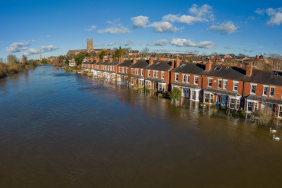
As any major storm, medicanes know no borders. Their impacts spread across multiple countries as they sweep across the Mediterranean coast, one of the world’s most densely populated and vulnerable regions (the total population of Mediterranean countries in 2020 was about 540 million people, around one-third of them living in coastal areas).
Rising sea temperatures due to climate change increase the reservoir of energy these storms can feed on. More research on this phenomenon, which couples atmospheric and oceanic effects, is urgently needed in order to improve early warning systems and the preparedness of populations, in terms of civil protection and regarding how we would affront a catastrophic event that might exceed our ability to prepare for them.
Medicanes: rare and devastating hurricanes in the Mediterranean
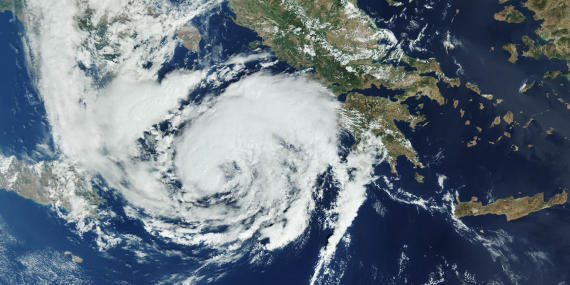
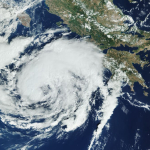
One of the earliest research papers on the subject, in 1983, opened with the sentence: “At times, Mother Nature does her best to deceive us”, accompanied by a satellite image of a cyclone displaying a well-organised spiral cloud structure and a cloudless eye at its centre, strikingly similar to those that habitually occur in the tropics. The opening line implies what a surprise it would be to encounter such an impressive and counterintuitive occurence of a tropical-like storm structure in the Mediterranean.
Since then, significant progress has been made in understanding medicanes through international scientific collaboration.
In 2025, a collective research effort produced a formal definition of this once counterintuitive phenomenon.

In short, medicanes share important physical characteristics with tropical cyclones, but are not identical to them. Flooding from intense and widespread precipitation are their most dangerous hazard, often extending well beyond the cyclone’s centre and covering areas of country-wide extent. But what is even more critical to retain is the very strong winds close to their centre, which make their track and landfall location highly relevant to impacts from windstorms and storm surges.
Events that meet this formal definition occur on average less than three times per year. This limited frequency means our statistical record is still too small to draw firm conclusions about preferred locations of occurrence.
How does climate change affect hurricane risk in the Mediterranean
The question of what climate change holds in store for medicanes does not have a reassuring answer.
Recent advances point to sea surface temperature as a key factor in storm intensification: a warmer sea drives greater evaporation and stronger heat fluxes into the atmosphere, providing the energy needed to develop and intensify a medicane. According to the Copernicus Climate Change Service Atlas, the Mediterranean warmed by approximately 0.4°C per decade during the 1990–2020 period, a clear and accelerating trend.
While such a figure may seem small in everyday terms, its physical implications are far from negligible. Indeed, an increase of just 1–2°C can produce significantly higher wind speeds and precipitation rates. Moreover, the figure above represents a basin-wide average (i.e. for the whole Mediterranean Sea); locally, during individual medicane events, sea surface temperatures of 2°C or more above normal have already been recorded.
A recent study demonstrating links between the intensity of a Mediterranean medicane and climate change appeared in 2022 and focused on the storm “Apollo”, showed that warmer sea surface temperatures and a warmer atmosphere increased moisture availability and heavy rainfall over Sicily.
Later analyses of Daniel also found that extreme precipitation over the eastern Mediterranean and Libya was intensified by climate change.
More broadly, recent research indicates that the most robust signal for Mediterranean cyclones concerns rainfall, with clearer increases in precipitation than in wind intensity. Wind changes can also be detected in some events. Today, climameter.org, an international consortium which rapid attribution studies with a peer-reviewed protocol, monitors medicanes and Mediterranean cyclones through rapid attribution studies of emerging extremes.
New methods to monitor and better understand medicanes are urgently needed
Collaborative research between the scientific community and civil protection agencies has been central to developing early warning systems and improving preparedness.
One such effort is the MEDICANES project of the European Space Agency, some of the research is being applied as we write to the latest medicane Jolina.
Ultimately, however, efficient adaptation requires better climate prediction models and therefore more reliable and accurate estimation of extremes caused by cyclones. This can be only achieved through scientific research. An end-to-end approach that translates research findings into actionable information for climate adaptation and civil protection is both timely and essential, including for example infrastructure resilience planning and early warning systems to reduce vulnerability and socioeconomic impacts.

The AXA science philanthropy is now part of the AXA Foundation for Human Progress, which brings together the commitments of AXA Group and Mutuelles d’Assurances in the fields of Science, Nature, Solidarity, and Culture. Before 2025, the global science philanthropy was held by the AXA Research Fund, which has supported over 750 projects around the world since its inception back in 2007. To learn more, visit Axa Foundation for Human Progress.












Comments are closed.