



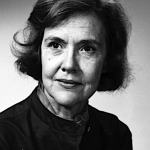
In 1950 Australian writer and dancer Jean Garling argued:
Dance reflects [a people’s] reaction to environment, for it is every art, and in its quality can be read the characteristics of a nation.


She could have no idea what that would look like in 2026.
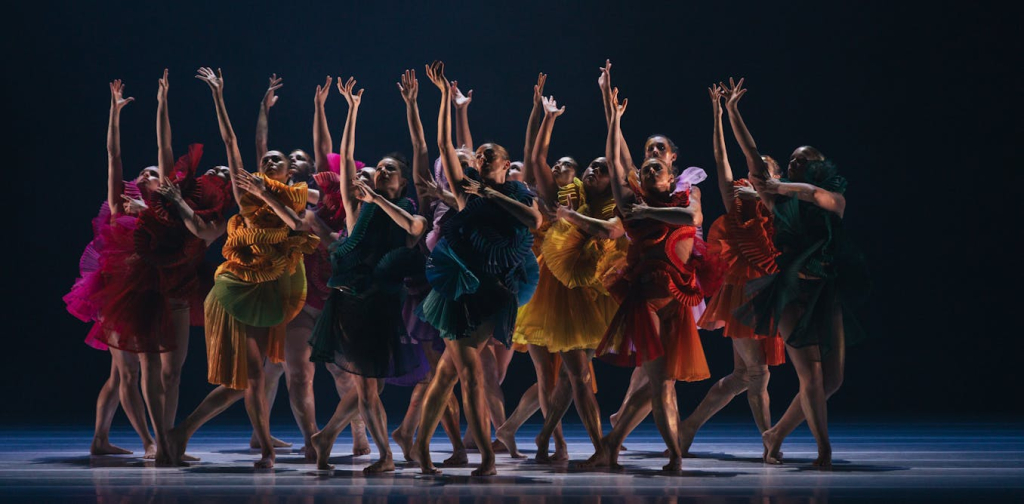
Flora, a collaboration between The Australian Ballet and Bangarra Dance Theatre, is an embodiment of our Australian environment. It optimistically and lavishly captures the characteristics and complexities of our contemporary nation. It represents something bold and new in Australian dance.
With choreography by Frances Rings and featuring dancers from both companies, in two acts the ballet unfolds not as a story but as a physical exploration of important botanic elements and botanic moments in Australian history.
Australia’s floral ecosystem
The first act takes us to an ancient world beneath the surface where seeds and plant life begin. The dancers in reds and pinks use sticks to beat the primordial rhythm as they move in circular patterns around the stage.
Long pieces of brown ropy cloth – root systems – descend from the ceiling and with them five golden dancers clumped as sleeping yams. The dancers hang upside down and sprout, extend and connect like a rhizomic network.

This shifts into a fluid and lyrical movement with dancers in green representing the energy plants offer us in keeping us alive through food and breath.
A homage to spinifex comes next. A group of male dancers enters with patches of pale yellow grass. When raised together, they take on the animated character of a furry beast. The grass has come to life, and we hear the dancers’ voices with “tch tch,” “HAH!” and “hoo”.
The grasses become the setting for a group of women weaving baskets. Their long skirts emphasise their hip rolls, arm movements and expressive upper bodies. They weave through each other.
The act ends with the disruptive sound of hooves and pickaxes and the arrival of a man in a red coat and a rabble of anonymous settlers.
Colonisation has upset the Australian floral ecosystem.
Colonisation and cleansing
The second act opens with colonist Joseph Banks’ collection of stolen plants: white netted specimens under flickering fluorescent lights. The dancers are trapped like the plants trying to escape their captivity.
The light dims and excerpts of the Australian constitution are projected onto the backdrop. A voice-over tells us Aboriginal people were still not recognised as citizens into the 1960s. The scene, like the constitution, is in black and white, and a single woman dances energetically in the foreground.

But colonisation is followed by two scenes of repatriation and cleansing. The first, women with baskets of smoking leaves. The second, lines of men in red and black with torches of live fire against a filmic backdrop of a growing bushfire.
These two traditional tools of renewal see new life in the regeneration of spiky grass trees and a finale of flourishing pink, orange, blue, purple and yellow bush flowers.
A new collaborative voice
Flora is the fourth collaboration between the two companies. But it feels different to the others.
William Barton’s rich and diverse score has layers and fascinating twists and turns with distinct voices, bells, chimes, harp and sliding trombone. It perfectly achieves his aim of creating a new musical space that remains true to its Indigenous roots and landscape while positioning itself within the classical canon.
Costumes by Grace Lillian Lee feel resplendent and luxurious with each of the 12 chapters adorned in its own style and with colour palettes from earthy to fiery to kaleidoscopic.

In her choreography, Rings has worked closely with the dancers. The movement belongs to them. They wear it like their skin. Despite its chapters, the work never loses its momentum. There is a sense of deep time and continuation.
While some of the solos or smaller group dances highlight the strengths and nuances of the different backgrounds of the dancers, they dance throughout as one deliciously heterogeneous group.
Some chapters draw heavily on traditional Indigenous dance, others are Martha Graham-esque, others more balletic. There are also moments that are contemporary with whispers of Stephanie Lake’s influence on the ballet dancers last year.
Flora both acknowledges the trauma of colonisation and expresses gratitude for an extraordinary botanic heritage. The work expresses honestly and harmoniously a reckoning and a shared sense of responsibility. And this is new.
I hope, in Garling’s words, these are the new characteristics of our Australian nation.
Flora is at the Regent Theatre, Melbourne, until March 21, then the Sydney Opera House from April 7–18.
















Comments are closed.