


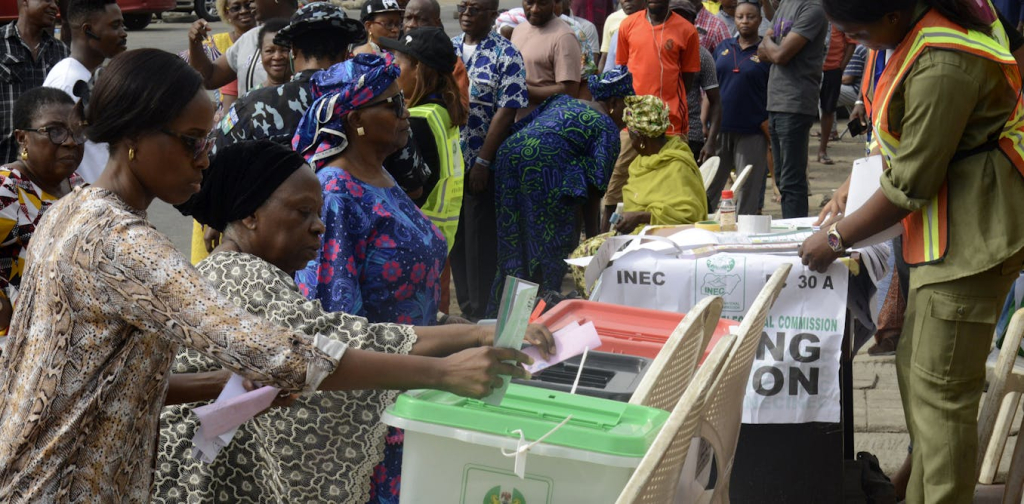

Nigeria’s new Electoral Act, passed in February 2026, is a significant attempt to overhaul the country’s electoral framework.
The act establishes a dedicated funding framework and requires that election funds be released no later than six months before a general election.



Technology will be the only method allowed for voter accreditation, and results will have to be transmitted electronically.
There will be stricter penalties for electoral misconduct such as falsifying results and manipulating or buying votes.
Political parties must maintain a digital membership register and submit it to the electoral commission at least 21 days before their primaries.
With these and other provisions, the act provides a stronger foundation for Nigeria’s elections than its predecessor. It helps in the push for technological integration and financial autonomy for the electoral commission.
However, laws alone do not guarantee credible elections.
It’s my view, as a scholar of electoral systems and governance in Nigeria, that the act doesn’t tackle some of the real problems of electoral governance. There are deeper structural issues that should be addressed to improve electoral integrity.
I submit that Nigeria needs five urgent reforms to create a free and fair voting system. These are:
-
strengthening the independence of the electoral commission
-
improving the candidate selection process
-
enhancing electoral transparency
-
addressing voter apathy
-
ensuring severe punishment for vote-buying.
My recommendations are based on the gaps in the recently enacted legislation and the historical context of Nigeria’s democratic journey.
Democracy in Nigeria is the primary mechanism for managing the country’s diversity and ensuring that its resources translate into shared prosperity rather than elite enrichment. Nigeria has a history of military rule, secessionist attempts, and inter-ethnic mistrust. Free, fair and credible elections are crucial for resolving political competition without violence.
Read more: Nigeria’s elections were once again disputed in court, a stark reminder of a weak electoral system
1. Strengthen the electoral commission
The credibility of any electoral process is tied to the independence and capacity of the electoral management body. The Electoral Act 2026 takes a crucial step by establishing a dedicated fund for the Independent National Electoral Commission.
However, analysis of Nigeria’s electoral reforms since 1999 shows that administrative success is linked to the commission’s ability to exercise political independence. Its leadership appointments should be more transparent and insulated from presidential discretion.
The 2026 act expands the commission’s authority to review questionable result declarations made under duress. To solidify this reform, leadership must be insulated from partisan interference. Only persons with impeccable credentials and a proven record of non-partisanship should be considered.
The president should not be the one to appoint the head of the commission. Several suggestions have been offered, including the one by the Uwais committee that it be done by the National Judicial Council or a multi-stakeholder appointment committee. What matters is that the process be competitive and open. The election focused NGO Yiaga Africa has suggested that the president should publish the list of potential nominees for public scrutiny before sending a name to the National Assembly. An appointment committee should represent various interests, including professional bodies like the Nigerian Bar Association, Nigeria Union of Journalists, and civil society organisations.
2. Strengthen democratic candidate selection
Since 1999, primaries – internal processes through which political parties choose their candidates for public office – have been dominated by money and a small cabal of delegates. Both undermine the will of ordinary party members.
The 2026 Electoral Act confronts this issue by abolishing indirect primaries, which limit voting to selected party delegates. Now, all registered members of a political party will be able to vote in choosing the party’s candidate, except in the case of consensus.
Section 77 mandates that political parties keep a digital register of members and submit it to the electoral body at least 21 days before any primary, congress, or convention. The success of this hinges on the integrity and accuracy of the new registers.
Read more: Nigeria’s elections faced five serious challenges – how to fix them before the next polls
3. Enhance transparency
The 2023 general elections exposed weaknesses in collating and sending results. This erodes public trust.
The 2026 act seeks to address these weak spots by making technology mandatory. Section 47 mandates the use of the Bimodal Voter Accreditation System to check that the person casting a vote is who they claim to be. Section 60(3) makes the electronic transmission of results to the viewing portal compulsory.
A loophole remains. The act permits the use of a manual form to send results where the electronic technology fails. The law does not define what “failure” is, nor does it establish an independent process to certify such failures.
This ambiguity recreates the discretion that led to the widespread failures of 2023, where only a fraction of results were uploaded in a timely manner.
4. Address voter apathy
The steady decline in voter turnout from 52.3% in 1999 to an alarming 26.72% in the 2023 general elections is a threat to Nigeria’s democratic legitimacy. It’s not a problem of civic laziness or voter fatigue. In my view it reflects an erosion of trust in the electoral process itself. When the electoral body failed to deliver on its promise of real-time electronic result transmission in 2023, it was a betrayal of citizens.
Restoring voter confidence requires showing that votes count, through electronic transmission of results. Electoral offenders must be prosecuted. Judicial decisions must respect voter intent rather than technicalities.
Immediate practical reforms are possible. They include introducing early voting for the over one million essential workers, security personnel, election officials, journalists and observers who can’t vote on election day. The 15 million Nigerians in the diaspora should be able to vote too, through provisions already adopted by 40 African nations.
Read more: 2027 Nigerian poll could trigger unrest unless electoral commission is fixed
5. Criminalising vote buying
Widespread poverty and inequality make Nigerian voters susceptible to vote buying. This reduces elections to auctions rather than choices. Without aggressive enforcement, the secret ballot becomes a commodity. Then democracy becomes a market for the highest bidder, keeping corrupt politicians in office.
Moving forward
Electoral reform is not a single event but a continuous democratic project. Its success will be measured not by statutory text, but by the integrity of the 2027 elections and beyond.
It requires sustained citizen engagement, civil society vigilance, and political determination to build an electoral system that commands the trust and participation of all its people.






















Comments are closed.