


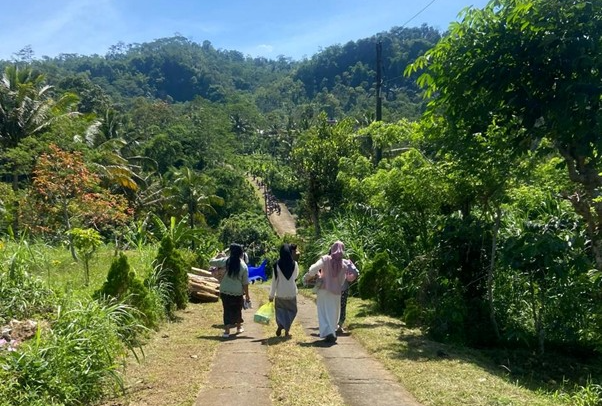

I remember my first morning in a small hamlet called Krecek, in Temanggung, Central Java.
The air was cold, carrying the smell of damp soil and wood smoke.



Roosters crowed somewhere behind the houses, and from the kitchen I heard the soft clatter of plates and the rhythmic sound of women chopping vegetables. Before the sun fully rose, the village was already awake. I had come to Temanggung to take part in Nyadran Perdamaian, but I did not yet understand that I was about to experience peace not as a concept, but as a way of life.

Krecek is small and quiet, surrounded by coffee plantations and hills that seem to hold the village in their embrace. Most residents here practise Buddhism. Muslims live in only around three houses.
At first, I carried my own assumptions…
From the outside, difference often feels fragile. It is something people are told must be “managed” or “protected.” But living in Krecek, I realised how unnecessary those fears were. Religion was never announced. No one asked where I belonged. People simply greeted one another, shared food, and continued their work.
When prayer times came, they were respected naturally. When rituals were prepared, everyone participated according to their own belief. No one was excluded, and no one was forced to assimilate.
Read More: The Invisible Breadwinners: Stories of Women’s Care Work in Balodano

Tolerance here was not discussed, it was practised. There were no banners about unity. No speeches about harmony. Just everyday acts of respect that had been repeated for generations.
Women and the Shape of Everyday Peace
What moved me the most was the women.
From early morning until late afternoon, they worked without pause. I watched them prepare food for dozens of people, organise offerings, arrange spaces, and quietly make sure that nothing and no one was forgotten.

Their movements were calm but decisive. Each woman knew her role, yet no one acted above another. They laughed whilst working, teased each other gently, and solved problems without raising their voices.
In between cooking and cleaning, they shared stories about harvests, children, sickness, and neighbours who needed help. Listening to them, I began to understand how closely care and peace were connected.
These women were never formally called leaders, yet leadership lived in their daily actions. They mediated misunderstandings, carried tradition forward, and taught younger generations how to live alongside others who believe differently. Without their emotional, cultural, and physical labour, Nyadran Perdamaian would not exist.
Nyadran as Lived Peace
Nyadran is often described as an ancestral ritual, a moment to honour those who came before and to express gratitude for life. But in Krecek, I saw Nyadran become something more.
It became a space where collective memory met collective responsibility. Peace appeared not in grand ceremonies, but in simple gestures: ensuring food was suitable for everyone, waiting for one another before beginning, listening when elders spoke, and making space for difference without suspicion.
Children ran freely between houses of different faiths. They did not know they were supposed to be divided. They only knew who their friends were. Dogs followed us everywhere, some belonging clearly to certain households, others wandering freely between homes. They slept near doorways, walked beside us along narrow paths, and rested under tables during communal meals. No one chased them away. Even when they were not one’s own, they were treated with familiarity rather than fear.
Living there, I realised that coexistence in Krecek extended beyond humans alone. People, animals, beliefs, and daily routines moved side by side, guided less by ownership than by mutual respect.
Watching them, I felt a quiet ache, how often adults unlearn this simplicity.
Read More: Indonesia’s Garbage Crisis: The Irony of Women Amid the Stench of Garbage

Looking back, what I witnessed in Krecek felt deeply grounded. Harmony was not enforced through rules or agreements, but sustained through relationships through attentiveness, patience, and the willingness to care for one another every day. Much of this work unfolded quietly. It did not appear in village regulations or written guidelines. Yet it shaped the rhythm of life more powerfully than any formal programme ever could.

During this time, I was there as a selected participant. Yet what made the experience meaningful was not only the knowledge I gained, but the way learning unfolded beyond formal sessions. It happened whilst walking through fields at dawn, sharing meals on woven mats, listening to stories in the kitchen, and sitting quietly with people whose lives were deeply connected to the land. Knowledge came not only through discussion, but through presence.
What I Carry Home When I left
I carried more than memories. I carried the sound of laughter from the kitchen. The warmth of shared meals. The image of women sitting together after a long day’s work, tired but content.

Nyadran Perdamaian taught me that peace is not built through sameness, but through respect. It is not maintained by silence, but by care. In a world that often frames difference as danger, this small hamlet in Temanggung offered another truth: Difference is not the problem, The absence of empathy is. In Krecek, empathy lives in women’s hands, in shared traditions, and in the quiet decision, repeated every day, to live together with dignity.
Here, peace is not an aspiration.
It is a practice.
(Editor: Luviana Ariyanti)
















Comments are closed.