


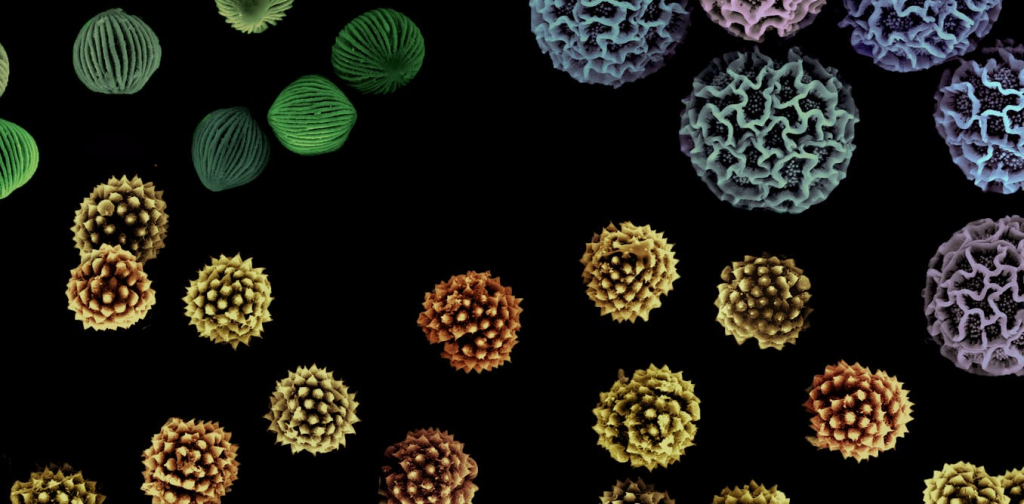

Imagine being tasked with counting every blade of grass in a field, noting every single species as you go. This is not far from the challenge many scientists face when analysing microscopic samples packed with thousands of tiny particles.
Imaging flow cytometry (IFC) solves this by guiding particles single-file past a camera and lasers, capturing detailed images of tens of thousands per second. It records the particles’ size, shape and optical properties, turning what was once painstaking manual work into automated analysis.



IFC has become a staple of biomedical research, with scientists using it to study blood viruses or classify tumour cells. It’s also increasingly used in environmental science – for example, to monitor water quality and detect microplastics.
Now, we’re using this medical tech on ancient mud, peat and lake sediments. It may help us identify exactly when ancient climate tipping points were crossed.
Blood to mud
To predict future climate change, we need to understand how things changed in the past. To do this, scientists use natural archives such as sediment found at the bottom of lakes or oceans, long “cores” drilled into peat or ice, or stalagmites and stalactites found in caves.

These archives effectively work as layered climate logbooks, recording environmental change over hundreds to thousands of years. As researchers dig deeper into sediment, peat or ice, they move further back in time. Each layer captures conditions at the time it was formed, from temperature and precipitation to the strength of ocean currents and wind belts.
Microscopic fossils and climate change
The abundance of certain microscopic fossils can be used to reconstruct these past conditions. For instance, the presence of certain species of pollen in peat or algae in lake sediments reflects changes in the climate system.
Pollen preserved in Amazon rainforest mud today is very different from that in Arctic tundra. In the far future, geologists will be able to tell from the fossilised form of this pollen which region once had tropical trees, and which had cold-weather shrubs.

This approach to reconstruction underpins a large portion of palaeoclimate research. Traditionally, however, it has involved counting thousands of particles by eye under a microscope. Because this is so time-consuming, only a small fraction of the total sample is analysed, while the rest is estimated by scaling up those results.
IFC dramatically speeds up counting, meaning climate reconstructions that previously took months can now be done much faster.
This makes it possible to produce higher-resolution records by analysing more samples, and to quantify rare species. Scientists using this technology can focus on questions that were previously too time-consuming to address, such as exactly when a certain environmental change occurred in the deep past.
Also, IFC digitises each sample, making results easier to share, reproduce and reanalyse, promoting more robust, open science.
Hidden patterns and tipping points
As IFC makes it feasible to count a much larger fraction of any given sample, it allows us to detect subtle changes that would have taken too long to detect manually.
Uncovering these small shifts in the particles found in a given place could provide early warning signals of abrupt climate change. For example, we can trace the migration of wind belts via the abundance of non-native pollen species at particular locations. Such movement of the winds may be responsible for triggering sudden change, perhaps by melting ice sheets or drying out a rainforest.
As a result, we may be able to precisely date the timing of past climate tipping points – and with that, the order in which these thresholds were crossed. This could let us distinguish between cause and consequence, as we can determine which changes happened first.
This approach also has the potential to uncover entirely new data, such as the presence of rare species at particular sites. These new records can then act as novel proxies for climate change – leading to more detailed reconstructions and deeper insights into how the climate works.
A tool designed to scan blood now offers us an exciting opportunity to read Earth’s history in finer detail and decipher hidden mechanisms. It could also help us predict abrupt changes in the near future.




















Comments are closed.