


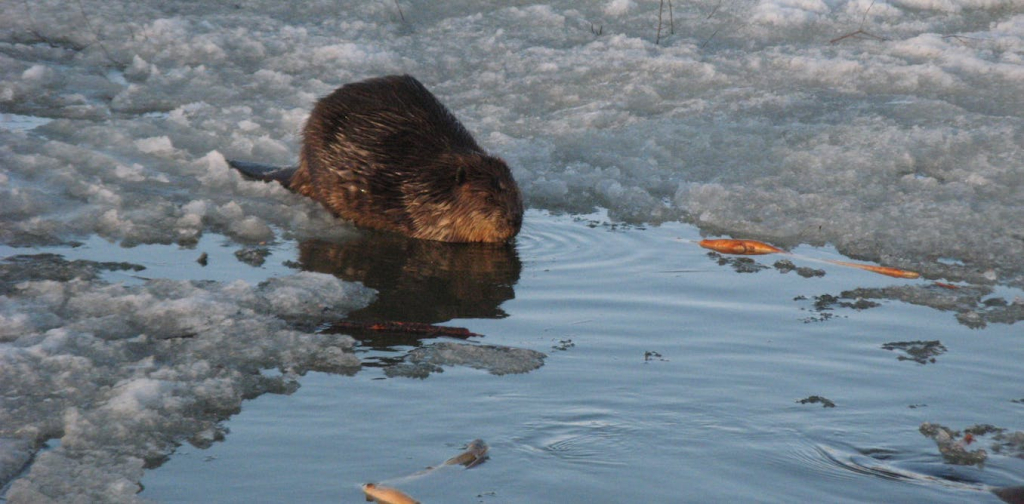

The most anticipated day of my year is “BDay” — the first day when beavers are spotted on the ice in spring after emerging from small openings in the water in front of their lodges after a long winter of confinement. With the rest of the pond still covered in ice, the beavers remain spatially confined but are free to roam within their winter lodge and below-ice habitat.
First, one of the adults emerges — much like a sentinel — and then the rest of the family follows in kind, except for the newborn kits who remain inside the lodge for several more weeks. In time, the entire pond becomes free of ice and spring begins anew.



Spring emergence is most often documented in hibernators — species that experience noticeable changes to their metabolisms, core temperature and behaviour in winter. As seasonally confined non-hibernating mammals, beavers remain active under the ice throughout the winter.
Also, unlike true hibernators, maintaining a normal body temperature allows beavers to mate during their winter confinement and give birth to their kits before emerging in spring. However, as with true hibernators, the timing of spring emergence can be strongly influenced by the climate.
In a recent study, a colleague and I investigated the timing of spring emergence of North American beavers. We incorporated 18 years of emergence data for a beaver colony at a pond in Miquelon Lake Provincial Park, Alberta.
We investigated the influence of ice-on dates (days when the pond was completely covered in ice), ice-off dates (when the pond was completely clear of ice) and climatic data on the timing of spring emergence of beavers.
Beavers respond to climate change

Once a pond is completely covered in ice, beavers are confined below the surface for the winter. Only in times of extremely low water do they chew their way out of their lodges in search of food in midwinter. More often than not, they then become food for equally hungry predators.
Along with trends in emergence dates, we modelled climate trends over the past 30 years in the study area. Combined with data on seasonal ice freezing and thawing, two clear factors emerged.
Firstly, for every 1 C increase in annual temperature, the data showed beavers emerged six days earlier (the average first emergence day was April 1). We also determined that the timing of ice-on dates was directly associated with average maximum summer temperatures, which our models indicated were increasing over time. On average, beavers were confined under the ice for 4.8 months, with a maximum of 5.8 months.
With longer ice-free periods, beavers are able to forage longer, potentially cutting valued trees on private and public land. They also have more time to build or enlarge dams, which can increase flooding of human infrastructure, thus extending the time period for potential human-beaver interactions.
As beavers emerge earlier, the amount of foraging they are able to do increases. This increased foraging can deplete vegetation more rapidly near lakes, rivers and wetlands where they live, and potentially exhaust food resources in their territories.
Conversely, long foraging periods also allow them to build larger winter food caches, which could increase their chances of survival over winter. These ecological changes present both long-term risks and benefits for beavers and the ecosystems they support.
Beavers moving north
Additionally, a warming climate is causing beavers move northward into the Arctic tundra. Examining the emergence times of beavers will help us better understand how regions with longer winters and fewer foraging resources might influence their ability to settle in areas previously uninhabited by beavers.
Beavers are one of nature’s most well-known ecosystem engineers, building dams across waterways that can change landscapes in dramatic ways. Wood Buffalo National Park in northern Alberta is home to the world’s largest beaver dam at almost 800 metres long from end-to-end. The pond formed by the dam retains about 70,000 cubic metres of water.
Beaver dams support ecosystems by increasing the size floodplains, reducing erosion, increasing sediment deposits and improving water quality. They can reduce the risk of floods, and during wildfires, the ponds they form can act as a refuge for wildlife and aid post-wildfire recovery.
Given the extensive influence of beavers, they have the potential to influence not only the biodiversity and traditional use of the tundra and its resources, but also alter waterways within this sensitive ecosystem.























Comments are closed.