




The United States Supreme Court recently struck down President Donald Trump’s executive order that sought to limit birthright citizenship for children based on their parents’ migration status.
This reflects a broader trend where policymakers target migrant women’s reproduction to justify stricter citizenship laws. Our research shows that Canada is not immune to such influences.



What can the U.S. ruling teach Canada about the importance of upholding birthright citizenship?
Global debates
Birthright citizenship via what’s known as jus soli allows children born in a country to automatically acquire its citizenship at birth. Trump falsely claims that the U.S. is the only country with birthright citizenship, but 36 countries — including Canada — currently maintain unrestricted jus soli citizenship provisions.
Birthright citizenship has become a point of debate as some governments adopt more restrictive policies aimed at limiting citizenship for certain migrants. While the latest American attempt failed, successful rollbacks of birthright citizenship in other countries serve as a warning.
At the heart of these debates is reproductive racism — the systemic control or regulation of people’s pro-creative capacities based on their race. The political reasons for restricting citizenship policy are tied directly to anti-immigrant, racist and sexist sentiments that stigmatize migrant women’s reproduction.
This was at play in the 1986 Australian Citizenship Act amendment, following the Kioa v West case where Tongan parents of an Australian-born child sought to avoid deportation; the 2004 Irish citizenship referendum, which maligned African women asylum-seekers’ reproduction; New Zealand’s 2005 Citizenship Act amendment, which restricted citizenship for children born to transient migrants; and the Dominican Republic’s 2010 constitutional reform, which was rooted in anti-Haitian racism and sexism.
Read more: For Haitian migrants in the Dominican Republic, ‘reproduction is like a death sentence’
Baseless birth tourism arguments
In the U.S., proponents of restricting birthright citizenship allege that birth tourism is on the rise. Nonetheless, the Supreme Court found “there is scant evidence for this dramatically revisionist view.”
In Canada, similar arguments rely on questionable evidence. In 2025, Conservative MP Michelle Rempel Garner moved an amendment to Bill C-3 that would end unrestricted birthright citizenship to children born to non-resident parents.

As she cited an alleged rise in birth tourism, Rempel Garner warned that allowing birthright citizenship to remain in place eroded the integrity of Canada’s immigration system. While narrowly voted down, the amendment marked the latest legislative attempt to end unrestricted Canadian birthright citizenship.
The entry of non-residents who are pregnant into Canada isn’t tracked by the Canada Border Services Agency. Researchers, media and politicians have relied on hospital “other country resident self-pay” codes to claim that birth tourism is an issue that needs attention.
When newborn delivery rates under this code increase, the assumption is that the rate of birth tourism increases. But this data only provides a proxy measure for quantifying birth tourism because the population captured in this pay code includes any non-resident giving birth.
Reliance on this billing code assumes a singular motivation, glossing over the overlapping reasons non-resident parents give birth on Canadian soil in the first place. Labelling all non-citizens and permanent residents as “tourists” is inaccurate, serving as a strategy to advance a broader anti-immigration agenda.
In both Canada and the U.S., there are similar high-profile attempts to target migrant women’s reproduction. Republicans claim that birth tourism offers an illegal immigration pathway for those south of the border, while Canadian critics associate birth tourism primarily with Chinese women.
While political rhetoric about the threat of birth tourism is ongoing, successive Canadian governments have reached similar conclusions: the available data don’t justify a substantive overhaul of Canadian birthright citizenship.
Birth-registration bordering practices
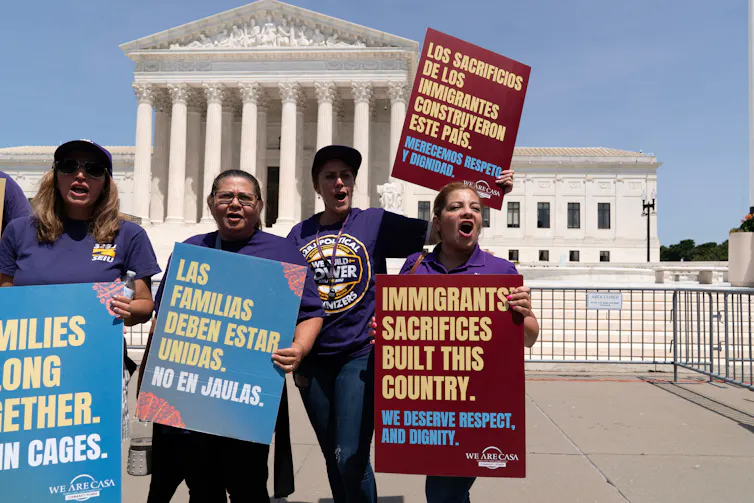
In the lead-up to the U.S. federal challenge to birthright citizenship, states like Texas curtailed access to birth certificates by refusing to accept Mexicans’ national ID cards and requiring a passport with valid visa. This administrative practice was successfully challenged in court. But it shows how birth registration can function as a bordering practice — the social and legal actions that create boundaries between people — before any legislative changes take hold.
In Canada, the Birthing Canadian Citizens project identified similar digital and administrative practices that can block access to a birth certificate for a baby.
In Québec, some hospital administrators withhold birth forms to pressure the uninsured to pay exorbitant fees out of pocket. This illegal practice has been contested before the United Nations Special Rapporteur on Violence against Women.
Online systems requiring digital authentication can be inaccessible to migrant parents in the midst of securing their own status. Their children are born Canadian citizens, but may lack a birth certificate and health card proving as much. This type of institutional bordering in the health-care system is on the rise, partly in response to panic about birth tourism.
Restricting birthright citizenship would require costly administrative changes to how births are documented. Even conservative members of the U.S. Supreme Court questioned the viability of implementing such a policy change.
In Canada, cracking down on birthright citizenship would require shifting federal immigration enforcement to provincial health-care and civil registration authorities — a move that would conflict with their mandate to uphold and fulfil human rights to health and identity.
It’s also worth noting the likely increase in statelessness among children born to parents with precarious status. Documents submitted as part of the U.S. Supreme Court challenge noted the potential for dramatically expanding the number of stateless people and unauthorized migrants in the U.S. — a result at odds with Trump’s policy aims.
Protecting birthright citizenship
While the U.S. Supreme Court justices have preserved birthright citizenship for now, the battle is likely to continue in congress.
Unlike the U.S., birthright citizenship in Canada isn’t protected as a constitutional right. Our research shows that access to birthright citizenship is being undermined for some Canadian children through policy debates, online authentication systems and administrative practice.
Read more: Canada’s immigration system is going digital, and accountability must keep pace
This runs counter to longstanding Canadian commitments to equality, multiculturalism, human and reproductive rights. Making it harder for newborn Canadians to be recognized as citizens seems counterproductive at a time when the country urgently needs population growth.
Upholding the promise of Canadian birthright citizenship requires more than legal action. It needs leadership with the courage to reverse racist reproductive rhetoric and question false narratives. It needs a policy to prevent and address statelessness. It needs transparent bureaucracies that protect reproductive and citizenship rights together. And most of all, it needs a population committed to keeping a promise too easily broken.























Comments are closed.