


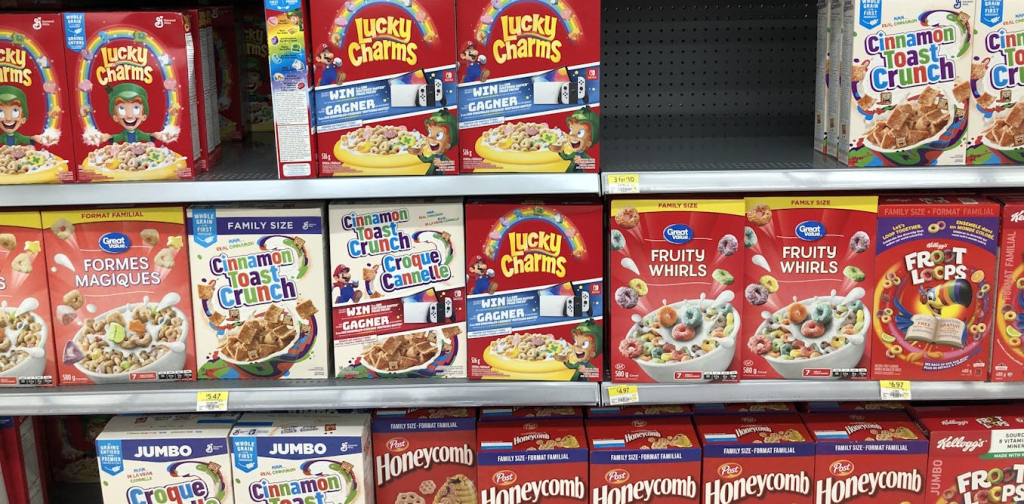

Many of us have grown up hearing the mantra that breakfast is the most important meal of the day, yet cereals for kids fall short of that standard. That is the takeaway of my new research study analyzing child-targeted cereals in Canada.
The study examined 103 unique children’s cereals found in the supermarket for their nutrition, nutrition claims and how the packaging worked to capture kids’ attention. It also assessed the cereals using two nutritional criteria: a government-led proposed Health Canada criteria for marketing to kids (unpublished, described in the study) and the food industry’s Code for Responsible Food and Beverage Advertising to Children.



While 88 per cent of products had nutrition claims communicating “health” value to shoppers, these cereals averaged 30 per cent of their calories from sugar, and 96 per cent of them exceeded appropriate sugar thresholds set by Health Canada. Beyond this, using Health Canada’s criteria developed to support “responsible” marketing to kids, not one of the cereals explicitly packaged to appeal to children would be permitted to be advertised to them!
Such findings suggest the need to push aside the cereal bowl and think more seriously about what we are feeding our kids — and about packaging as a vehicle for marketing to children.
Communicating health, selling sweetness
That children’s cereals are high in sugar may seem obvious to some, especially those who grew up in an era when Sugar Frosted Flakes, Sugar Corn Pops and Sugar Smacks lined the store shelves. Yet times have changed, with high sugar consumption linked to unhealthy diets and noncommunicable disease. The Lancet recently underscored the “profound consequences” of ultra-processed foods on children’s health.
Global market research firms tracking trends in the food and beverage industry now point to today’s consumer demands for health, functional ingredients and protein, while trade publications like Food Dive publish on how changing eating habits (including demands for protein and portability) are prompting breakfast to “evolve beyond cereal.” As such, one might expect children’s cereals to have improved with the times.
In some respects, they have. As noted, the study found that roughly nine of every 10 kids’ cereals also had (adult-directed) health and nutrition-related claims, cues to reassure shoppers that healthful content is encased in fun packaging. Use of such claims is substantially higher than the 56.4 per cent found on children’s cereals a decade ago. Similar increases have been observed in nutrition-related claims on child-targeted food packaging more generally over this period.
Many claims on kids’ cereals today highlight the “naturalness” of the product, such as containing whole grain (45.6 per cent) or fibre (16.5 per cent), being naturally flavoured (27.2 per cent) or “made with real…” (honey, peanut butter, cinnamon, etc.). Appeals also underscore what the product does not contain, with claims such as no artificial flavours or colours (22.3 per cent) or no genetically modified ingredients (10.7 per cent).
However, while whole grain or natural flavours might be trumpeted, the cereals averaged 30.4 per cent of calories coming from sugar — with one cereal, also claiming to be “Made with whole grain oats” and a “Source of 7 essential nutrients,” containing 58.2 per cent of calories from sugar per serving.
An expanding universe of fun packaging
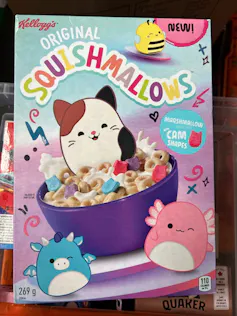
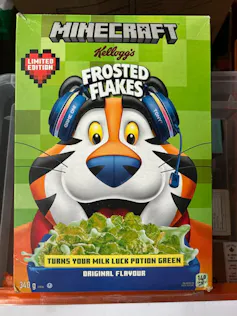
Cereals in the study used an array of techniques to capture kids’ (and parental) attention, for example, cartoon mascots, licensed media characters or fun shapes, colours and/or flavours.
For the adults thinking of the Lucky Charms or Frosted Flakes of their youth, today’s children are presented with an expanding universe of fun options.
These include Squishmallows inspired by the squeezable plush toy; Minecraft Creeper Crunch based on the children’s video game, with green “Creeper Bit Marshmallows”; Bluey blue-tinted corn cereal referencing Disney’s cartoon series; Strawberry Milkshake Frosted Flakes, which turns the milk “a fun, vibrant pink!” or the LOADED line-up of cereals (Cinnamon Toast Crunch, Trix and Coca-Puffs) “loaded” with vanilla crème filling.

Without question, these packages target children, functioning as standing advertisements on grocery store shelves. As such, the study examined them as advertisements, using the criteria proposed (but not enacted) by Health Canada as part of its Healthy Eating Strategy for Canadians, and the criteria implemented by industry to guide responsible marketing to children.
Both criteria outline thresholds for sugar, sodium and saturated fat, as well as the additional nutrient criteria specific to cereals in the industry Code. Foods exceeding these thresholds would not be permitted to be advertised to children.
Based on Health Canada’s criteria, none of the child-targeted cereals examined would be permitted to be advertised to children, and 96 per cent surpassed sugar thresholds. Based on industry criteria, 69 per cent of those same cereals would be permitted to be advertised (and 24 per cent exceeded sugar thresholds). Saturated fat was rarely a problem (using either criteria), yet the cereals’ sodium exceeded Health Canada thresholds by an average of 50 per cent versus 11 per cent using industry thresholds.
Why this matters
In a world of digital media, it’s easy to gloss over the importance of food packaging as a form of marketing to children. Global public health bodies have long warned about the negative impacts of food marketing more broadly on children’s dietary preferences and long-term health, while research using wearable cameras has identified product packaging as the top source of unhealthy marketing exposure for children.
Packaging is powerful, and while the cereals in this study are fun, they need rethinking when it comes to breakfast fare. Importantly, the government-led criteria used was proposed, not enacted, but my study also reveals the striking differences that emerge in terms of what “counts” as appropriate for marketing to children, depending on the criteria used.





















Comments are closed.