


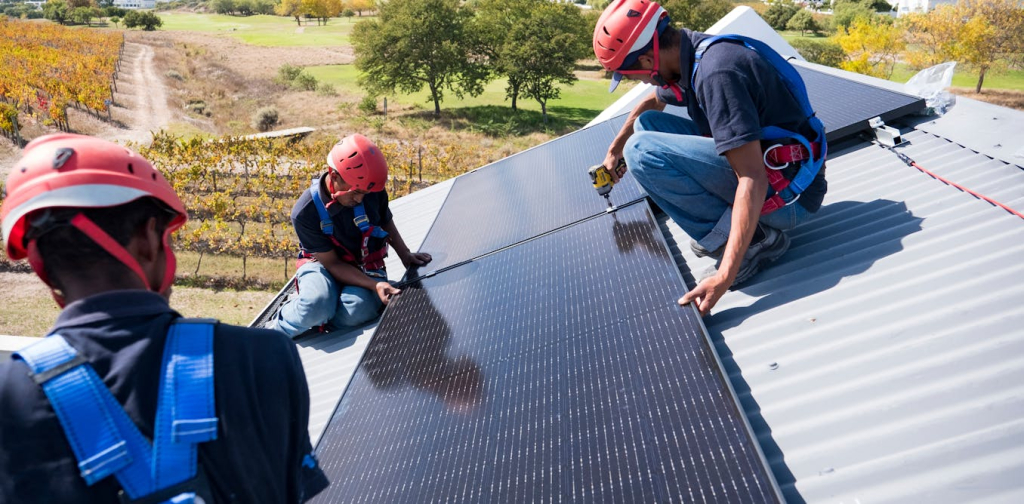

South Africa has committed to reaching phasing out human-caused carbon pollution by 2050. To get there, it needs to push as much renewable energy as possible into the national grid.
The country is the world’s 15th largest carbon polluter. It’s one of only a handful of countries still heavily dependent on burning coal to generate electricity. The country’s transport system is totally reliant on crude oil and its derivatives.


Read more: What’s stopping sunny South Africa’s solar industry? Court case sheds light on the wider problem
One of the keys to the transition to net zero is decarbonising household energy consumption. This means finding ways for homes to reduce the greenhouse gases that cause global warming. At the moment, household energy use contributes up to 40% of total emissions.
I am an engineer and technology management specialist who recently researched how South Africa could use excess clean power from rooftop solar systems on homes if it was fed into the grid. I also studied how battery electric vehicles could be used to store solar energy at home, and feed this into the grid too.
The following analogy explains the idea: think of South Africa’s current solar energy potential like a leaking rainwater tank. It has plenty of “rain” (sunlight). But because it lacks the “pipes” (bidirectional meters) and “extra buckets” (electric vehicle batteries), half of that “water” (clean energy) spills onto the ground unused.
Read more: How South Africa can spread renewable energy to low income areas
Instead, a system could be built that captures every drop of sunlight. This solar energy could be shared between the house, the car, and the neighbours to ensure the whole community has enough. Commercial projects based on this approach are already operational in China, Japan and Germany.
The biggest obstacle to this idea in South Africa is that both small-scale solar and electric vehicles are too expensive for most households, as we showed in two recently published studies on solar electricity for homes and electric vehicles.
Read more: Electric vehicles in South Africa: how to avoid making them the privilege of the few
Fortunately, there is a solution: the aggressive use of two technologies. The first would be giving every home with solar power a bidirectional (two-way) meter. This is a meter that allows homeowners to sell their excess solar power back to the grid. The second would be giving electric vehicle owners a vehicle-to-grid device so that they could store excess solar power in their electric vehicle batteries and sell it back to the national grid.
We believe that a synchronised effort between two novel technology adoptions – infrastructure modernisation (installing bidirectional smart grids and vehicle-to-grid devices in homes) – could dramatically increase the country’s clean energy production.
Energy from small-scale embedded solar systems
Rooftop solar systems installed on residential buildings are estimated to generate about 40% more energy than the residences need. This is because most rooftop solar systems are set up to generate enough energy to power a house during winter when the demand is greatest – people run heaters and tumble driers – and sunlight is at its weakest.
If these homes were fitted with bidirectional meters, which are already widely available, they could sell their unused solar power back to the grid.
Municipalities could also benefit by buying the excess renewable energy generated by homes and reselling it. In Cape Town alone, the city would generate an estimated R144 million (US$8.8 million) per year from doing this, equivalent to an additional 3% in profit, if the bidirectional meters were in place. At the same time, it would be supporting a more inclusive energy transition and reducing the amount of greenhouse gas produced by burning coal to generate power.
Vehicle-to-grid devices
My research also found that home solar systems could be integrated with battery electric vehicles using vehicle-to-grid devices. These are systems that allow batteries from electric vehicles to be integrated with electrical devices in a home (fridges, geysers and heaters) and with the national grid. In other words, electric vehicle owners would use their vehicle-to-grid device to sell power to the national grid.
This would benefit the grid and the vehicle owners, but most importantly would reduce the yearly costs of running an electric vehicle (the combined cost of the electricity the vehicle needs to run, the cost of the vehicle itself and the annual operating costs).
In practice, this would need electric car owners to charge their cars between 10am and 4pm every day when solar power generation is at its peak. This would mean that the car owners could subsidise their travel costs using “free” excess solar energy.
Read more: Electric vehicles in Africa: what’s needed to grow the sector
This would be ideal for people who worked from home or used their vehicles for transport to and from work or school in the early morning and late afternoon. Charging stations at workplaces would also achieve this.
The vehicle battery (typically 40–100 kWh) could then be used by people to power their homes during peak night periods or sell energy back to the grid, while leaving sufficient energy in the battery for the morning travel. Again, this would offset the yearly costs of owning an electric vehicle and boost the national grid by peak shaving.
If homeowners managed this well, by generating enough green energy and avoiding the use of energy from the grid, home and vehicle owners should be able to pay no more than they would if they were driving internal combustion engine vehicles that run on petrol, and using electricity from the national power utility, Eskom. In other words, switching to a renewable energy option would be possible without additional cost.
What needs to happen next
Net Zero by 2050 is not an aspiration of a small group of environmental activists; it is a legal obligation under South Africa’s Climate Change Act. Despite what climate change denialists may claim, it is not a preferred option – it is the only option.
Bidirectional meters and vehicle-to-grid charging stations would help the country reach this goal.
However, the question of who pays for home bidirectional meters, their installation and having them certified has become highly contested. I argue that the state-owned electricity provider, Eskom, and the municipalities should cover the cost of both registration and metering. It shouldn’t be paid by the homeowners.
This is because the benefit for electricity distributors is at least five times the cost of the meter itself. Distributors get cheap energy and sell it to other customers. The grid also benefits from having more renewable energy being fed into it.
Without technology like this, the cost of transitioning to a green energy future remains too high for individual households. But with the technology, the transition becomes economically competitive.
















Comments are closed.