


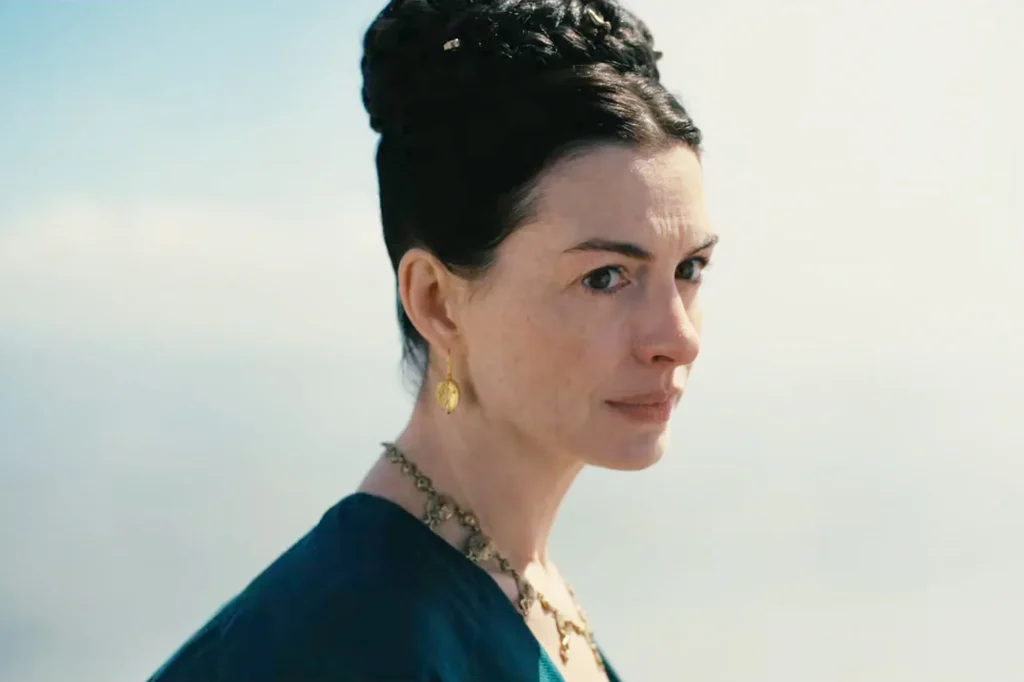

Classical Greek mythology has long been celebrated as the foundation of Western civilization. It gave us epic heroes, legendary quests, and stories that continue to shape literature, cinema, and popular culture. The most recent is, undoubtedly, Christopher Nolan’s ‘The Odyssey’ (2026) adapted from the infamous Classical Greek mythology with Nolan’s remarkable touch as a filmmaker.
‘The Odyssey’ was an impressive movie. Popular actors and actresses starred in it, from Elliot Page, Zendaya, Tom Holland, Anne Hathaway, to Robert Pattinson. However, this ‘The Odyssey’ seemed to not be able to at least note the female agency, if not trying to smash the long-ran patriarchy in the Classical Greek mythology itself.



Viewed through a feminist lens, many of these myths reveal something far less heroic. They are stories built on women’s suffering, where female bodies become political currency and women themselves are rarely allowed to exist as fully realized human beings.
The Trojan War is perhaps the clearest example. The conflict that inspired countless books and films supposedly began because Helen—the “most beautiful woman in the world”—was taken by another man. Whether she was abducted, seduced, or claimed as a prize has always depended on who is telling the story. What remains remarkably consistent is that Helen herself is rarely granted agency. Her desires matter less than the honor of the men fighting over her. She functions as a symbol, a reward, a justification for war—not as a person.
Read More: ‘Situationships’ Were Just the Beginning, Welcome to the ‘Maybelattership’ Era
The violence does not stop there. Before the Greek fleet could even sail, King Agamemnon sacrificed his own daughter, Iphigenia, to appease the goddess Artemis and secure favorable winds. A young woman’s life became collateral damage for an oath forged between powerful men, all in the name of preserving masculine pride and political alliances. Long before the first sword was drawn, women’s bodies had already become expendable.
Perhaps that is why it feels ironic that Hollywood never seems to tire of retelling these stories. Each generation promises a fresh perspective, yet many adaptations simply repackage the same patriarchal values with bigger budgets and better visual effects.
That is exactly why Christopher Nolan’s ‘The Odyssey’ (2026) generated so much excitement. As one of Hollywood’s most celebrated filmmakers, Nolan is directing a reported $250 million adaptation of Homer’s epic, centered on Odysseus’s decade-long journey home after the Trojan War. Many hoped his version would finally offer something more than another celebration of male heroism.
Those hopes intensified when a behind-the-scenes clip surfaced featuring Anne Hathaway as Penelope delivering an improvised line:
“Empty throne? I’ve been sitting on this empty throne for twenty years.”
Read More: Sacred, but at What Cost? The Children and Elders Sustaining Banyuwangi’s Ancient Ritual
The internet immediately embraced the quote. It sounded like a long-overdue correction to one of literature’s most misunderstood women. Instead of portraying Penelope as the endlessly patient wife waiting for her husband’s return, the line suggested something far more radical: perhaps she had been ruling Ithaca all along.
It is an undeniably satisfying moment. But is one powerful sentence enough to rewrite a patriarchal myth? Probably not.
When ‘The Odyssey’ begins, the Trojan War is already over. Odysseus has disappeared somewhere at sea, leaving Ithaca without its king for another ten years. By the time the story unfolds, Penelope has effectively governed alone for two decades while raising Telemachus, protecting the kingdom, and resisting relentless political pressure.
Yet the narrative refuses to acknowledge her authority. Instead, dozens of suitors flood her palace, consuming its wealth while demanding that she choose a new husband. Their objective is not simply marriage. Winning Penelope means claiming Odysseus’s throne and legitimizing their own political ambitions.
Her palace becomes occupied territory. Her body becomes a battlefield.
Read More: No Child Should Die of Worms: Poverty, Parenting, and Shared Responsibility
Like Helen before her, Penelope is transformed into an object through which men negotiate power. Her legitimacy as Queen of Ithaca is never treated as sufficient on its own. The suitors recognize only a kingdom ruled by men, reducing Penelope’s political position to little more than a prize awaiting possession.
It exposes one of the central contradictions within Greek mythology. While Olympian goddesses wield immense cosmic power, mortal women remain trapped within rigid patriarchal structures. Divine women may command storms or wars, but human women are expected to embody obedience, purity, and silence. That contradiction continues to echo through many modern adaptations.
Anne Hathaway’s improvised line certainly pushes against the stereotype of Penelope as the quietly suffering wife behind a loom. It allows audiences to imagine her as an active political figure rather than merely a faithful spouse. But symbolic resistance alone is not the same as structural transformation.
Hollywood has become remarkably skilled at adding feminist-sounding dialogue without fundamentally changing the stories those lines inhabit. The result is what many scholars describe as commodity feminism: empowerment packaged as aesthetic rather than political change. Feminist language becomes a marketing tool while the underlying narrative continues to reinforce the very hierarchies it appears to critique.
If Nolan’s Penelope ultimately still organizes the archery contest that determines which man will possess the throne, while the emotional and narrative center remains Odysseus’s heroic return, then one memorable quote cannot undo an entire patriarchal framework. It merely decorates it.
What Feminist Scholars has been Saying for Decades
This is hardly a new critique. Feminist scholarship has spent decades examining how classical myths preserve gender hierarchies even when women appear intelligent, resilient, or powerful.
In The Female Eunuch (1970), Germaine Greer warns against forms of artificial empowerment that create the illusion of female strength without redistributing actual power. Women may appear independent, outspoken, or resilient, yet the systems governing their lives remain fundamentally unchanged.
Penelope exemplifies this contradiction. She demonstrates intelligence through her famous strategy of weaving and secretly unraveling Laertes’ burial shroud to delay remarriage. She successfully outmaneuvers the suitors for years. Yet the political order never truly shifts. Her authority is tolerated only as a temporary substitute until the rightful male ruler returns. Her leadership exists on borrowed time.
Mary Beard extends this critique in Women & Power: A Manifesto (2017), arguing that Western literary tradition has systematically associated public speech with masculinity while casting female voices as disruptive or illegitimate.
One of the earliest examples appears in The Odyssey itself. When Penelope asks the palace bard to stop singing a painful song about the Trojan War, Telemachus interrupts her. He tells his mother to return to her room because public speech—muthos—belongs to men.
Read More: The ‘Feminine Energy’ Trend is Patriarchy in a Prettier Package
The moment is striking not because it is exceptional, but because it establishes a pattern that echoes throughout Western history. Women’s authority is undermined not only through violence, but through exclusion from public discourse itself.
Seen from this perspective, Penelope’s eventual decision to hold the archery contest is less an expression of agency than the culmination of a system that has systematically narrowed her available choices.
Her “decision” emerges from structural coercion. That same patriarchal logic appears in discussions of fidelity.
In Of Woman Born (1976), Adrienne Rich explores how patriarchal societies regulate women’s bodies in ways fundamentally different from men’s.
Odysseus travels across the Mediterranean, sleeps with Circe and Calypso, wages war, and kills dozens of men without sacrificing his heroic status. These experiences become evidence of his masculinity.
Penelope, meanwhile, spends twenty years under constant surveillance.
Her worth depends almost entirely on preserving her sexual purity for her absent husband. Her loyalty becomes a public performance, while Odysseus’s infidelity barely registers as a moral contradiction. The double standard could hardly be clearer.
Penelope Deserves More than a Better One-Liner
None of this means Anne Hathaway’s performance will lack emotional depth. Nor does it mean Nolan cannot produce an extraordinary film. The concern lies elsewhere.
Hollywood increasingly understands that audiences want stronger female characters. Yet too often, that demand is answered with sharper dialogue instead of deeper structural change. Women are given memorable speeches while the stories themselves continue revolving around men’s journeys, ambitions, and redemption.
That is precisely why Penelope deserves more than a clever line.
She deserves a narrative that recognizes the political labor she performed for twenty years. Deserves a story that treats governing a kingdom as equally worthy of epic storytelling as surviving monsters and shipwrecks. She deserves a version where her authority does not exist merely to preserve a throne for its rightful male owner. Perhaps most importantly, she deserves a mythology willing to imagine female power without immediately placing it back under patriarchal control.
There is another irony here. Hundreds of millions of dollars are invested in resurrecting classical myths whose central assumptions remain deeply rooted in gender inequality. Contemporary productions may introduce more diverse casting, modern dialogue, or symbolic gestures toward inclusion, yet those interventions often leave the architecture of the original narrative untouched.
Read More: Angry, but Not Free: How Women’s Rage Can Be Turned into Another Form of Control
Representation alone cannot dismantle patriarchy. A transgender cameo, an improvised feminist line, or a marketing campaign celebrating “strong women” means little if the story still reproduces the same hierarchy that has shaped Western mythology for nearly three thousand years.
That is why engaging with contemporary adaptations of Greek mythology requires more than admiration for cinematic spectacle. It demands that we ask what has actually changed beneath the polished visuals. Has the myth itself evolved? Or has Hollywood simply found a more profitable way to sell patriarchy?
Until adaptations are willing to reconstruct—not merely redecorate—the foundations of these stories, Penelope’s unforgettable line risks becoming exactly what Hollywood excels at producing: a powerful soundbite suspended inside a house whose walls remain firmly, stubbornly patriarchal.
(Editor: Salsabila Putri Pertiwi)
(Picture source: Universal Pictures)

















Comments are closed.