


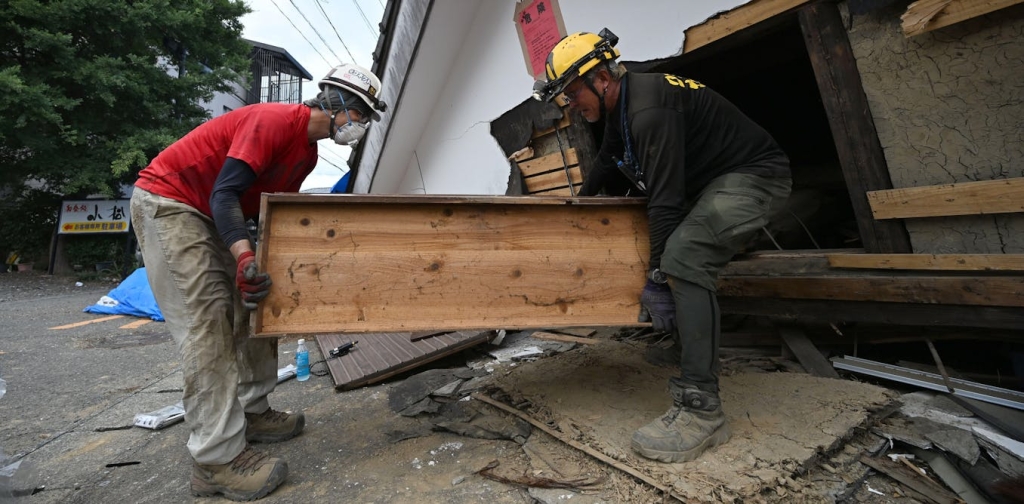

Emergency workers attempting to rescue survivors after a recent earthquake in Kyushu, Japan, also had to cope with extreme summer heat.
After the earthquake killed at least 38 people and left thousands homeless in late July, daytime temperatures climbed into the high 30°Cs and in some places hit 40°C for the first time ever, with high humidity.


Extreme heat affects almost every aspect of an emergency response. For the close to 7,000 people in 130 evacuation shelters and in temporary accommodation across the Kumamoto region, on the southernmost of Japan’s four main islands, hot and humid conditions increase the risk of dehydration, heat exhaustion and heatstroke.
Older adults, infants and people with chronic illnesses are particularly susceptible. It is suspected that one older woman has already died of heatstroke while sheltering in her car.
Heat also makes it harder for people to sleep, especially when air conditioning is unavailable or electricity supplies have been interrupted. Poor sleep can worsen stress, impair decision-making and slow recovery following traumatic events. Emergency responders are similarly affected.
Rescue work, debris removal and infrastructure repairs are physically demanding activities. High temperatures reduce physical performance, increase fatigue and require more frequent rest breaks, potentially slowing recovery operations.
Temperatures in Kumamoto during and after the earthquake

The effects extend beyond health. Damaged water infrastructure increases demand for drinking water precisely when supplies may be constrained. Electricity demand for cooling rises at the same time as power outages. Some medicines require refrigeration. Businesses face longer interruptions. Schools and community facilities may remain closed for longer. This creates a complex web of interacting risks.
Water supplies have been disrupted in some areas and electricity outages have limited access to cooling equipment, leaving evacuation centres very hot. These conditions create a second emergency that receives far less attention than the earthquake itself but can have profound consequences for public health and recovery. This is an example of what hazard scientists call a compound event.
The second emergency
Often natural hazards are thought of as isolated events, but they frequently interact with one another, so that their combined impacts are greater than the sum of each individually. Sometimes the interaction is between different weather extremes, such as heatwaves followed by drought or wildfire. In other cases, climate hazards combine with other geophysical hazards such as earthquakes.
The conditions in 2026 are very different to those when Kumamoto last experienced large earthquakes, in April 2016.
Comparison of temperatures: 2016 and 2026 earthquakes

The 2016 Kumamoto earthquake caused widespread destruction. However, the April temperatures were relatively mild. The recent earthquake occurred during one of the hottest parts of the Japanese summer. Although rescue priorities remain the same, the environmental conditions are fundamentally different.
As the climate changes, the impact of any disaster will increasingly depend not only on the primary event but also on the climatic conditions in which it unfolds. The Kumamoto earthquake shows how extreme heat can become a powerful disaster risk multiplier. A similar lesson emerged after the catastrophic western Japan floods of 2018, when a record-breaking heatwave, subsequently shown by research to have been virtually impossible without human-induced climate change, compounded the disaster, increasing health risks and hampering recovery efforts.
Together, these events demonstrate how heatwaves following other disasters can amplify the consequences.
Planning ahead
The Kumamoto earthquake shows that disaster resilience is no longer just about building stronger infrastructure or improving earthquake-resistant design. It also means preparing communities for multiple interacting hazards.
As climate change increases the frequency and intensity of extreme heat, those planning for emergencies will have to factor this in.
The question is no longer simply how societies respond to earthquakes or heatwaves separately, but how they prepare for all of these circumstances.
As the world experiences more heatwaves, extreme temperatures will pose new challenges for disaster recovery during the hottest parts of the year.




















Comments are closed.