


Tiny viruses that infect bacteria could one day help us tackle infections that antibiotics can no longer treat. But first, scientists need to understand how these viruses work, and artificial intelligence could provide them with a powerful way to do that.
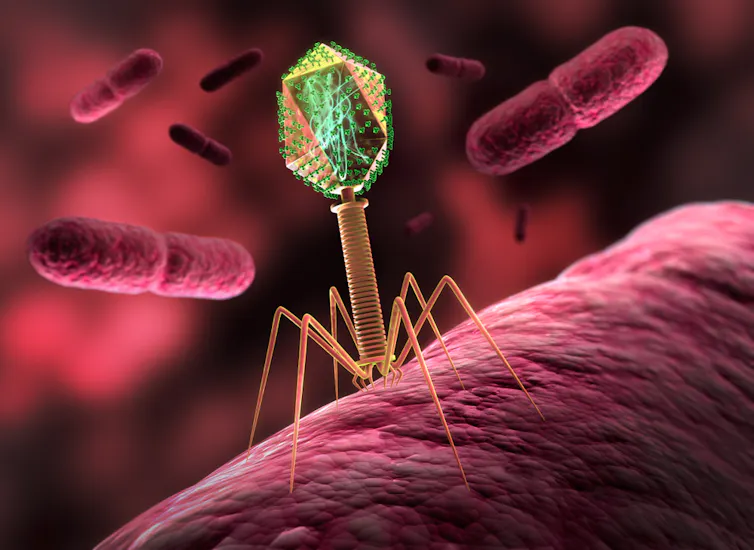
Known as bacteriophages, or simply phages, these viruses infect bacteria and use them to make more copies of themselves. There are thought to be more phages on Earth than any other type of biological entity, and they have spent billions of years evolving ways to find bacteria, invade them and overcome their defences.


This extraordinary diversity could be a boon for medicine. Some phages are already being investigated as treatments for bacterial infections, but finding the right virus for the right infection is not straightforward. Scientists need to understand why one phage can infect a particular bacterium while another cannot, why some can overcome bacterial defences and why some work better than others in the complex environment of the human body.
The idea is no longer purely theoretical. In a new study, published in the journal Science, researchers at Stanford University used AI to design the DNA of a complete phage. When the synthetic DNA was built in the laboratory, it produced a functioning virus – an important demonstration that AI can learn enough about a biological system to design something that works in the real world.
What comes next?
For scientists who study phages, though, the more interesting question is what comes next. If AI can learn enough to build a phage, could it help us understand how these remarkable viruses work?
The Stanford researchers started with ΦX174, a bacteriophage that infects the bacterium E coli. It is one of the smallest, simplest and best-studied phages known to science.
That makes ΦX174 a good test case for showing that an AI-designed genome can be built and used to create a viable phage. But it’s a long way from the much more complicated phages that scientists are interested in developing as medicines.
Some potentially useful therapeutic phages are five to 50 times larger than ΦX174. They have double-stranded DNA genomes and can contain hundreds of genes. They also have sophisticated molecular machinery that allows them to recognise particular bacteria, reproduce inside them and overcome the many defence systems bacteria have evolved to fight them.
This complexity matters because a phage being developed as a medicine needs to do more than simply reproduce. It needs to find and infect the right bacteria, work effectively in conditions inside a patient and, ideally, remain useful as bacteria evolve resistance.
However, much of phages’ diversity remains a mystery, and this is where AI could become particularly useful.
How AI can help
We are already seeing AI help us look deeper into phage biology. Software such as AlphaFold can predict the 3D structure of proteins from their amino-acid sequences. This is particularly valuable for phage proteins whose functions are still unknown. A gene that once appeared to be little more than a mysterious stretch of DNA can now give us clues about the shape of the protein it produces and therefore what that protein might do.
AI does not replace experiments, but it can give us new ideas to test.
At the Becky Mayer Centre for Phage Research at the University of Leicester, much of our work starts with the enormous diversity of phages found in nature. We isolate, sequence and study phages that infect bacteria including E coli, Klebsiella and Pseudomonas, and many other harmful bacteria that are hard to treat.
Again and again, when we study these phages in detail, we find biology we did not expect. Different phages recognise different parts of bacterial cells. They use different proteins and molecular tricks to overcome bacterial defences. They can also behave differently when combined with antibiotics or placed in conditions that more closely resemble those inside the human body.
Collections of these naturally occurring phages could provide AI with something extremely valuable: a huge library of real biological solutions. Instead of simply asking AI to design a new phage genome, we could use it to connect three things: DNA sequence, protein structure and what the phage actually does.
For example, could AI identify the genetic features that determine which bacteria a phage can infect? Could it reveal which proteins help a phage defeat bacterial defences? Could it explain why some phages work particularly well alongside particular antibiotics?
Ultimately, we want to understand what separates a phage that looks promising in a lab experiment from one that actually works in the much more complicated environment of a living patient.
AI might be able to spot patterns in this vast biological diversity that are difficult for humans to see. It could help predict which naturally occurring phages are most promising, identify proteins whose functions we have overlooked, suggest where we might find useful phages and, eventually, propose changes that could make them more effective. But every prediction would still need to be tested in the real world.
The most exciting part
That back and forth between computers and experiments could be the most exciting part. AI can suggest a biological rule or make a prediction, scientists can test it, and the results can then be fed back into the next round of analysis.
The Stanford study raises an important question: has AI learned general rules about how phage genomes work, or has it simply learned enough about one unusually small and well-understood phage to reproduce successfully? We don’t know yet. The way to find out is to give AI much more biology to work with.
Fortunately, phages provide an almost unimaginably rich source of information. Nature has spent billions of years experimenting with different ways for viruses to infect bacteria, reproduce, evade defences and survive in different environments. We now have an opportunity to use AI to help us make sense of that enormous natural experiment.
The ultimate goal is not simply to get AI to design new phages, but to use AI to uncover the rules hidden in the incredible diversity of phage biology – and then use those rules to help turn both natural and engineered phages into better treatments for bacterial infections.























Comments are closed.