


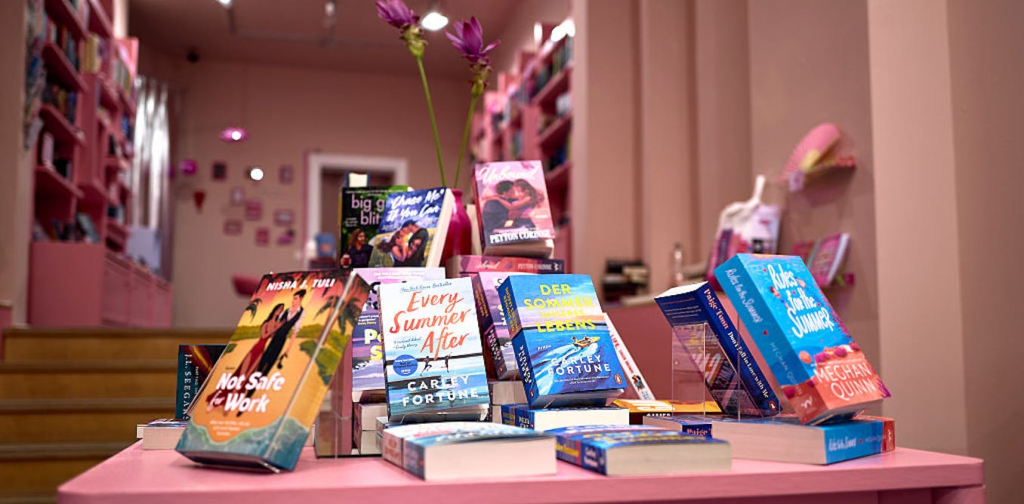

“I’m looking for a book where …” has become a defining phrase of BookTok, TikTok’s massive community of readers and book influencers.
The request is rarely for an author or even a title. Instead, romance readers describe spicy details of a favorite trope: enemies to lovers, only one bed, fake dating and forbidden love, to name just a few.



Increasingly, these conversations aren’t staying online.
They’re also happening inside Pittsburgh’s newest romance bookstores, Passionate Pages, which opened its doors in January 2026, and The Shelf Love Society, which opened in April 2026. Both bookstores have made their home in Lawrenceville, a trendy Pittsburgh neighborhood. What’s behind their sudden appearance, and why now?
To understand the moment, it helps to understand the baggage. The stigma surrounding romance contradicts its enduring popularity as one of publishing’s most successful genres. There is still a pervasive assumption that these books are fluff, smut or secret guilty pleasures.
The presence of local brick-and-mortar romance bookstores not only combats the stigma but also fosters connection among readers searching for community beyond their screens.
My research broadly explores how social identities and intergenerational experiences can influence psychological well-being in adults of all ages. This includes the role that community spaces like bookstores play.
A ‘third place’ for romance readers
Ramon Oldenburg, an American urban sociologist, once described a concept known as a “third place.” Third places are informal public spaces where people gather, socialize and build community outside of work and home. They offer a low-pressure break where people can be themselves, free of tasks and responsibilities.
Romance bookstores can offer Pittsburgh romance readers a safe third space to meet other fans of the genre and subsequently experience a sense of belonging.
Psychologists Richard Ryan and Edward Deci argue that people thrive when basic psychological needs are met. One basic need is to feel connected to others, as this connection fosters a sense of belonging.
Pittsburgh’s romance bookstores also host themed events that celebrate various books, authors or tropes. Local readers can build community with like-minded fans of sapphic romance, a subgenre centered on romantic relationships between women, romantasy, a blend of romance and fantasy, and many other subgenres.
The benefits of these romance bookstores as third places are not limited to interpersonal connections.
Efforts to revitalize Pittsburgh often focus on issues such as economic burdens, housing affordability and job growth. But building civic infrastructure in the form of third places shouldn’t be overlooked. Such investments can promote residents’ engagement with their communities, communication among neighbors and a better perceived quality of life.
The power of a guaranteed happy ending
Many of these arguments can be made about bookstores in general, so why is it especially important to acknowledge the opening of romance-specific bookstores in the city?
There is one core convention of the romance genre that sets it apart from literary fiction: the guaranteed emotionally satisfying and optimistic ending.
This emotional payoff is uncertain in every other literary genre. Yet with romance, readers are trained in a more hopeful way of thinking. This learned hopefulness is because in romance novels, goals are readily attainable, multiple pathways to happiness can exist and perseverance is worthwhile. Readers know to expect that no matter what conflict arises, a resolution is possible.

This expectation of a happily-ever-after despite any adversity ties into Barbara Fredrickson’s broaden-and-build theory of positive emotions. The theory suggests that emotions such as hope, joy and love help expand a person’s range of thoughts and actions after an emotional experience. This makes people more likely to explore, create, play, learn, connect with others, imagine, think critically and try new problem-solving strategies. These actions, in turn, build resilience.
In other words, romance novels plant the hope, and romance bookstores give readers somewhere to act on it by lingering, browsing, joining a book club or striking up a conversation.
Romance for every reader
Romance readers are diverse, and so is the genre.
Pittsburgh’s two romance bookstores have different missions: Passionate Pages carries a broad range of contemporary titles alongside the classics, while The Shelf Love Society aims to make LGBTQ+ romance at least half its inventory. Romance bookstores often curate their shelves to represent all kinds of love, including LGBTQ+ stories, books by and about people of color, and novels featuring disabled and neurodivergent protagonists.
Research on environmental cues shows that physical spaces can signal to people with marginalized identities whether they belong. Shelves stocked with love stories about people from all backgrounds send that signal in ways readers likely won’t find at traditional bookstores.
Demographically, Pittsburgh’s population is roughly 60% white and 40% people of color. Lawrenceville, the home of both bookstores, serves as an anchor for the LGBTQ+ population in Pittsburgh. It’s likely not a coincidence that both Passionate Pages and The Shelf Love Society found their homes there.
Katelyn Frey is the sister of Pittsburgh Editor Cassandra Stone.
Read more of our stories about Pittsburgh and Pennsylvania.




















Comments are closed.