


Melbourne-based artist Richard Lewer has been awarded the prestigious Archibald Prize for his life-sized portrait of senior artist and ngangkari (traditional healer) Iluwanti Ken.
Though Ken is small in stature, Lewer’s portrait of her carries what the artist himself describes as a “quiet authority” – an ability to command a space with a sense of calm attentiveness.



It is perhaps the way Ken is brought forward by the bright yellow ochre background that gives the work its greatest sense of presence and vitality.
A radiant presence
Late last year, Lewer travelled to Amata in the Anangu Pitjantjatjara Yankunytjatjara Lands so he could spend time at Ken’s art centre, Tjala Arts. It was during this time Lewer gained a deeper understanding of the responsibilities Ken carries in maintaining continuity and care of culture.
Ken’s own work, which is informed by walawuru tjukurpa (story of the eagles), speaks of such care. She is well known for her large-scale ink drawings, which feature graphic depictions of mother eagles hunting.
Lewer’s portrait seems to depict a moment in which Ken has briefly stepped away from her work. Yet the small flecks of paint on her left arm suggest the ongoing labour of carrying and caring for the stories of her father’s Country, an attentiveness that persists whether in the studio or beyond it.
I was in the room at the Art Gallery of New South Wales when Lewer’s work was awarded the Archibald Prize – Australia’s most prestigious annual portrait prise.
After all the excitement, Ken herself slowly waded through the crowd towards her portrait. The warm yellow aura surrounding her in Lewer’s work is not merely an invention of the artist’s imagination; the same warmth and quiet radiance could be felt in her presence as she sat down quietly next to the portrait.
Gaypalani Wanambi wins the Wynne Prize
Yolngu artist Gaypalani Waṉambi has won the Wynne Prize this year with her etching on metal, The Waṉambi tree. This prize is Australia’s oldest art prize, and is awarded annually for the “best landscape painting of Australian scenery in oils or watercolours or for the best example of figure scultpure”.
In her winning piece, Waṉambi has etched the important ancestral honey hunter of the Marrakkulu clan, Wuyal, on the back of various discarded road signs.

Beatrice Gralton, who curated this year’s Archibald, Wynne and Sulman prizes, ensured viewers of the exhibition could see both sides of Waṉambi’s work by suspending it directly from the ceiling.
Waṉambi carries forward a legacy of cultural innovation, with a practice that recovers discarded industrial material. Growing up in an artistic family, Waṉambi learned to paint and etch with her father and brothers. After receiving news she had won the Wynne Prize, Waṉambi said:
My father was a great artist and I learnt by his side.
After announcing Waṉambi as the winner of the Wynne Prize and playing a short video message from the artist in her absence, board president Michael Rose recalled calling community members in Yirrkala, East Arnhem Land, to share the news. The person he spoke to remarked that the very Waṉambi trees depicted in the winning work had just begun to flower.
Rose also mentioned that the decision of the Wynne Prize was very close this year. In an unusual occurrence, a highly commended honour was also awarded to Sanne Mestrom for her sculpture, What the body knows.

To make things even more interesting, the Trustees decided to also announce a winner for the Trustees Watercolour Prize, which was awarded to Jennifer Mills for her work ET home (another Wynne Prize finalist).
Finalists in the Wynne Prize are also eligible for the Trustees’ Watercolour Prize, valued at $5000.

Lucy Culliton wins the Sulman Prize
The Sir John Sulman Prize is awarded to the best subject painting, genre painting or mural by an Australian artist, and is judged by a guest artist each year.
This year’s Sulman Prize judge was Sydney-based Del Kathryn Barton who selected Lucy Culliton’s intricate painting of Toolah, one of her beloved rescue greyhounds.
This is Culliton’s seventh time as a Sulman Prize finalist. When this fact was mentioned by Culliton herself, as she graciously accepted the award, I instantly thought of the kotowaza (Japanese proverb) “nanakorobi yaoki”, meaning “fall down seven times, get up eight”. (This is also the title of Taryn Cameron-Smith’s entry to the Archibald this year.)
In the work, Toolah is seated on a lavishly decorated armchair, a choice that Lucy Culliton has said reflects her belief that greyhounds, like all animals, deserve comfort and dignity rather than confinement in cages.
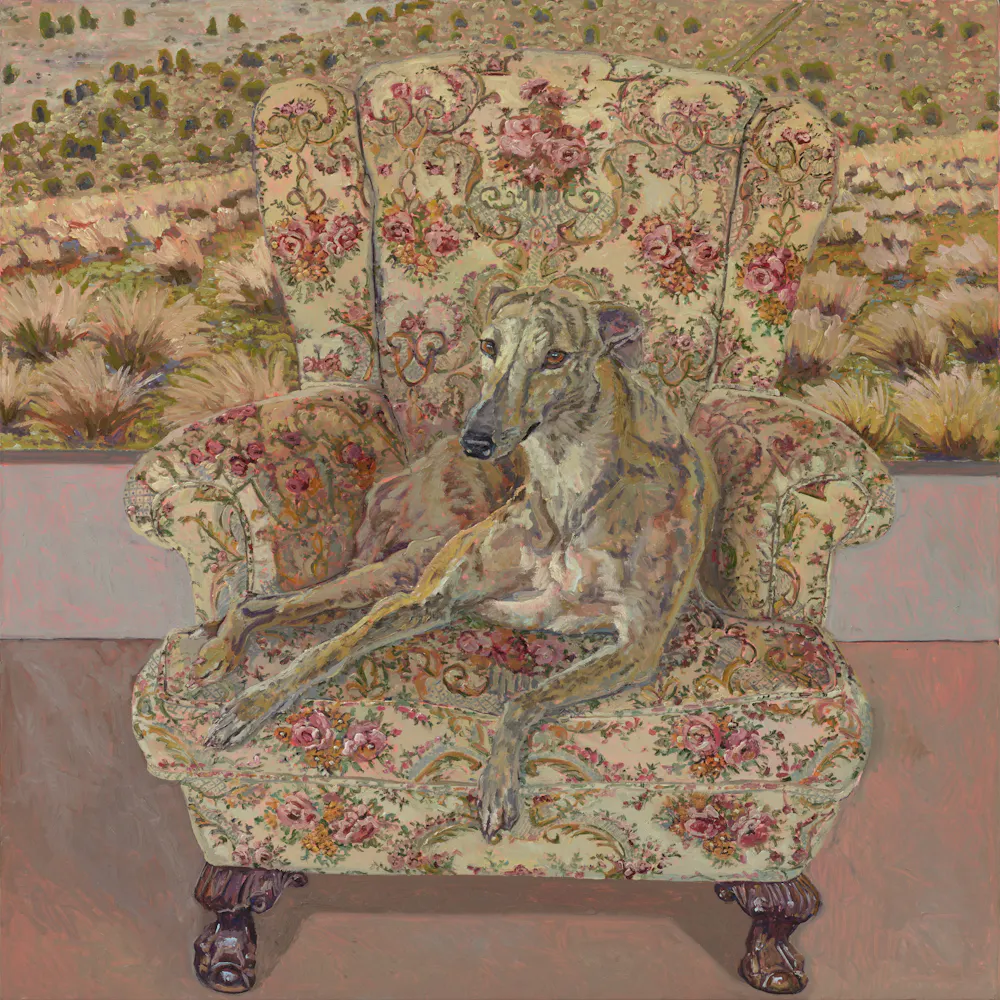
Behind Toolah is a large landscape painting by Culliton that was recently featured in an exhibition about climate change.
In Culliton’s palette of soft pinks and yellowy greens, Toolah, the ornate armchair, and the landscape painting behind them seem to bleed into one another, visually collapsing boundaries between subject and setting, and underscoring the interconnectedness of these themes.
Unfortunately, Culliton was unable to bring Toolah to the announcement. But she promised many cuddles were in order.








Comments are closed.