


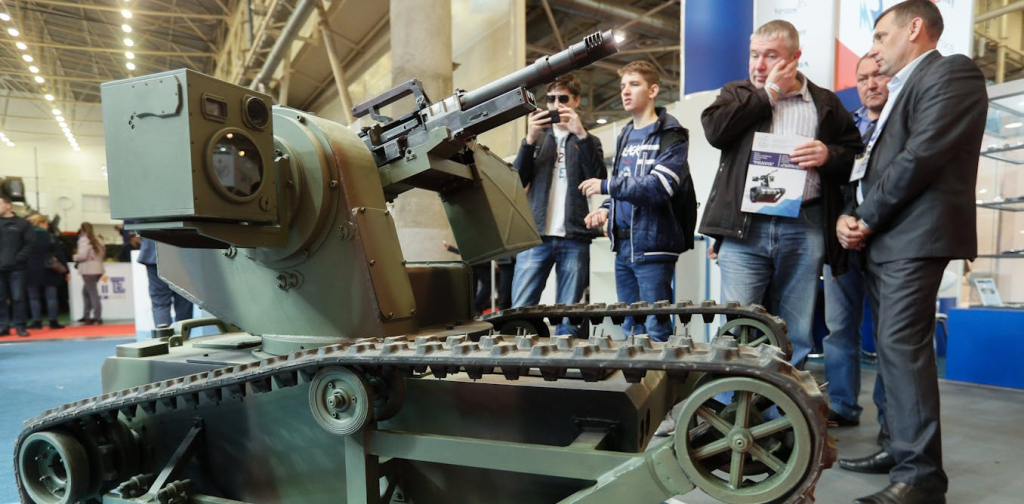

Ukraine’s president Volodymyr Zelensky recently announced that ground robots (also known as unmanned ground vehicles) had captured a Russian position. Zelenskyy said it was the first time in the Ukraine war that an enemy position had been taken exclusively by robots.
Ukraine’s increasing use of drones in its defence has received a great deal of attention as Russia’s invasion has dragged on. While most of this has focused on aerial and maritime drones, the army’s use of ground robotics has been a quieter story – but one with growing significance.



Military ground robotics are rapidly transforming battlefield tasks. However, for the foreseeable future, their greatest impact will be in supporting roles rather than directly replacing infantry soldiers. So, while this capture of the enemy position by robots is a milestone moment, it shouldn’t be over-interpreted.
When it comes to ground robots taking on infantry combat, there are a set of serious obstacles. The first is, quite literally, obstacles. Anyone who has watched increasingly sophisticated robotics demonstrations online will have seen machines navigating complex and difficult terrain.
However, operating in a controlled environment in front of a camera is a world away from crossing broken ground under fire. Most ground robots continue to rely either on wheels or tracks for a variety of very good reasons: mechanical simplicity, availability of spare parts, and cost.
But they have sharp limits on the types of terrain they can traverse, and not all enemy strongpoints are built at the end of paved driveways.
Even accounting for combat loads and the nature of the battlefield, human infantry can climb, jump, wade and otherwise traverse a large variety of obstacles unassisted, in ways that robots still cannot match.
Human in control
The second major obstacle is the electromagnetic environment. While the term robot is often used to describe uncrewed ground vehicles, they are mostly still remotely operated, which means the operator must maintain a constant control link with the vehicle.
This can be done via radio link. However, these links can be interrupted by enemy jamming, or by unfavourable weather or terrain.
The operator can also control the robot by a fibre-optic cable, which cannot be jammed but limits how far the robot can travel from its operator. A cable can also be severed by a blast, shrapnel or just adverse terrain.
The alternative is autonomy, and these ground robots do increasingly have some autonomous capabilities. But so far, this tends to be for specific tasks such as highlighting identified enemy positions, rather than being autonomous in the sense of driving and controlling themselves.
Autonomous driving is a massive challenge. Residents of London may have seen Waymo autonomous cabs in recent weeks, moving through the city’s streets ahead of their public rollout. But following traffic laws and (more-or-less) consistent road markings is still a huge and complex task.
Navigating a battlefield in a complex 3D environment is at least as complex, requiring a huge amount of processing power. That power can either be put aboard the robot itself, which significantly increases its cost and complexity, or done remotely and transmitted – which brings us back to the issue of control link vulnerability.
Support roles
While these are serious challenges for ground robots in an infantry role, they pose less of an issue in a range of critical support tasks. Robots have, for example, been extensively used by Ukraine for battlefield casualty evacuation, front-line resupply, combat engineering, mine laying and mine clearing.
In these instances, their smaller size, substantially lower cost, versatility and lower profile relative to traditional crewed vehicles (which makes them harder to detect) hold benefits that substantially outweigh the drawbacks. And while they are remotely operated so do not drastically reduce overall personnel requirements, if the ground robot is destroyed, its operator is not.
For Ukraine, the strategic imperative to rapidly roll out ground robots is enormous. Four years of war against a numerically larger opponent has imposed huge challenges on its ability to continue recruiting and deploying a large enough force to safeguard its sovereignty.
On a battlefield where the enemy can see and hit almost anything moving within 20 kilometres of the front line, swapping irreplaceable humans for cheap and replaceable robots is a necessary condition for staying in the fight long enough to win it.
But for the immediate future at least, robots are more likely to support that fight, rather than lead it.
















Comments are closed.