




Toronto’s rental market is unforgiving for everyone. But for students, it exacts a cost that has gone largely unmeasured in housing-affordability debates: academic performance.
Where a student lives can shape how much time they have to study, how easily they can participate in campus life and whether they have access to academic and social support. A lack of affordable housing can affect student mental health and reinforce social hierarchies on campus.



Housing is therefore one of the most powerful, and unequally distributed, factors affecting whether students thrive at university.
We are a team of four researchers — a real estate economist, an architect and planner, a business school dean and a housing researcher — brought together through StudentDwellTO, a multi-university initiative. It was launched by four Toronto university presidents after they kept hearing that students’ housing situations were undermining their university experience.
Read more: Universities and colleges want to enrol more students. But where are they supposed to live?
Our new research, recently published in Housing Studies, draws on more than 750,000 student records from four Toronto universities. It combines more than a decade of administrative academic data with National Survey of Student Engagement responses on educational satisfaction, commuting and living arrangements.
We found that where a student lives is linked to measurable differences in academic performance and satisfaction.
A city where residence is the exception
Only between seven and nine per cent of Toronto’s university students live in on-campus housing in a given year. That figure has fallen since provincial funding for this purpose was cut to Canadian universities in the 1990s, and more recently as universities have faced provincial constraints on their debt loads.
Read more: Student housing crisis: Municipal bylaws have created roadblocks for decades
Decades ago, student residence was one of the more equalizing experiences a university offered: students from a wide range of incomes and backgrounds lived in similar conditions. But that’s changed as universities have scaled back on building student residences, even as they have publicly committed to equitable access and student success.
Now, where and how a student lives is determined to a large extent by what they or their families can afford. One of university life’s most formative shared experiences is no longer shared by all.
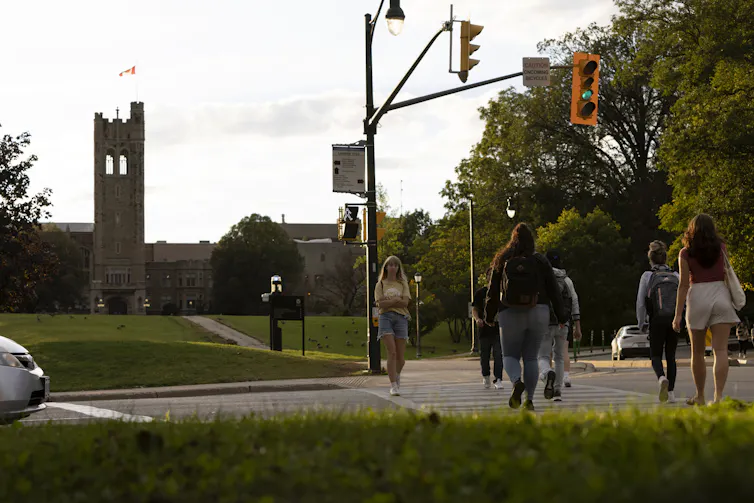
Residence is now effectively rationed. Many universities can guarantee a room only to first-year students, and some cannot guarantee even that.
After first year, most students are pushed into a rental market where rising rents and record-low turnover have kept vacancy tight in cities like Toronto. Students who cannot afford to live near campus must often accept long commutes.
Commuting is linked to lower grades
Students who live off campus, even at short distances, report significantly lower grades, our study found.
The effect grows with commute time: each additional hour spent commuting during the week is associated with a measurable drop in academic performance. Students facing long commutes of 10 or more hours a week see the steepest declines.
There are several plausible reasons for this: commuter students have a less immersive university experience, less socialization and fewer friends, less time for study and less access to on-campus programs.
We also tested this against a student’s prior ability. Using student “fixed effects,” we compared the same person’s grades when they lived on campus with their grades when they didn’t. The on-campus advantage held.
The results show students living in university residence consistently earn higher grades and report greater satisfaction than students living off campus. The gap is largest for lower-performing first-year students, the group most most vulnerable to Toronto’s housing affordability gap.
Proximity isn’t enough on its own
Living close to campus in private off-campus housing does not replicate all the benefits of on-campus residence. The advantage appears to come less from proximity itself than from the institutional and social infrastructure that on-campus living includes: residence staff, peer programming and a built-in living environment that pulls students into the rhythms of university life.
Much of the private-sector response to student housing shortages — purpose-built student accommodation financed as a real estate asset class — replicates proximity but not support. These buildings may place students near campus, but they don’t necessarily provide the same repeated, low-effort engagement and support systems as on-campus university residences.
Earlier research by two of our team members, Shelagh McCartney and Ximena Rosenvasser, helps explain why design matters as much as location. Their research found corridor-style units with shared common areas foster more student socialization than private studio apartments.
Their earlier study showed that as privacy levels in residence design have risen, so has evidence linking that shift to changes in student success.
These differences can have lasting consequences for students. Grades influence eligibility for graduate programs, scholarships, internships and other opportunities. A housing-related academic penalty in first year can compound into a narrower set of options years later.

Living with parents isn’t a safety net
Our study also complicates the assumption that living with parents is a straightforward safety net.
Students who live with their parents report levels of educational satisfaction similar to those of students in residence. But commute time still predicted lower grades regardless of who a student lived with.
That means the well-documented pattern of young Torontonians staying in the family home longer doesn’t fully offset the academic cost of distance from campus. That’s the equity problem hiding inside what looks like a housing problem.
Affordability and access are not the same problem, and solving one does not automatically solve the other.
What governments could do
If access to housing shapes academic outcomes this directly, on-campus residence construction belongs in the same policy conversation as tuition, academic infrastructure, programs and grants. It shouldn’t be treated as a side issue.
The federal government’s 2024 housing plan marked the first time students were formally named among vulnerable populations in national housing policy. Housing gets discussed almost exclusively as an affordability crisis, but our findings show it’s also a learning and equity crisis.
While important, current federal financing tools for developers require guarantees of affordable student units for shorter periods than the multi-decade horizon university housing requires. They also don’t prioritize on-campus residences over private developers building student housing that can later be converted to condos.
In 2025, Ontario announced an $83-million investment in student housing in downtown Toronto. While it’s a good start, it isn’t enough to support the student population as a whole or to reach students across the province. What’s needed is sustained, predictable funding that allows universities to plan for years to come.
Whether governments, cities and universities treat on-campus residence construction as core academic infrastructure will help determine whether higher education in Canada can genuinely function as a public good. Student residences were originally built in part on that premise.
If governments that fund universities are serious about student outcomes, on-campus housing must be funded and built at scale, as core academic infrastructure, with priority given to first-year and lower-income students. The market cannot provide on-campus housing — only universities can.


















Comments are closed.