




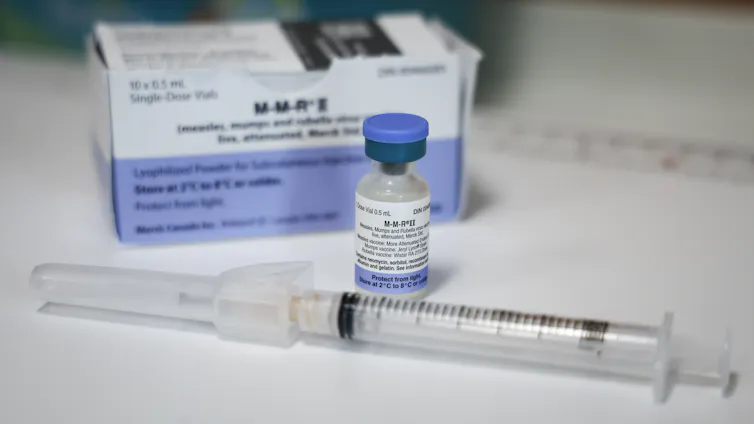
A previously eliminated disease — measles — is resurgent in Canada amid declining vaccination rates
It’s occurring at a time, post COVID-19, of increasing polarization with respect to vaccine policies. Meanwhile, overly simplistic notions of autonomy and personal choice are becoming familiar refrains in public and political debates alike.



The measles resurgence is also happening as vaccine mis- and disinformation is rife, including by those who claim to care about autonomy. But mis- and disinformation are fundamentally anti-autonomy.
Autonomy, broadly, is the ability to make choices in life that align with who we are, and our own personal beliefs and values. It is the foundation for informed consent and thus a central aspect of ethical vaccine policies and programs.
But genuine autonomy depends on the information we are exposed to and have access to, and that helps shape our beliefs. When we are exposed to mis- and disinformation, it becomes difficult to be truly autonomous.

Immunity and Society is a new series from The Conversation Canada that presents new vaccine discoveries and immune-based innovations that are changing how we understand and protect human health. Through a partnership with the Bridge Research Consortium, these articles — written by experts in Canada at the forefront of immunology, biomanufacturing, social science and humanities — explore the latest developments and their impacts.
Making decisions based on misinformation
Today, we face not only an abundance of information (an “infodemic”) on vaccines, but the rapid and far-reaching spread of false and misleading information that affects our ability to be free.
Misinformation is generally understood to be wrong information shared unintentionally, while disinformation is created and shared purposefully to deceive.
Mis- and disinformation are of course not new. However, the ease, speed and distance with which false information can spread is ever increasing, and that fast spread is harmful to our autonomy.
Read more: How AI bots spread misinformation online and undermine democratic politics
When we are mis- or disinformed, we are effectively prevented from understanding the true reality of a situation, and from meaningfully deliberating on our options. We may make decisions that do not align with our beliefs, even when we seem to be acting voluntarily.
Certainly, we are not just passive consumers of information, and the “correct” information is also available for us to find. But when it comes to complex issues such as infectious disease prevention and vaccination, we need to be able to trust expertise. And as our information sources become increasingly contaminated with mis- and disinformation, it becomes ever more difficult to wade through and determine what we can trust to support our decision-making.
This becomes even more difficult when official sources also spread false information, such as when the United States’ Center for Disease Control website was updated in November last year to repeat false claims about infant vaccines.
A compromised information environment effectively challenges the conditions by which we can exercise autonomy or make informed choices. People are harmed by erroneous information even before they make a decision about vaccines, regardless of what decision they make.
But mis- and disinformation also harms our ability to be free and live the lives we plan for ourselves, given the real-world effects on vaccination rates and the spread of vaccine-preventable diseases. It has been estimated that as many as 13,000 hospitalizations and 2,800 deaths from COVID-19 could have been avoided in Canada between March 1 and Nov. 30, 2021, had those who were mis-informed about the COVID-19 pandemic being a hoax been vaccinated.
While we often think about autonomy at the moment of deciding whether to take a vaccine or not, this is not the only consideration. By increasing the risk of contracting preventable diseases, mis- and disinformation limits our ability to engage safely and freely in society.

Duty of government to preserve quality information systems
If we value autonomy for what it really means — that people should be free to choose in ways that accord with their beliefs and values — we must take action to address mis- and disinformation.
A robust understanding of autonomy means there is not only an obligation on the part of health-care workers and public health practitioners to provide the most accurate available information. Governments also have a duty to strengthen the information environment that allows us to make autonomous decisions to begin with.
Critically, this is not about curating information or making moral judgments about people’s individual beliefs or the decisions they make. On the contrary, it is about the quality of systems, institutions and practices that influence how information can be accessed and used, and ensuring they don’t hinder our ability to form our own beliefs or act upon them.





















Comments are closed.