


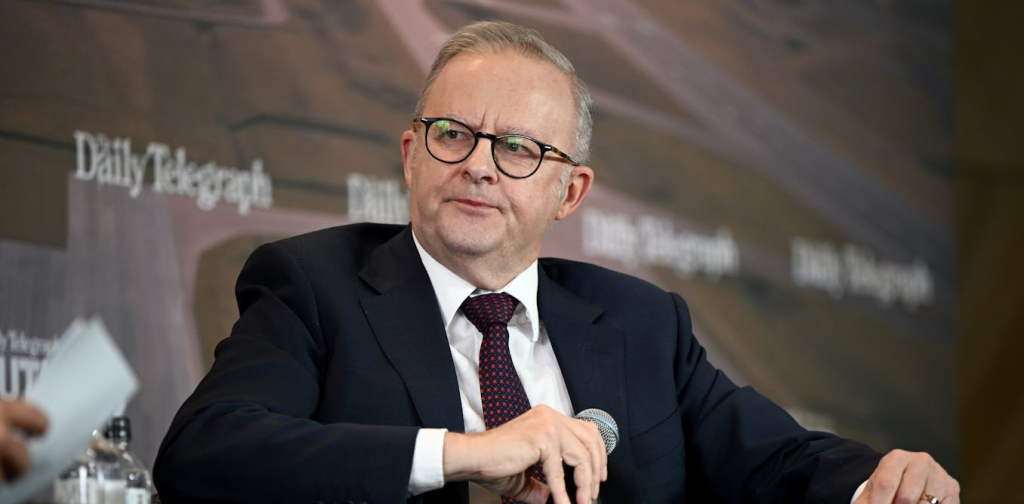

With all the talk about the May 12 budget containing significant tax reform, Anthony Albanese sounded very sensitive when confronted about one big reform his government won’t be making.
In a question-and-answer session at a forum run by the Daily Telegraph on Friday, it was put to Albanese, “You’re talking about fundamental and profound reforms, but why won’t you do the simplest and most effective reform and index income tax rates?”


The prime minister bristled, first saying (wrongly) “no government has done that” and then going on, “you define it that way. I don’t think that’s the most – I think that’s a very big call from you,” he told editor Ben English.
Pressed on whether such a change would not be about equity, Albanese said, “It’s an even bigger call for you to say that that’s the biggest thing we can do on equity in the budget. So, thank God you’re not on the ERC [expenditure review committee].
“There’s a range of tax measures you can do to really go hard on equity. That’s not at the front of them.”
Economist Richard Holden, from UNSW, points out that “bracket creep” – inflation pushing people into higher tax brackets – will worsen as a result of the Iran war.
“The higher inflation flowing from the ongoing impact of the energy crisis will lead to more bracket creep than before,” Holden told The Conversation.
“Even pre-crisis, bracket creep was significant. Based 2.5% per annum inflation over a decade a taxpayer on average full time earnings would go from paying an average tax rate of 22.8% to 25.9% over a decade.”
An advocate for indexing tax brackets to inflation, Holden said “this would end bracket creep forever.
“Many peer jurisdictions, including the United States, do exactly this. Politicians have an incentive not to do so, so they can dish out essentially fake tax cuts.”
Governments shy away from indexation because of the cost to revenue, and also the fiscal flexibility and political advantage they get when they have discretion over the timing and amount of tax cuts.
The Fraser government introduced tax indexation but later cut it back and then dropped it altogether.
Former treasury secretary Ken Henry has advocated indexing income tax thresholds. Henry said last year: “Fiscal drag has got so bad, politicians are getting away with blue murder – and they shouldn’t”.
Then opposition leader Peter Dutton flirted with the idea before the last election but did not commit to it as a policy promise.
The budget will contain changes to the capital gains tax and negative gearing. They will be sold as promoting intergenerational equity, and helping with housing affordability.
On another tax front, Albanese has ruled out any new tax on gas exports, despite a strong public campaign for one.
Meanwhile Treasurer Jim Chalmers has released updated numbers to show some of the “biggest spending pressures” on the budget.
They include:
-
$25 billion for the hospitals agreement with the states
-
About $14 billion for defence investments
-
More than $6 billion in new and amended Pharmaceutical Benefits Scheme listings
-
$4.4 billion in additional payments for Disability Support Pensioners
-
$3.2 billion in additional income support for Jobseekers
-
$2.5 billion to halve the fuel excise
-
$2.5 billion in additional natural disaster support
-
$1.5 billion to meet infrastructure cost pressures
-
$1.5 billion in additional financial support for Carers
-
$1.5 billion in additional payments for Aged Pensioners
-
More than $500 million to respond to the antisemitic Bondi terrorist attack – with additional funding provisioned for the National Gun Buyback scheme.
The figures cover the budget period, over five years from 2025-2026. (The hospitals agreement covers five years from 2026-27.)
The spike in inflation from the Middle East conflict affects both the spending and revenue sides of the budget, increasing the cost of some programs but also boosting some revenue items.
Chalmers said the Middle East conflict meant higher borrowing costs on debt “that will hit the budget hard, and higher inflation that will flow through to higher payment costs”.













Comments are closed.