


Parenthood today is radically different today from what it was 50 years ago. Women’s steadily increasing participation in the workforce and fathers’ greater involvement in daily family routines have reshaped Canadian families.
The proportion of Canadian fathers providing care to their children increased from around 30 per cent to 50 per cent over a period of 30 years, with fathers contributing an average of more than four hours of care per day, according to the 2022 census.



At the same time, parenting is increasingly shaped by the omnipresence of smartphones — something known as technoference, or the disruptive effect of technology on social relationships.
At a time when digital distractions increasingly interfere with parents’ bonds with their children, recognizing the developmental value of playful interactions is important.
Read more: In Toy Story 5, it’s tech versus toys — something families are grappling with
Physically present, on phones
Recent evidence suggests that even when parents are physically present with their children, a substantial portion of that time is spent on smartphones. For example, a study from the United States found that for every hour parents of infants spent with their child, approximately 16 minutes were spent on their phones.
A 2025 Canadian report discussed this and other recent research, and stressed the significance of preserving daily interaction without digital distractions.
These societal and technological changes have renewed research interest in parenting, especially the quality of direct interactions with children. The concept of parenting has expanded, and is no longer bound by a mother-centric view (where mothers uniquely are understood to be in a nurturing and comforting role).
Instead, parenting now reflects both parents being actively involved in child-rearing activities. This has encouraged scholars to examine a greater variety of parenting behaviours, including parental playfulness.
Playful moments
One may wonder why we should care about play if it’s regarded just as entertainment or seen to distract kids from what is important (like learning the alphabet).
Since the adoption of the Convention on the Rights of the Child (1989), access to play and leisure has been recognized as a fundamental children’s right, and significant on its own. More importantly, play does wonders for many aspects of child development.
Playful moments shared with parents could include rough-and-tumble interactions, or sharing nursery rhymes with playful hand gestures like “Itsy Bitsy Spider” that can engage children, make them laugh and nurture relationships as well as language development.
However, it’s important to understand that “parental playfulness” is not restricted to physical play.

Parental playfulness refers to a parent’s spontaneous use of physical, cognitive and social behaviour marked by creativity, joy, imagination and humour during child–parent interactions.
It is a state of mind that can be expressed in a variety of contexts such as during the family meal, a car ride or other daily interactions parents share with their children. A playful parent thinks flexibly, takes risks with ideas and allows creative or novel thoughts to emerge.
Growing evidence suggests that these playful exchanges are associated with cognitive and socio-emotional development, as well as with parent-child attachment security. However, parents don’t always have the energy, resources or emotional availability to engage in play, particularly when families are facing socioeconomic hardship or other forms of adversity.
Read more: How children’s play with everyday objects can encourage skills needed for STEM success
Parental playfulness as a state of mind
When parents have a playful state of mind, this sends a strong message to the child that their mothers and fathers enjoy interacting with them.
Playful interactions also provide an ideal context for encouraging the child to think differently (be creative), to develop trust in others (for example, knowing the parent will not hurt them during rough-and-tumble play) and regulate intense emotions during periods of high excitement.
Even the infamous “dad jokes” can play an important developmental role by showing children they can survive momentary embarrassment and shame. This can be a valuable tool when navigating self-conscious emotions that become particularly present during adolescence.
Importantly, the benefits of parent-child playful interactions extend beyond the child to parents also.
Research led by psychology researchers Anat Shoshani and Shachar Yaari highlighted that engaging playfully with our children can enhance parents’ sense of efficacy and meaning in life as well as happiness. The quality of parent-child playful interactions appears to matter more than the amount of time parents spend with children across leisure, caregiving and family activities.
Is it restricted to fathers?
Gendered stereotypes sometimes primarily associate fathers with being “the fun one.”
It’s important to note that although fathers do devote a larger proportion of their caregiving time playing, mothers spend significantly more time with the child on average, and ultimately devote just as much, if not more, time playing with the child than fathers do.
This may partly explain why, contrary to traditional portrayal, mothers and fathers do not really differ in their repertoires of play behaviours or in the effort to entertain the child.
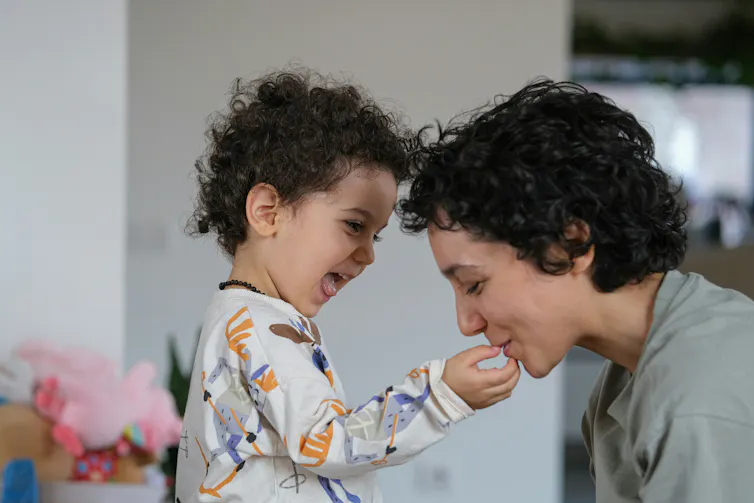
In a recent study, we instructed parents to make their child laugh. We observed that the most effective method for eliciting laughter was the same for fathers and mothers (tickling them: A behaviour also used by chimpanzee mothers to make their offspring laugh). Children laughed just as much with both parents.
Despite these similarities, a notable difference emerged: the ability to make the child laugh was associated with attachment security only for father-child dyads. (“dyad” refers to a unit of two individuals in a significant relationship and is used to highlight how interconnected they and their dynamics are.)
This may suggest that a father’s ability to establish a playful relationship with his child may be a determining factor to foster a secure bond, whereas mothers typically interact with children in a greater variety of contexts (for example, doing household chores together or bedtime routine), which may all contribute to fostering and maintaining mother-child attachment security.
Promoting trust, resilience
Parent-child interactions remain one of the most important drivers for children’s development. Playful exchanges are among the richest and most meaningful, as they create safe atmospheres that promote trust, creativity, emotional regulation and secure attachment.
These playful encounters scaffold children’s emerging abilities to think outside the box, regulate their emotions and navigate social relationships with confidence and resilience.
At a time when digital distractions increasingly interfere with parents’ bonds with their children, recognizing the developmental value of playful interactions is important. Choosing to be fully present allows parents to cultivate interactions that strengthen connection and support both children’s and parents’ well-being.
























Comments are closed.