


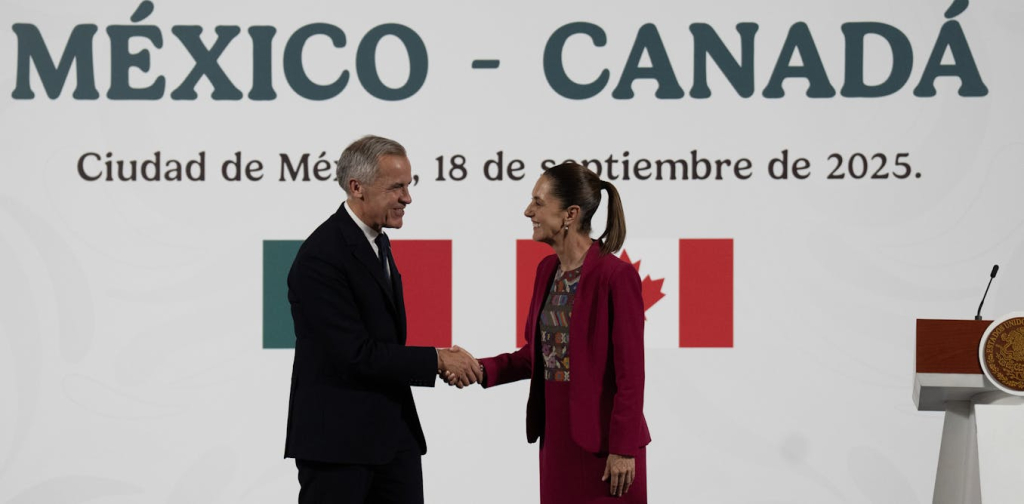

When United States President Trump imposed tariffs on Canada and Mexico in early 2025, the two countries reacted very differently. Canada led with an “elbows up” campaign involving counter-tariffs and boycotts of American alcohol.
Mexico, by contrast, struck a more conciliatory tone and cautiously started to align its trade policy with the U.S. As Canada prepares for a turbulent 2026, Mexico’s experience offers valuable lessons.


Both Mexico and Canada depend heavily on trade with the U.S: both send three-quarters of their exports there. The Canada-United States-Mexico Agreement (CUSMA) underpins tariff-free access to the U.S. for most North American goods. But the deal is in jeopardy.
The U.S. alleges Mexico and Canada are being used as trans-shipment hubs for Chinese goods. These tensions will come to a head in July 2026 when CUSMA is up for review.
Mexico’s calibrated response
To pre-empt American concerns, Mexico has begun cautiously aligning with U.S. trade policy. As early as 2023, it pledged to work with the U.S. on foreign investment screening to address security issues around rising Chinese investment.
In late December 2025, Mexico followed up by raising tariffs on 1,400 Chinese items to between 35 to 50 per cent, including in sectors like electric vehicles and steel.
It would be wrong to dismiss these measures as capitulations to American demands. Instead, Mexico has cleverly navigated trade tensions with the U.S. while protecting its own values and interests. Mexico’s latest duty increases aim to protect domestic industries and counteract trade imbalances with China.
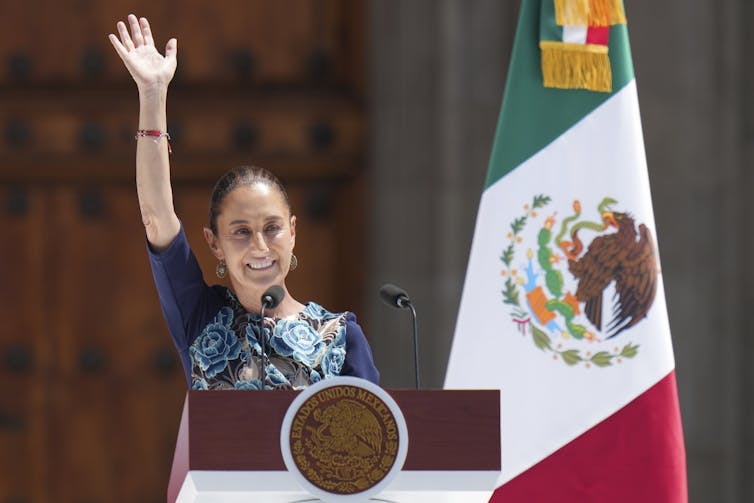
By raising duties only in select sectors, Mexico avoided putting duties on everyday consumer goods, which have driven up prices in the U.S. In addition, while the U.S. is imposing tariffs on friends and foes alike, the Mexican tariffs explicitly exempt countries with which it has free-trade agreements, supporting its broader trade diversification agenda.
Unlike the U.S. tariffs, which violate international trade law, Mexico’s measures are also fully consistent with its international obligations. As a developing country, Mexico committed to higher tariff ceilings at the World Trade Organization (WTO) than the U.S. This allows it to unilaterally raise tariffs up to the maximum levels permitted under international trade law.
Although China has criticized the move, Mexico’s non-discriminatory application of tariffs to all non-FTA partners avoids singling out any specific country and is legal.
Alignment without subordination
Mexico’s strategy offers a template for aligning with the U.S. without sacrificing sovereignty or respect for the rule of law. It is a far cry from a full North American customs union that some hope to achieve as part of the upcoming CUSMA review, which would unduly tie Mexican and Canadian trade policy to the whims of Washington, D.C.
It also demonstrates Mexico’s ability to walk the tight rope of seeking common ground with the U.S. while diversifying its trade and protecting its industry.
It is also superior to alternative ways of aligning with the U.S. Deals struck by the U.S. with Malaysia and Cambodia committed these countries to aligning with American import restrictions and export controls whenever it is in the U.S. national interest, effectively forcing them to forgo an autonomous trade policy altogether.
Canada also learned its lesson when it copied an illegal 100 per cent U.S. tariff on Chinese electric vehicles in 2024, only to face both U.S. auto tariffs and Chinese retaliation the following year.
Smartly, Ottawa has now partially reversed course by agreeing to allow 49,000 Chinese electric vehicles into the Canadian market at a tariff rate of 6.1 per cent. In return, China is expected to lower tariffs on Canadian canola to 15 per cent by March.
What Canada should do differently
In 2026, Canada will feel growing pressure to align with some U.S. trade-restrictive measures and, like Mexico, should do so smartly. Unlike Mexico, Canada has lower tariff bindings and cannot raise import duties without violating its commitments. Canada needs a bespoke approach, similar to Mexico’s, but implemented differently.
First, Canada should renegotiate its tariff bindings at the WTO in sectors critical to its industrial base. The European Union, for example, is preparing to increase its tariffs on imported steel by renegotiating its bindings at the WTO. This would provide a long-term solution offering predictability for both the affected Canadian sectors and trading partners and would be fully lawful.
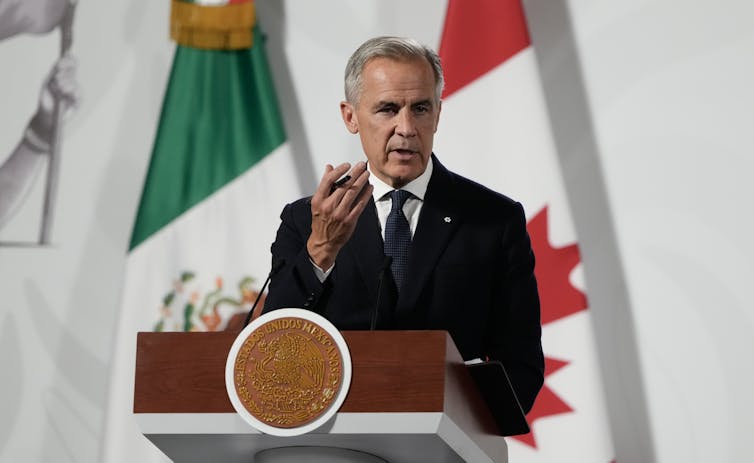
In the steel sector, this route is preferable to the current Canadian tariff-rate quota regime, which is both WTO-illegal and hitting Canada’s closest free-trade agreement partners hard.
Second, Canada should actively pursue safeguard measures in sectors affected by trade diversion. U.S. tariffs have closed off the American market and diverted goods to Canada.
Safeguards are WTO-compliant trade defence instruments explicitly designed to counteract an unexpected surge of imports threatening serious injury to a domestic industry. That scenario has already played out in the Canadian lumber and downstream industry and will likely affect other sectors subject to U.S. tariffs.
Third, using the recent rapprochement with China as a blueprint, Canada should strive for similarly nuanced solutions in future partnerships. Rather than dropping electric vehicle tariffs altogether, Canada has negotiated a compromise that let some Chinese vehicles in, but not enough to endanger either its domestic auto-sector or relations with the U.S.
As U.S. trade representative Jamieson Greer recently stated, the U.S. is not asking its trading partners to mirror its trade policy. Rather, it’s looking for “similar trade actions” with “equivalent restrictive effect.”
This pragmatic formulation allowed Mexico to have its cake and eat it too: selectively align with the U.S. in key sectors to preserve its market access, protect domestic industries from trade diversion and avoid upsetting key trading partners elsewhere through WTO-illegal actions. Canada would be wise to follow Mexico’s lead. The recent China deal is a step in the right direction.



















Comments are closed.