


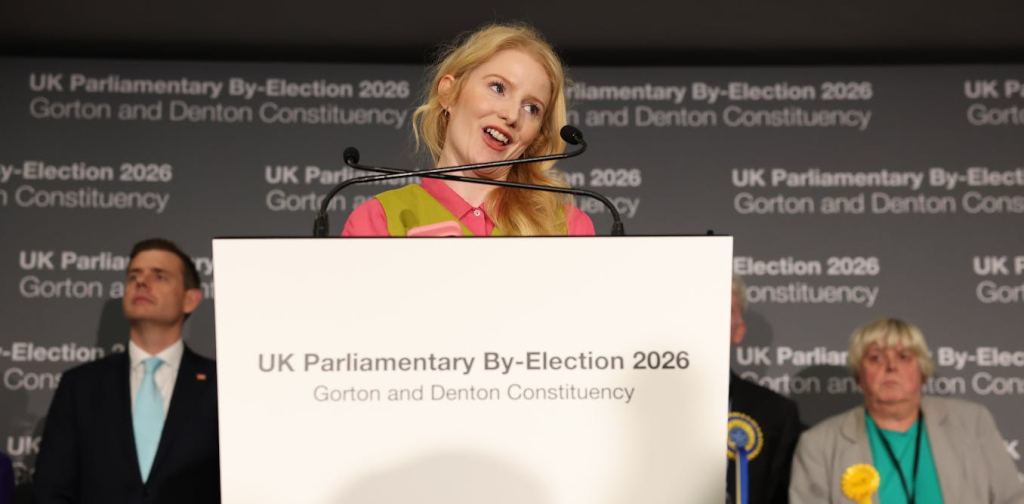

Hannah Spencer’s parliamentary story – as the new Green MP for Gorton and Denton – has just begun.
Nevertheless, the life story that she presented in her victory speech was that of a plumber, not a politician. She identified herself – in present tense – by that trade; she had not grown up wanting to be a politician. She also celebrated qualifying as a plasterer during the “chaos” and “pressure” of the election campaign. She described campaigning jovially as “all this”, as if it were just a challenge in the broader adventure, not the adventure itself.



Despite, or perhaps because of, accusations that the Greens used “sectarian politics” to secure victory, the speech was one of solidarity, of aligning herself with the struggles and achievements of “the community that I am from”. Spencer said that she had lived there in one of the hardest times of her life, and presented the strength of the community “at holding things together” as an inspiration.
She aligned herself and her personal characteristics with those of the constituency, stressing that “I am no different to every single person here in this constituency. I work hard. That is what we do.”
Alongside all the talk of “we”, of common interests and lack of difference, Spencer singled out several audiences for her story. One such audience? Her now-plumberless “customers”, to whom she duly apologised: “I’m sorry, but I think I might have to cancel the work that you had booked in, because I’m heading to parliament”.
Spencer also addressed those who voted for her, and those who didn’t. She spoke of “my Muslim friends and neighbours”, who “are just like me: human”. She discussed the “left-behind” (“I see you, and I will fight for you”), and people doing jobs like hers: “We will finally get a seat at the table”. And she addressed “our white working class communities, the background that I have become so glad to be from”.
A personal and political journey
My research focuses on political narratives and storytelling as a means of communication: the stories that parliaments contain and project, the stories we tell about the places we’re in and the stories that politicians use to communicate themselves to voters. Spencer’s speech is an attempt to portray a compelling story to her new constituency.
She spoke about how moving away from the constituency to nearby Trafford made the qualities of Gorton and Denton’s community “even clearer”. Only realising your love for a place and the people in it when you’ve moved away is a familiar narrative device. As Joni Mitchell once sang, “You don’t know what you’ve got ‘til it’s gone”.
In Spencer’s speech, this tactic carried a sharper political edge. This is a constituency that people move away from to get the “nice life” that Spencer described: “good schools, a thriving high street and clean air”.
This part of the story carried a rebuke to an audience that Spencer was addressing, but not by name: the Labour Party, for whom this was a traditionally safe seat. Spencer observed that “working hard used to get you something”.
I would argue that “you”, in this context, is a reference to traditional Labour voters. The implication here is that it is voting Labour that “used to get you something”.
Being a politician now isn’t an aspect of Spencer’s story that she’s keen to claim. She may now sit at Westminster, but she appears to frame this as an extension of who she already is — a worker, a neighbour, a constituent — in a new arena.
In doing so, she attempts to recast political representation itself as continuity of identity. The challenge, of course, will be whether she can sustain that claim. It is easier to say “I am no different” on a victory stage following a byelection win than from the House of Commons. The durability of her narrative – and perhaps her political appeal – will rest on whether she can remain recognisably “from” the constituency while operating within the institution of parliament.




















Comments are closed.