


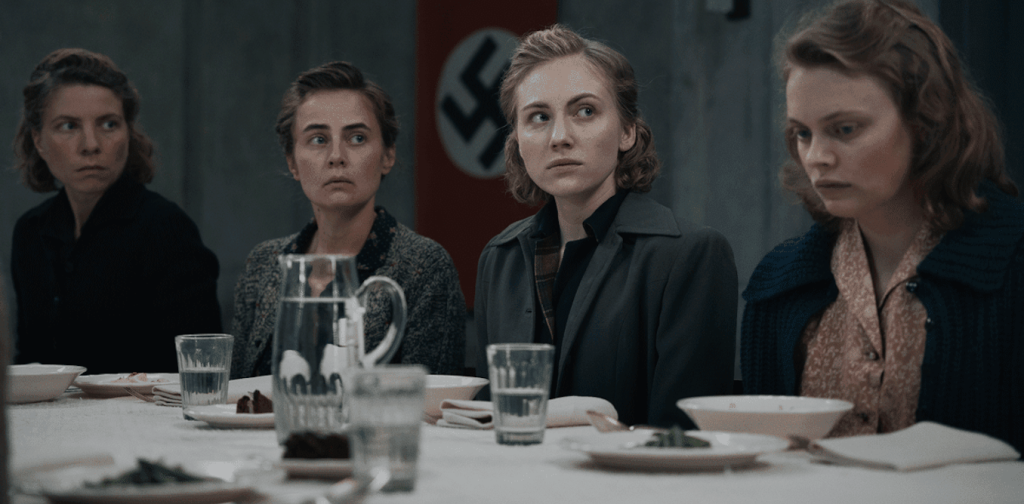

Director Silvio Soldini’s wartime drama The Tasters is a gripping and deeply affecting film. Inspired by the testimony of Margot Wölk, who claimed in 2012 that she had been forced to taste Adolf Hitler’s food during the second world war, the film examines survival and moral compromise among those caught inside the machinery of the Nazi regime.
The film is adapted from Rosella Postorino’s 2018 historical fiction novel The Women At Hitler’s Table (also known as At The Wolf’s Table in the US), itself inspired by Margot Wölk’s account.



At its centre is Rosa Sauer (Elisa Schlott), a young woman who leaves Berlin in 1943 to live with her parents-in-law in rural East Prussia while her husband fights on the Russian front. Hoping to escape the bombing of the capital, she quickly finds herself facing a different danger when Nazi soldiers arrive and force her into a van with several other women from the village.
They are taken to the nearby Wolf’s Lair, Hitler’s secret headquarters, where the women are ordered to taste every meal prepared for the Führer to confirm that the food has not been poisoned. They sit together under guard to eat dishes prepared by the kitchen staff and then wait under supervision to see whether anyone falls ill.
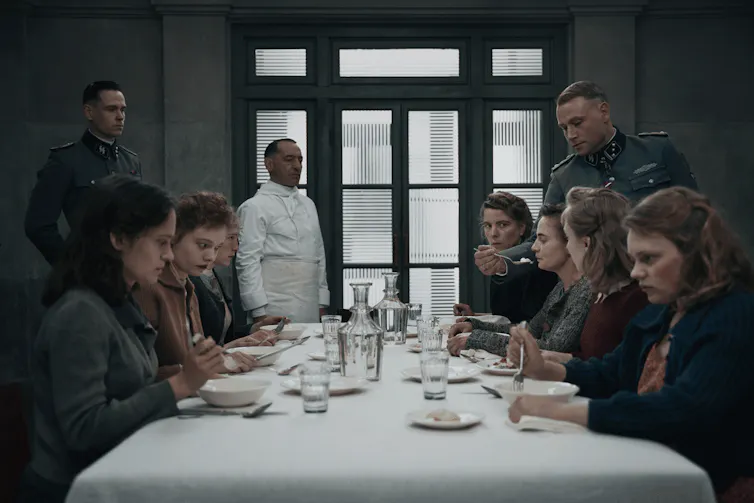
The film unfolds within a muted visual palette that reflects the bleakness of its rural wartime setting. The countryside is drained of colour and the interiors appear subdued. This restraint extends to Hitler himself, whose presence is constantly acknowledged but never shown. The unseen dictator hangs over the film and shapes the lives of the women without ever appearing to them.
Elisa Schlott delivers a quietly commanding central performance. Her Rosa is observant and uneasy, a woman trying to understand a situation imposed on her without explanation. Schlott conveys the character’s anxiety through small gestures and careful silences, creating a performance with steady emotional weight which anchors the film.
The ensemble surrounding Schlott is equally impressive. The other women gradually come into focus, each drawn carefully with her own complexities. Emma Falck gives a strong performance as the wide-eyed and optimistic Leni, while Alma Hasun is compelling as the guarded Elfriede. Their shared circumstances create moments of closeness as well as distrust, so that survival becomes a matter of constant adjustment.
Rivalries emerge and alliances shift as the women spend long hours together under surveillance. Bonds form through conversation and secret gestures of care, and even within a system that treats them as expendable, the women continue to recognise one another as individuals.
The Nazi soldiers are a constant threatening presence. Their authority over the women is absolute and the violence behind it surfaces in sudden moments. One lieutenant (Max Riemelt) begins to single out Rosa and the two enter a clandestine sexual relationship that offers brief escape for them both before the reality of their situation, and their own role in the horror of war intrudes.
Soldini’s patient, understated direction allows the story to unfold through confined interiors and careful observation. Composer Mauro Pagani’s impressive score carries an insistence beneath the action, evoking the war beyond the boundaries of the film. The conflict remains outside the frame, while the score intrudes at key moments and unsettles the fragile calm of the women’s routines.
In the crowded field of second world war films, The Tasters is a rare story that places women at its centre. These women continue their lives as best they can within the constraints of their reality. They talk and confide in one another, and small acts of kindness carry enormous weight in an environment shaped by control and fear.
Exploring the fragile humanity which persists within an oppressive system, The Tasters is a thought-provoking, compelling and quietly powerful film that will devastate you softly.
This article features references to books that have been included for editorial reasons, and may contain links to bookshop.org; if you click on one of the links and go on to buy something, The Conversation UK may earn a commission.
















Comments are closed.