


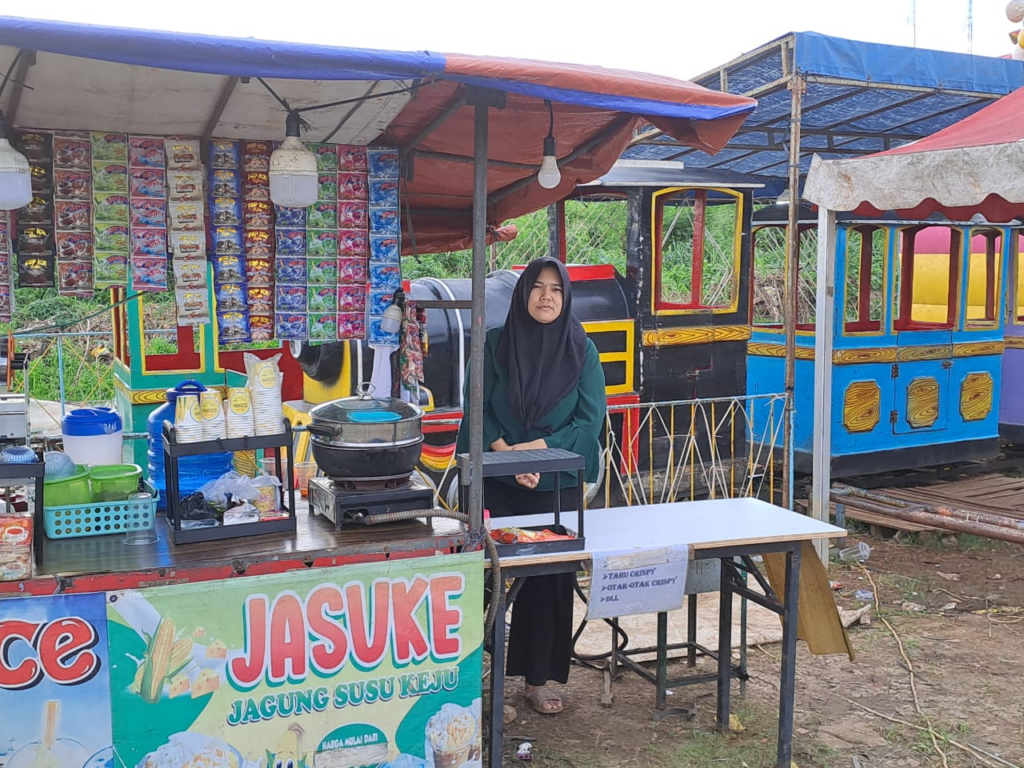

Yesterday afternoon I went to the night market. This night market only opens during holidays, this time during Ramadan.
I met Eka Rosiana (34), a vendor selling drinks and fried snacks. There were crispy tofu, crispy tempeh, and crispy balls prepared next to the frying pan. As for the drinks, she sold them in sachets. Sometimes she also sells Jasuke or Corn with Milk and Cheese.



Eka Rosiana runs her stall accompanied by her husband and two children. That afternoon, she was busy preparing the fried snacks, occasionally tidying up her wares, while her husband, Abdul Latif, was preparing bottled water. After that, Abdul flew a kite with their youngest child, while their eldest child sat on a mat next to the cart. Every now and then, the sound of a children’s train passing by—chug, chug, chug—mingled with the very loud dangdut music.
“Is it quiet or busy, sis?” I asked.
Eka asked me to speak up a bit, because my voice sounded soft—not as loud as the remix of “Jatuh Bangun,” the song once sung by dangdut singer Meggi Z, which was playing that afternoon.
“Alhamdulillah, Saturdays and Sundays are still busy, but on weekdays, it’s quiet—maybe because it’s still the beginning of Ramadan,” replied Eka Rosiana.
If it’s quiet, she only makes Rp20,000 a day; she sells from 4 p.m. to 11 p.m., just enough to cover the cost of buying water and ingredients for the fried snacks.
Eka Rosiana’s home is not far from the night market, in Ciledug, Tangerang. She just rides her motorcycle, brings her goods, and arrives, while she leaves her cart at the night market.
Read more: Indonesia’s Garbage Emergency: Scavengers Buried Under Mountains of Garbage in Bantar Gebang

Eka used to work as a Sales Promotion Girl (SPG) in the Mal Taman Anggrek area, but the store went bankrupt and closed. Meanwhile, Abdul Latif worked as a security guard in Bintaro. For five years, they worked from morning until night. Eventually, they decided to start their own business, trying their luck by selling goods from a cart.
“Selling fried snacks and packaged drinks like this has a lot of competition, so we go from one night market to another.”
The night market in Ciledug, located not far from the Puri Beta Busway Terminal where they set up shop, isn’t the only night market they’ve ever visited. Every time they go around, Eka pays rent or a sort of contract fee to the night market operator of Rp3.5 million per month during Ramadan, or Rp1 million per month on regular days.

In addition to being a place to sell food, clothes, buckets, and pots, the night market also features a carousel, a train, a “devil’s barrel,” and fish-fishing games, which add their own unique appeal for visitors. The prices are definitely much cheaper than those in stores.
“So we’re not worried if there are no customers. There are always customers, even if our earnings are just enough—the important thing is to break even,” said Eka Rosiana on February 25, 2026.
On regular days, Eka and her husband go around selling with the night market team; sometimes they set up shop in Bintaro, sometimes in Bogor, Serang, or Bojong Sari—all over the place.
Read more: Indonesia’s Garbage Crisis: The Irony of Women Amid the Stench of Garbage
To prepare for the possibility of not breaking even, after dropping Eka off to sell, Abdul Latif works as an online ride-hailing driver (ojol). The income from ojol is enough to cover daily expenses. Eka and Abdul don’t rent a house, which is what makes their lives a bit easier—at least that’s how they feel. If they had to rent a house, they’d have to work even harder to cover the rent. Their children are also still young and don’t require much in the way of expenses yet. While they go around selling at various locations, their two children are looked after by their parents.
“Thank goodness Mom is still here, so we’re safe.”
“Forget about going out of town for Eid; they can’t even afford to buy clothes at a store,” Eka said. At this night market, as Eid approaches, they buy clothes here because night market clothes are cheaper than store prices.
“We buy all our clothes here; sometimes they give us a discount since we’re both vendors, and we’re buying four sets for our family,” Eka explained, noting the clothes are for her, her husband, and their two children.
If it costs Rp500,000 at the mall, here it’s only Rp50,000.
Unlike Eka Rosiana, Watiningsih, a seller of risol and jasuke, chooses to sell outside the night market during Ramadan. This is because the rental fees are expensive. If it weren’t Ramadan, Watiningsih would join the night market group since the rental fee is only Rp1 million, but during Ramadan, it’s too much.
“It’s so quiet, it’s tough, that’s why I only sold inside the night market yesterday, but now I’m outside.”

Read more: 2025 Year-End Edition: Women’s Resistance in the Season of Arrests and the Year of #DemocracyApocalypse
Her stall did indeed look quiet yesterday afternoon. A stove was set up for frying, and some of the spring rolls had already been partially fried, so if a customer came, she’d just need to reheat them.
Outside the night market, Watiningsih only pays a daily sanitation fee of Rp20,000. Yesterday afternoon, business was slow because there are so many impromptu vendors selling suddenly during Ramadan, so the competition is fierce.
Not far from Watiningsih, another stall was also selling risoles with different flavors. These risoles are currently trending on TikTok—some are chocolate-flavored, others strawberry, and there are even vanilla ones. Competition is getting fiercer as iftar approaches; people are scrambling to buy them, especially since they’re trending on social media.
Watiningsih started selling after her husband passed away because she had to support her child. But now, her life is better because she lives with her child, who is already working. As Wati puts it, she’s living off her child.
“I actually want to go back home, but what can I do—business is slow,” said Watiningsih.
Watiningsih is from Padang; she returned to her hometown three years ago. Every Eid, she always wants to go home, but what can she do—the money she’s saved still isn’t enough.
The desire to return home is also felt by Sartini (58), a nasi uduk vendor near Puri Beta, Ciledug. On regular days, she sells nasi uduk and lontong sayur at dawn, but during Ramadan, she has to switch gears and sell kolak, fried noodles, and fried snacks at her usual spot.
Read more: 2025 Year-End Edition: A Season of Persecution Without Transition in the Age of #DemocracyApocalypse
Sartini lives in Klaten, Central Java. Every Eid, she always wants to go home to see her older sister, but she chooses to focus on meeting her daily needs instead.

I met Sartini while she was frying tofu and bakwan. Her goods were selling well; customers came and went. She already has regular customers, most of whom buy her nasi uduk. She chats with every customer and doesn’t hesitate to call out to passersby to stop by her stall.
“Come on over, come on over, what do you need? We have fried snacks, kolak, lontong—fried snacks are just two thousand rupiah, come on, come on over,” said Sartini.
Sartini’s lontong has a distinctive flavor—it’s soft and the seasoning really comes through. While other lontong doesn’t use coconut milk, Sartini mixes hers with coconut milk to make it soft. Her fried noodles are also savory, mixed with meatballs and eggs.
“There’s a lot of competition, so I add coconut milk to my lontong to make it soft, and I add eggs to the fried noodles to make them savory,” said Sartini as she set aside the cooked fried tofu, transferring it to a bamboo tray.

During Ramadan, as soon as she finishes suhoor, she heads straight to the market. After that, she cooks 100 pieces of lontong, two large pots of kolak, 30 packets of rice noodles, and about 200 pieces of fried snacks. Sartini sometimes cooks by herself, and sometimes her neighbors help out when there are orders.
Read more: Stop Tech Misogyny: The Long Chain of Gender-Based Cyber Attacks and Disinformation
“Even though the income isn’t as much as from nasi uduk, it’s okay—what matters is that the goods sell.”
Sartini’s husband, Bambang, previously worked as a school security guard, and Sartini sold food at the school cafeteria while also cleaning. However, since they’re getting older, they’ve now retired. Bambang hasn’t worked for a long time, though for the past month he’s been working again at a warehouse.
“I’ve been working at the warehouse for a month now, handling incoming goods.”
Before he started working at the warehouse, the family’s main source of income came from Sartini’s street vending; Bambang helped her sell and drove her to the market. This past month, they’ve received an additional income from Bambang.
Their combined income covers the Rp2 million monthly rent for their home, located in a narrow alley in Ciledug. It is a row house with one bedroom; the rest of the family, including Sartini and Bambang, sleep on mats on the floor.
On a typical day selling nasi uduk, Sartini can earn Rp200,000 per day, whereas selling kolak during this Ramadan, her net income is only Rp100,000 per day, since her sales hours are limited to 3–6 PM. So during Ramadan, her income has decreased, barely enough for food and rent.
Sartini has four children, but three of them are already working; only her youngest child remains at home. All her children are high school graduates, but only her youngest is in college—and even then, he’s on a scholarship, Sartini explained. Every time Eid comes around, she really wants to go home, and her older sister offers to cover the cost of her trip back to Klaten. But Sartini feels embarrassed to go home if her sister pays for it and she has nothing to bring back.
Read more: Stop Tech Misogyny: When AI Becomes a Tool for Manipulating Women’s Bodies
“I’m afraid I’ll just be a burden if I go home. So I’d rather not go home at all—I’ll just celebrate Eid in Jakarta.”
Some articles mention that Ramadan can bring benefits to merchants. These are temporary vendors who sell goods during the month of Ramadan.
However, a study conducted by Hududa Akmami, Ayin Fias Munifah, Syarmiati Syarmiati, Elsa Julia, and Iqin Muttaqin in Pontianak City in 2023 found that 12.5% of vendors did experience an increase in income during Ramadan, 25% of vendors earned the same income as in a typical month, and 67.5% of vendors experienced a decrease in income because they failed to provide Ramadan-specific food and beverage items that consumers sought.
In general, money circulation and public consumption always surge sharply during Ramadan. Household spending can increase up to 1.2 times compared to regular months.
The study’s conclusion states that the well-being of street vendors in terms of income during Ramadan generally does not improve because vendors lack product innovations tailored to consumer preferences for breaking the fast. The products sold are relatively the same as on regular days, so the decline in income results in a decline in well-being.
During Ramadan 2025, total consumer spending in Indonesia, according to Redseer Strategy Consultants, reached Rp1.188 trillion, with an average expenditure of Rp4.8 million per person. Despite high enthusiasm (93% of consumers), there is caution in spending; purchases are dominated by essentials, fashion, and beauty products, with a surge in the gift and health categories.
Read more: Stop Tech Misogyny: Misinformation on Social Media Used to Trap Victims of Human Trafficking
This stands in contrast to the skyrocketing prices of necessities during Ramadan. Inflation at the start of Ramadan in recent years has shown a consistent seasonal pattern, namely increasing price pressures, particularly in the food, beverage, and tobacco groups.
At the start of every Ramadan, monthly inflation tends to be higher than in normal months, with the largest contribution coming from the food commodity price index for items such as rice, chicken, eggs, chili peppers, and ingredients for breaking the fast.
Although aggregate inflation figures appear relatively under control, the impact is not evenly distributed across all segments of society. Urban poor households, particularly those economically led or managed by women, tend to be more vulnerable to food price hikes. This is because the proportion of household spending on food in poor households is far greater than in middle- and upper-income households. When food prices rise rapidly, the room for budget adjustment becomes severely limited.
Urban poor women often serve as both household financial managers and additional breadwinners in the informal sector. Price hikes during Ramadan not only increase the burden of daily consumption but also create social pressure to meet iftar needs and prepare for Eid al-Fitr. In the context of unstable income, seasonal inflation can lead to a decline in real purchasing power, a reduction in the quality of food consumption, or an increase in reliance on short-term debt.
Considering the historical trends from 2021 to 2025, the projected monthly Ramadan inflation for 2026 has the potential to once again increase the cost-of-living burden in urban areas. If not offset by food price stabilization and strengthened social protection, this increase could deepen the economic vulnerability of urban poor women, particularly those working in the informal sector with daily incomes.
Sartini feels the impact. Every Eid, she braces herself for rising prices. Inflation causes prices to rise during Ramadan and in the run-up to Eid, even though vendors like her make only a small profit. Sartini doesn’t dare raise her prices because of the fierce competition.
“I don’t dare to make a big profit, because there are many others selling around here too.”
Although the government, through Trade Minister Budi Santoso, has guaranteed stable prices ahead of Eid, inflation data on the ground shows that food prices—such as chicken, eggs, and chili peppers—skyrocket when Ramadan arrives.
The government seems to be ignoring this. It is the small vendors who are the ones suffering the most when prices rise.
Harassed While Fighting for Their THR
Women working as online motorcycle taxi drivers (ojol) also face hardships during Ramadan. This Eid, they are fighting to receive their Eid Bonus (THR).
The narrow streets of Rawamangun, East Jakarta, were still brightly lit as Lily Pujiati (53) returned home from work. She had just reached the entrance of the alley when she realized something strange was happening at her house.
Lily caught a different scent—an odor that shouldn’t be present in broad daylight. It wasn’t the smell of cooking, nor the usual Jakarta street aroma. There was something else—a pungent, thick, and unsettling stench. That’s what greeted Lily when she returned home on February 4, 2026. There was a foul odor.
Curious, Lily hurried to the doorway; she couldn’t contain her shock when she saw her yard littered with rotten eggs mixed with what she suspected was chicken blood.
“After returning from an errand around 2 p.m., as I approached the entrance to my alley, I could already smell a pungent, foul odor. And, sure enough, right in front of my front door, there were rotten eggs scattered about, mixed with what looked like thick chicken blood,” Lily told Konde.co (2/23) via a ride-hailing app.
With a tight knot in her chest, Lily tried to calm herself, though “calm” was the last word that described what she was seeing at that moment. Her hands frantically searched for anything she could use to sweep away the foul mess, the source of which was unknown.
Lily is the Chairperson of the Indonesian Transport Workers Union (SPAI), an advocacy group for online transportation workers, couriers, and logistics workers.
Recently, she has been actively advocating for holiday bonuses (THR) for online motorcycle taxi drivers. The terror at her own doorstep was not an isolated incident; on social media, she faced personal attacks.

A flyer discrediting Lily with a call for a boycott on social media. (Doc: Special).
An inflammatory flyer that appeared on Lily’s screen contains a call for people to boycott her. It includes the following accusation:
“Boycott Lily!! Lily SPAI isn’t an ojol driver. She’s a nasi uduk vendor in Jakarta. She’s just using the ojol issue to gain attention.”
This harassment is believed to be linked to Lily’s current campaign advocating for a holiday allowance (THR) for ride-hailing drivers.
“This harassment coincides with attacks aimed at discrediting me personally in my capacity as SPAI Chairperson, as we are currently fighting for THR for ride-hailing drivers, taxi drivers, couriers, and delivery workers this year,” explained Lily.
Attacks on identity often surface when substantive debates hit a dead end. Instead of addressing criticism regarding app commissions, social security, or THR, the focus shifts to who is speaking. Is she “authentic”? Is she “deserving”? Does she “represent” the group?
In the transportation sector, which has long been male-dominated, Lily feels that women who step forward as leaders often face double standards. They are not only expected to prove their competence but also the legitimacy of their presence. Accusations that someone is “seeking the spotlight” or “not part of the community” can serve as a way to erode their legitimacy in the public eye.
Lily calls this harassment against women’s leadership; she points to the broader experience that working women often have to work twice as hard to meet economic targets while simultaneously proving that they are worthy of being heard.
“The smear campaign on social media that casts doubt on my credentials as an online motorcycle taxi driver reflects their failure to make a valid case in the public sphere. These personal attacks against me—or this ad hominem fallacy—only further prove that the facts we’ve presented regarding our exploitation are indeed true. This intimidation is also a form of harassment against women leaders, who are perceived as weak and easily intimidated by such attacks,” said Lily.
Ramadan is just days away. The hope for the fulfillment of online motorcycle taxi drivers’ rights through the holiday allowance (THR) remains a distant dream. And amidst the hustle and bustle of preparations to welcome the holy month, a mother is instead forced to clean up blood and rotten eggs in front of her own home.
Five days later, Lily reported the attack to the police. As of this writing, Lily says her report is still being processed.
“Then I reported it to the police, and it’s still being processed to this day.”
For Lily, home is the last battlefield. When labor unions are suppressed, factories are locked down, and demonstrations are dispersed, home becomes the only fortress. So when the terror struck, Lily felt it targeted not just her as an individual, but her family as well. It targeted the domestic sphere—a space that, unfortunately, is socially and culturally tied to women.
“This terror attacks the domestic sphere, my family. It’s meant to make me and my family afraid and stop us from fighting for ojol drivers alongside our fellow ojol drivers and other labor unions,” said Lily
Despite the tension, Lily channeled her fear into courage. She declared she was undaunted by this terror and kept her fist raised high.
“They thought I’d be scared, but they’re dead wrong—and this terror has actually made me and my fellow riders even braver to keep fighting.”
What happened to Lily further underscores that gig economy workers are in the most vulnerable position because they are not recognized as formal workers, resulting in severely limited access to legal protection and social security. In Indonesia, the Central Statistics Agency (BPS) reports that over 59% of the workforce is in the informal sector. Ojol riders exist in this gray zone: fully regulated by apps, yet not recognized as workers.
When legal protections are weak, intimidation becomes an effective tool.
Lily described the attack as harassment against female leadership, pointing out that female workers must not only prove their productivity but also the legitimacy of their very existence.
“This terror aims to weaken our struggle as women, particularly for women leading a labor union in the fight against injustice. Rest assured, this attack does not alter the nature of our resistance; rather, it makes us even bolder and stronger, not weaker or retreating,” she emphasized.
Digital platforms promise flexibility. But that flexibility rests on a rigid algorithmic hierarchy. Who is visible, who is silenced, who is deemed legitimate to speak—all are governed by a non-neutral ecosystem.
If terror is the brutal face, then the term “partner” is the subtle face of the same power.
“This happens because platform companies like Gojek, Grab, Maxim, Shopee Food, InDrive, Lalamove, Deliveree, Borzo, and others create discriminatory and exploitative schemes or programs such as priority schemes, hub schemes, slots, ‘aceng’ (cheap fares), double orders, same-day delivery, discounted rates like GrabBike Hemat and GoRide Hemat, and even 20% or higher app commission cuts,”
The term “partner” creates an illusion of equality. It makes it seem as though drivers and companies stand on equal footing as two independent entities working together.
In practice, however, the company sets the fares, determines the order distribution algorithm, sets incentives, imposes penalties, and even decides who is “prioritized.”
A 20% commission or more is a significant figure in a volatile daily economy. In the context of the Minimum Wage (UMP) across various provinces—which, according to BPS data, averages between three and four million rupiah—ride-hailing drivers’ earnings often don’t even reach that amount after operational costs are deducted.
At this point, the gender dimension becomes starkly evident. There is no menstrual leave, no miscarriage leave, and no maternity leave. This means women’s bodies are forced to conform to the logic of productivity without recognition of the reproductive labor that sustains society. The partnership system not only evades economic obligations but also erases the biological and social needs of female workers.
“The well-being of ride-hailing drivers is far from secure because their income is unstable and below the minimum wage (UMP), there is no overtime pay, no menstrual leave, miscarriage leave, or maternity leave, no sick leave, and no year-end bonus (THR). Additionally, there is no health or employment insurance,” explained Lily.
When the state allows the term “partner” to replace “worker,” legal obligations vanish. The year-end bonus (THR), which according to the Ministry of Manpower’s regulations is a formal worker’s right equivalent to at least one month’s salary, is transformed into a voluntary bonus.
Millions of people work under the control of algorithms but lack worker status. And within this model, women bear a double burden: productive work without security and domestic work without recognition.
The threat at Lily’s doorstep is merely a symptom. The root of the problem lies in a structure that views labor as a cost to be minimized, not as human beings who must be protected.
“The partnership system is unfair because ride-hailing drivers do not receive a year-end bonus equivalent to one month’s minimum wage (UMP) and are not covered by the Social Security Agency for Employment (BPJS Ketenagakerjaan) because companies refuse to pay. Even if they do pay, it is discriminatory because it is based on criteria such as ‘Trusted Partners’ and ‘Champion Partners,’ while ‘Hope Partners’ are not paid.”
“Yet the vast majority of millions of ride-hailing drivers fall under the ‘Hope Partner’ and ‘Member’ categories. The term ‘partner’ used by the app operators—as noted by the Ministry of Law and Human Rights—tends to be used to avoid their obligations as employers, even though in practice they fully control the drivers’ work,” he added.
Every day, online motorcycle taxi drivers face significant risks; the road is a battlefield full of unpredictable and unavoidable possibilities. Under Indonesia’s labor law framework, such risks are not solely the individual’s burden but the employer’s responsibility.
Through the scheme managed by BPJS Ketenagakerjaan, JKK and JKM are designed as forms of social protection for workers. JKK covers medical expenses and provides compensation when a worker suffers a work-related accident. JKM provides compensation to the worker’s heirs when the worker dies from causes other than a work-related accident. Legally, contributions to these programs are the employer’s obligation.
However, it is precisely at this point that the “partner” status plays a crucial role.
When platform companies refer to drivers as partners, the working relationship is positioned as if it were equal: two independent parties collaborating. Administratively, drivers can indeed register with BPJS Ketenagakerjaan on their own. However, they bear the cost of the contributions themselves. This means that the risks arising from activities that generate profits for the platform are actually borne by the individual drivers.
This change in terminology may seem simple, but its implications are far-reaching. In law, definitions determine liability. Once the status shifts from “employee” to “partner,” the company’s legal obligations regarding social security coverage vanish.
On the ground, the impact is very tangible. A driver involved in a severe accident could lose income for months. If they cannot afford the premiums or register late, access to protection becomes limited. For families relying on daily income, a single incident can shake their economic stability.
“It should be like Work Accident Insurance and Death Insurance under the BPJS Ketenagakerjaan—the premiums must be fully covered by the platform company ( ). But in reality, ride-hailing drivers bear the cost themselves due to their ‘partner’ status. That’s why we keep demanding to be recognized as workers,” Lily criticized.
Why Is THR Important for Ride-Hailing Workers?
This status impacts the situation for ride-hailing drivers during Ramadan. During this holy month, prices of basic necessities rise, transportation costs may increase, family needs change, and parents await their return. This annual tradition also requires expenses.
“The economic pressure is undoubtedly immense because the cost of living during Ramadan rises significantly to prepare for the Eid holiday—returning to one’s hometown and visiting family and neighbors,” said Lily.
In the household economy of the working class, Ramadan is a crucial moment. Without additional income, families can become trapped in consumer debt that extends beyond the one holy month. This is where the THR becomes crucial for workers, including ride-hailing drivers, as a social safety net.
“The THR is a right for ride-hailing drivers because we are workers. The THR is non-wage income intended as recognition for the work performed over the past year and as additional income to support ride-hailing drivers’ purchasing power in meeting basic needs, clothing, transportation for the homecoming journey, and other necessities so they can celebrate Eid properly—a time for reconnecting with family and within our social lives in the community—especially for female ride-hailing drivers, many of whom are also single mothers.”
According to BPS data, the number of households headed by women reached its highest point in 2025 over the past five years. A total of 14,535,071 households were headed by women, based on data as of November 2025. In the informal sector, many women have become the primary breadwinners due to divorce, the death of a spouse, a husband who also works in precarious conditions, or a husband who does not provide financial support or work.
The double burden has turned into a single burden. A single mother does not just ride a motorcycle under the scorching sun or in the afternoon rain. She also calculates school fees, pays the electricity bill, buys rice, and ensures her child has decent shoes for Eid so they won’t feel inferior in front of their friends.
In this context, the THR serves as a bridge between productive work and social dignity.
Without THR, female heads of households are forced to choose: pay off old debts or buy clothes for the children? Return to their hometown or save for next month? Worship in peace or keep the app running for incentives?
When demands for THR are voiced, what comes isn’t recognition of their rights, but a far smaller substitute: the Holiday Bonus (BHR). Lily criticizes this inappropriate scheme and views it as akin to slavery.
“The response from companies and the government is half-hearted. Instead of providing THR, they offer a Festival Bonus (BHR) whose value falls far short of THR. Last year, only a few received the BHR. Of those few, most received just Rp 50,000. Meanwhile, millions of others received nothing at all. We’re even being told to work during Eid on the first and second days with the lure of an incentive—a wage or rate increase of just Rp 2,000. That’s tantamount to slavery because we aren’t getting our rights as workers; instead, we’re being forced to work during Eid when we should be given the chance to take time off to celebrate the holiday and visit with relatives and the community. This is clearly inhumane,” he lamented.
Rp50,000—a figure that isn’t even enough for a single grocery run for a small family in a major city. On the other hand, the Rp2,000 incentive for working during Eid is a symbol of how flexibility has turned into a form of covert coercion. Formally, there is no obligation to work. But when daily income depends on the app, that “choice” becomes illusory.
According to a Konde.co survey of female ride-hailing drivers in May 2025, only 63.3% had ever received the Eid Allowance (BHR), while the remaining 36.7% had never received it.
The amount of the allowance received also tends to be small. Among drivers who have received BHR (63.3%), the majority received less than Rp50,000 (57.9% received under Rp50,000), only 26.3% received ≥50,000, and 15.8% received ≥100,000.
Data from Konde.co aligns with the IDEAS survey on the Well-being of Online Drivers conducted in December 2025 among 1,018 drivers across 63 districts/cities (using non-probability sampling). The IDEAS study revealed that 44.30% of respondents did not receive any Festival Assistance (BHR) at all.
In other words, nearly half of the workers in this sector have not received the benefits they are entitled to. Meanwhile, of the 55.7% of drivers who received BHR, 67.02% only received assistance in the range of Rp50,000 to Rp100,000, reflecting that the value of assistance received by the majority of recipients is relatively limited.
Under Indonesian labor law, the THR is an employer’s obligation to workers who have been employed for at least one month. The amount is equivalent to one month’s salary for those who have worked for one year or more. However, due to their “partner” status, this obligation has been twisted into a voluntary policy.
The state is half-hearted. Companies are half-hearted. The only ones who cannot afford to be half-hearted are the workers, because if they stop working for even a single day, the kitchen might not be able to keep the pot boiling.
Icha Works Two Jobs and a Lacking Ramadan
Icha’s (36) Grab app screen shows her account has been suspended.
While fighting off hunger and thirst, Icha remains committed to working as an online motorcycle taxi driver in Jakarta. Shopee and Sida, which she recently activated, are her hopes for the day, in addition to orders for domestic work through several other apps.
“Failed facial verification,” she said briefly when asked why her Grab account was suspended.

Icha’s Grab app screen indicating that her account was temporarily suspended due to a failed verification process. (Photo: Luthfi Maulana A/Konde.co)
Taman Singkarak has become like a second home to her; there, Icha spends her waiting time checking notifications on her mobile phone, which contains at least five apps for her gig work. During Ramadan, Icha feels the waiting time is longer. Of the four active accounts—one of which was suspended—when Konde.co met her nearly two hours ago, not a single notification had come in.
Occasionally, there were only phone notifications from relatives or updates in the dozens of ride-hailing group chats on her WhatsApp.
“Yeah, it’s like this—during Ramadan, it’s quieter, more laid-back,” said Icha.

The home cleaning service app that serves as Icha’s source of income alongside ride-hailing. (Photo: Luthfi Maulana A/Konde.co)
Ramadan in Jakarta always presents a paradox. The city slows down during the day, but as sunset approaches, it comes alive; food orders surge, and the streets become gridlocked with people racing against the clock to break their fast. For many families in the city, Ramadan is both a spiritual and social space, a time to come home early, share iftar snacks, and tidy up the dining area. But for gig workers who are also heads of households like Icha, Ramadan only highlights the disparity between religious values and economic reality.
On the app screen, a surge in demand means an opportunity for income. At home, the call to evening prayer means two children waiting for their mother.
“Sometimes, yeah, I get orders right up until Maghrib, so I can’t break the fast with the kids. They keep asking, ‘Why isn’t Mom coming home?’ ‘Why does Mom always come home so late?’ ‘What time is Mom coming home?’”
“It’s sad, but, well, if I’m already home during the ‘open’ hours (when the app automatically accepts orders), I just turn it off. So, I just accept orders manually,” she said.
Turning off the app just before iftar is a small act laden with political meaning. Icha’s productive hours during Ramadan tend to be slow, and iftar time is like harvest time. Yet Icha sometimes chooses to turn off the app and be physically present at home for her two children.
That choice isn’t romantic; Icha knows it comes at a high cost. Every minute offline means potential income lost. Capitalism relies on reproductive labor, which is often performed by women without pay. Ramadan highlights how this reproductive labor actually increases: preparing the pre-dawn meal, the breaking-of-the-fast meal, and maintaining the children’s prayer schedule.
In the context of fasting, women’s bodies have a biological dimension that is often overlooked in labor discourse. During menstruation, for example, Muslim women do not fast, but that does not automatically mean they stop working. Icha continues to drive for ride-hailing services as long as her body holds up. There is no formal menstrual leave for platform partners, nor any special compensation.
In materialist feminist studies, as pioneered by Silvia Federici, the female body is always a site of production—both biological and economic. Ramadan reveals how that body continues to work, even within a different spiritual rhythm.
On a scorching afternoon, Icha delivers food to people preparing to break their fast. She may not have eaten since suhoor. She may be tired. But the algorithm knows no hunger. Ratings know no dehydration.
And amidst the heat of the asphalt and order notifications, she still thinks of her two children at home.
“I feel like fasting is supposed to bring me closer to my kids, you know, especially since they’re coming home early, but, well, I just can’t,” Icha hopes.

Icha has been waiting for about three hours for an order to come in at Taman Singkarak, Bendungan Hilir, Central Jakarta. (Photo: Luthfi Maulana A/Konde.co).
Those words echo off the city’s walls. The ideal Ramadan is about togetherness. But for female heads of households in the informal sector, togetherness often has to be negotiated against economic needs.
If Ramadan is a test of daily rhythm, Eid is an annual economic test. In Indonesia, the Eid Allowance (THR) has become a symbol of recognition for work. However, this does not apply to platform workers. Icha has never received that allowance, or what was referred to as the Eid Bonus (BHR) in 2025.
“I don’t know why, but I didn’t get it from Grab or Shopee either. Not a single cent. Even though, based on my earnings, I should have. I do make a million or two million rupiah—I work from morning till night—but still, I don’t get it. Some of my friends get it, others don’t; it’s unpredictable,” she lamented.
Eid highlights the power dynamics within the platform economy. Formally, Icha is a “partner,” not an employee. This status allows companies to avoid many labor obligations. In recent years, the government has encouraged the provision of holiday bonuses for online drivers, but the schemes and criteria are often opaque.
Yet for Icha, the holiday bonus isn’t just a number on paper. It’s new shoes for her child, a bag that doesn’t leak, or a patch for mounting installment payments.
“Not to mention the shoes—these ones are already starting to get holes; playing soccer, and suddenly they’re full of holes. Especially the bag. The other one is supposed to be waterproof, right? His bag is only around 50,000 rupiah; if it rains, his books get wet, you know,” she recalled.
Eid in Jakarta is often synonymous with returning home, new clothes, and a table full of food. But for families like Icha’s, Eid is a negotiation of what can be bought and what must be postponed. She hasn’t gone home for years. She still has to work during Eid just to get by.
“Eid isn’t fancy; thankfully, the kids don’t ask for much, but, well, sometimes I do want to, I do. We just cook whatever we can,” said Icha.
Her parents’ now-empty house in Brebes, Central Java, is Icha’s responsibility, even though she hasn’t visited it in years. She even had to take out an online loan to renovate the house—a place she can’t even consider visiting during the annual homecoming season.
“Taking care of that house in the village is a heavy burden too. I’ve already borrowed ten million just to cover the costs for now. Then there was the grave payment yesterday. As for going home, I haven’t been there in ages,” Icha explained.
Icha lives in a small, 800,000-rupiah rental in Jakarta. She never pays for the rent with cash; instead, she works as a domestic worker (PRT) for her employer.
During Eid, Icha had no choice but to stay in her rented room. When asked if she wanted to go back to Brebes, her hometown, Icha beamed and said she did.
“I’ve forgotten when the last time I went home was. I want to, I really do. Money can be found, but, well, if I stop working and get replaced by someone else, what will happen to the rent?” Icha said softly.
This is where the gender dimension becomes crucial. As a mother, Icha feels the moral pressure to provide a happy Eid for her children. Failing to provide isn’t just an economic issue, but also a matter of guilt.
“It’s tough, really tough (with today’s economic situation). If the kids don’t get anything, what will they eat? That’s the impact. In the end, at least every week we can get some aid and social assistance,” she said.
Social assistance may come, but it is unpredictable. The state’s presence is temporary, while needs are ongoing.
Ramadan and Eid are often filled with rhetoric about solidarity, zakat, and sharing. But for women like Icha, solidarity isn’t just a slogan; it’s a structural necessity. Icha needs policies that ensure job security, transparency regarding fair wages, and recognition of the double burden she carries.
From the dawn call to prayer until the sunset call to prayer, Icha keeps riding her motorcycle. She navigates Jakarta’s traffic with the hope that her essential material needs are met: enough money for food, enough so that her child’s shoes don’t have holes, her bag doesn’t leak, and enough to maintain a five-star rating without having to endure too many injuries.
Ramadan and Eid, in her life, are not merely spiritual moments. They are the clearest mirror reflecting how patriarchy, platform capitalism, and social inequality operate within the life of a female head of household in Jakarta.
And amidst all those limitations, she still chooses, as much as possible, to return home before sunset, turn off the apps, and sit with her children. A small act that, in a world that monetizes every second, feels like the most loving form of resistance from a single mother to her two children in their tiny rented room.
And for women, especially single mothers like Icha, missing out on Ramadan and the holiday means missing out on moments of togetherness with her children. It’s not just about worship, but also about a sense of belonging within her family and community.
Who Does Ramadan Togetherness Belong To?
Ramadan is often framed as a holy month that brings tranquility, reflection, and family togetherness.
In public spaces, it is promoted through syrup advertisements, shopping mall discounts, and narratives about the warmth of the dinner table during iftar.
Yet behind this romanticization lies work that never stops—work largely sustained by women’s bodies and time. For many women, fasting is not a break but an intensification. Rest periods shrink, the “ ” work rhythm intensifies, and social demands rise, without commensurate recognition.
The Indonesian labor market remains an exploitative, patriarchal space. Financial inequality is rooted in a wage structure that marginalizes women, placing them in an impossible position to meet Ramadan consumption standards without going into debt.
Data from the BPS Sakernas survey in August 2025 shows that the national average wage is Rp 3.33 million. However, a gender-based analysis reveals a deep divide:
Men’s Wages: Rp 3.59 million.
Women’s Wages: Rp 2.86 million.
The difference of Rp 730,000 (about 20%) is surplus income taken from female workers. When compared to the per capita spending target of Rp 4.8 million, it is mathematically impossible for women to participate in the “Ramadan Dream” without the aid of debt.
Wages in the “Other Services” sector—where many women work—stand at just Rp 1.97 million, leaving a very slim margin for survival, let alone celebrating Eid. In a society still heavily shaped by gender-based division of labor, Ramadan starkly reveals how domestic burdens are naturally assigned to women. They wake up early to prepare the pre-dawn meal (sahur), ensuring the family’s needs are met, and then continue working outside the home—whether in offices, factories, markets, schools, or other people’s homes. After work, they return to the kitchen to prepare the breaking-of-the-fast meal (buka puasa) and the evening meal. Their fasting bodies become bodies that never stop working.
“Female workers prepare the pre-dawn meal and the iftar. Because this is tied to a kind of cultural tradition, the menus for the pre-dawn meal and the iftar are usually different from daily meals,” explained Jumisih from JALA PRT to Konde.co on Tuesday, February 24, 2026.
“Women are the ones preparing suhoor and iftar; so their rest time is reduced. So there’s a time when she’s busy preparing iftar, then later supervising, monitoring, and asking her children to pray Tarawih—including herself praying Tarawih—and then as suhoor approaches, she also prepares the meal. Then she cleans up and gets ready to go to work. This is the typical situation for industrial workers. So, her rest time is reduced. That is the form of the double burden experienced by female workers themselves.”
The concept of “double burden” in feminist studies refers to situations where women perform reproductive labor (domestic and caregiving) alongside productive labor (wage work). Ramadan intensifies this double burden. In addition to daily routines, there are extra demands: a “special” suhoor meal, takjil for breaking the fast, Eid cookies, preparations for the annual homecoming, and social rituals like communal iftar gatherings.
This domestic labor is unpaid and is often not counted as work. It is considered part of a woman’s nature or an expression of a wife’s and mother’s piety. A materialist feminist perspective reminds us that reproductive labor is the foundation of the economic system. It reproduces the workforce every day. Yet it is subordinated and erased from value calculations. Ramadan underscores this irony: while society praises spirituality, women’s labor remains viewed as a moral obligation, not an economic contribution.
For female workers in both the formal and informal sectors, these conditions are increasingly burdensome. Factory workers must still meet production targets, often without adjustments to their workload during fasting. They return home exhausted and dehydrated, yet domestic chores await. There is no “suhoor” leave. Overtime is not counted when they prepare meals late into the night.
“The economic problems faced by female workers are structural problems,” stated Jumisih.
“We see that what happens to female workers regarding economic hardship is structural; it is a structural problem. And the pressure is certainly excessive. After all, the state impoverishes us with low wages; culturally, we are victims of patriarchy. But society at large largely fails to acknowledge that women are the primary breadwinners within the family. So even if a woman is actually the primary breadwinner, she is not recognized as the person or party making the primary contribution to building civilization.”
Jumisih continued, “And that is what disrupts female workers’ health. Because the priority is how she and her family can get through this Ramadan well, and worship properly. So, in addition to earning a living and paid work, she also performs domestic work that is not considered work.”
In fact, Jumisih explained, life would not function without the skilled hands of women. On the other hand, this is also in separable from patriarchal culture. “And this aligns with the gender and sexuality education we conduct in our organization. That, in fact, every adult family member also has an interest—and should—in sharing roles regarding domestic work.”
This vulnerability is compounded for Domestic Workers (DWs). In their employers’ homes, they are responsible for preparing the pre-dawn meal (sahur) and the breaking-of-the-fast meal (buka puasa) for an entire family—sometimes for more than one household if they work part-time. They wake up earliest and go to bed latest. Yet when they return to their own homes, domestic work is not yet finished. They still must prepare the pre-dawn meal for their children and partner, do laundry, clean, and manage their own household needs.
Domestic workers experience a double burden of domestic labor: paid reproductive work in someone else’s home and unpaid reproductive work in their own home. Many of them lack clear employment contracts, regulated working hours, or access to social security. During Ramadan, work hours can extend without compensation. From an intersectional feminist perspective, domestic workers’ position lies at the intersection of class, gender, and often internal migration. They are working-class women, sometimes migrants from rural areas, with little bargaining power against employers and the state.
When regulations protecting domestic workers do not fully guarantee their basic rights, Ramadan becomes a season of more intense labor, not a liberating spiritual season. There is an expectation that they remain alert and smiling, even while fasting and exhausted. Their bodies become the unseen instruments of service.
“Many workers and domestic workers do not receive the THR. This isn’t just this year; it’s been the same in previous years,” said Jumisih from the Indonesian Domestic Workers Union. According to her, this occurs because employers do not consider the THR a mandatory obligation. Even when it is provided, the amount is very small, not commensurate with the workload of female workers.
“Generally, since the Domestic Workers Protection Act hasn’t been enacted and domestic workers aren’t recognized as workers, many domestic workers haven’t received their THR,” she continued. “Or even if they do, it’s far from what the law requires. For example, with industrial workers, it’s clear: their THR is at least one month’s wages for one year of service. But for domestic workers, there’s no such provision. So many informal workers, including domestic workers, won’t receive THR.”
Jumisih also revealed the reality on the ground. Among other things, companies are luring workers facing layoffs with the promise of severance pay under the pretext that the company is bankrupt.
“So the employer announces to the workers that the company is in bankruptcy. Then they offer a certain amount; whether accepted or not, it’s settled—‘Here’s the money we have,’” said Jumisih. “But upon calculation, the amount offered by the employer isn’t enough to cover the THR and severance pay for hundreds of workers. Well, that’s happening this month. We’re currently advocating for that case. So it feels pretty tough; these are female workers, the primary breadwinners, who are becoming victims of a bankrupt company, and the company says it can’t afford it; whether it’s enough or not, that amount must suffice. That’s the situation on the ground.”
She emphasized, “In our view, female workers—whether in industrial settings, the informal sector, as domestic workers, or those who choose to be homemakers—are all part of the working class.”
The vulnerability of Ramadan is also acutely felt by migrant women. Many young women work in cities as factory workers, retail workers, domestic workers, or service sector workers. Ramadan and Eid bring social obligations to return home and share blessings with family in their hometowns. The Eid Allowance (THR), which is supposed to be additional income, is often spent on expensive transportation tickets and travel expenses.
Data from Bank Indonesia’s Consumer Survey during last year’s Ramadan revealed a decline in household resilience. The consumption ratio (Average Propensity to Consume) rose to 75.3%, which directly eroded the Savings-to-Income Ratio from 14.7% in February to 13.8% in March. On a macro level, this phenomenon contributes to the household debt-to-GDP ratio remaining high at around 15.80% to 16%.
The rise in the Debt-to-Income Ratio to 10.8% in March 2025 indicates that regular income is no longer sufficient to cover seasonal expenditure burdens. The low-spending group (Rp1–2 million) is in a state of financial paralysis, with consumption accounting for 79% of their budget. This extremely narrow income margin leaves them with no room for risk mitigation, trapping them in a cycle of consumer debt to meet traditional obligations.
This lack of savings creates absolute dependence on non-wage income, making the Festival Allowance (THR) a crucial instrument for maintaining liquidity before the mass migration period begins.
For some women, the THR is not even enough to cover round-trip tickets while also providing money to parents or siblings. There is a sense of guilt when unable to send money. There is social pressure to appear “successful” in their host communities. Here, class and migration become key factors in understanding the Ramadan experience.
Migrant women find themselves at the intersection of vulnerabilities: low wages, high urban living costs, and the demands of family solidarity in the village. Within the framework of intersectional feminism introduced by Kimberlé Crenshaw, their experiences cannot be understood through a single category of identity. Gender intertwines with class, geographic location, and migration status, shaping specific forms of injustice.
If they work in the informal sector, the risks are even greater. Not all workers receive the THR. Not all have contracts or job security. Some even lose their jobs ahead of Eid al-Fitr due to seasonal workforce reductions. Ramadan, which is idealized as a month of sharing, actually exposes structural inequalities in the distribution of prosperity.
The implementation of the THR is based on Ministry of Manpower Regulation No. 6 of 2016. Although this regulation covers permanent (PKWTT) and contract (PKWT) workers, there is a significant legal loophole for gig economy workers (ride-hailing drivers/couriers). The government, through Circular Letter (SE) No. M/2/HK.04.00/III/2025, merely “urges” the provision of bonuses rather than mandating the THR for ride-hailing drivers due to the partnership model. This ambiguity continues to be criticized by labor unions such as SPAI as a form of uncertainty regarding protection for millions of digital workers.
The integrity of THR implementation itself remains questionable; data from the 2024 THR Command Post recorded 1,475 complaints involving 930 companies. Strict sanctions are imposed on violators, ranging from a 5% fine allocated for worker welfare to severe administrative sanctions such as the Suspension of Business Operations. The fulfillment of THR rights serves as the primary means for the public to fund the increasingly rising costs of Eid celebrations.
During the Ramadan-Eid period, fintech lending has now become a significant seasonal liquidity bridge. The OJK recorded a 3.80% (month-over-month) growth in fund disbursement during Ramadan 2025. However, the loan structure shows a concerning dominance of consumer debt (71.75%) compared to productive loans (28.25%).
OJK data from July 2023 highlights gender dynamics. Although the value of loans to women (Rp27.47 trillion) exceeds that of men (Rp22.64 trillion), women demonstrate far superior risk management quality.
Post-Eid, systemic risks emerged in the form of a surge in 90-day NPLs/TWP. This pressure was exacerbated by Buy Now Pay Later (BNPL) liabilities, which reached Rp29.59 trillion during the Eid season in April 2025. The combination of online lending and pay-later services creates a financial “time bomb” two months after Eid, when income returns to normal but installment burdens surge due to the accumulation of impulsive spending during Ramadan.
The dominant narrative about Ramadan often emphasizes patience, sacrifice, and sincerity. These values are spiritually important, but when disproportionately imposed on women, they become a tool to legitimize injustice. Women are expected to be patient in facing a double burden, to serve their families with sincerity, and not to complain about exhaustion.
Feminism invites us to distinguish between personal choices and structural obligations. If a woman chooses to cook because she enjoys the process, that is agency. However, when cooking becomes a non-negotiable social obligation, under the threat of being stigmatized as a “bad” wife or mother, then we are confronting the structure of patriarchy.
Ramadan should open up a space for collective reflection on justice, including gender justice. If fasting is understood as a practice of self-restraint and empathizing with the hunger of the poor, then it should also serve as a moment to feel the exhaustion of reproductive labor that women have long borne. The question is: why isn’t the division of domestic labor discussed as part of Ramadan’s ethics?
Reading Ramadan from a feminist perspective does not mean rejecting its spiritual values. On the contrary, it seeks to restore the spirit of justice that lies at the core of religious teachings. This justice includes recognition of domestic labor, an equitable division of labor within the household, legal protection for domestic workers, and gender-sensitive labor policies.
The state has a responsibility to ensure that female workers receive their rights, including a decent year-end bonus and protection against unilateral termination of employment. Regulations protecting domestic workers must be enforced so that humane working hours and the right to rest are respected. Companies need to adopt policies that take into account workers’ needs during Ramadan without compromising their health.
At the family level, the division of domestic labor needs to be renegotiated. Preparing the pre-dawn meal (sahur) and the breaking of the fast (iftar) are not the sole responsibility of women. Boys and adult men must be actively involved in reproductive work. This transformation may seem simple, but it touches on the root of power dynamics within the household.
Ramadan is not gender-neutral. It is lived out within unequal social structures. Therefore, discussing the double burden, exclusion, and vulnerability of women during the fasting month is not an attempt to undermine its sacredness, but rather part of the effort to uphold justice. Fasting that liberates should not leave women in silent exhaustion. It should be a space of solidarity, where invisible labor is recognized, shared, and valued.
If Ramadan is about refraining from excess, perhaps what we need to refrain from is the privilege of not seeing women’s labor. And if it is about sharing, then what is most urgently needed to be shared is the burden that has long been carried alone.
(This coverage is a special women’s edition for Ramadan)
Special Edition Team
Coverage Coordinator: Luthfi Maulana Adhari
Reporters: Luthfi Maulana Adhari, Salsabila Putri Pertiwi, Luviana Ariyanti
Editor: Luviana Ariyanti














Comments are closed.