



The ongoing federal shutdown has resulted in a pause on regular government data releases, meaning economic data has been in short supply of late. That has left market-watchers and monetary policymakers somewhat in the dark over key indicators in the U.S. economy.
Fortunately, the University of Michigan’s Surveys of Consumers is unaffected by the impasse in Washington and released its preliminary monthly report on Oct. 10, 2025; the final read of the month will be released in two weeks.


The Conversation U.S. spoke with Joanne Hsu, the director of the Surveys of Consumers, on what the latest data shows about consumer sentiment – and whether the shutdown has left Americans feeling blue.
What is consumer sentiment?
Consumer sentiment is something that we at the University of Michigan have measured since 1946. It looks at American attitudes toward the current state of the economy and the future direction of the economy through questions on personal finances, business conditions and buying conditions for big-ticket items.
Over the decades, it has been closely followed by policymakers, business leaders, academic researchers and investors as a leading indicator of the overall state of the economy.
When sentiment is on the decline, consumers tend to pull back on spending – and that can lead to a slowdown in the economy. The opposite is also true: High or rising sentiment tends to lead to increased spending and a growing economy.
How is the survey compiled?
Every month, we interview a random sample of the U.S. population across the 48 contiguous states and the District of Columbia. Around 1,000 or so people take part in it every month, and we include a representative sample across ages, income, education level, demography and geography. People from across all walks of life are asked around 50 questions pertaining to the economy, personal finances, job prospects, inflation expectations and the like.
When you aggregate that all together, it gives a useful measure of the health of the U.S. economy.
What does the latest survey show?
The latest survey shows virtually no change in overall sentiment between September and October. Consumers are not feeling that optimistic at the moment, but generally no worse than they were last month.
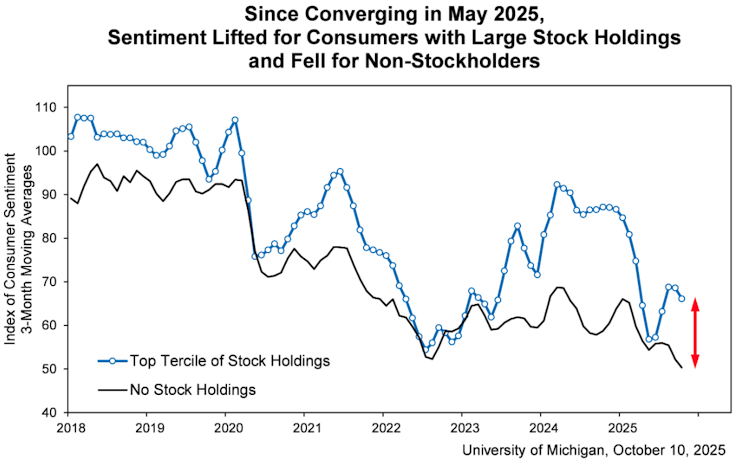
Pocketbook issues – high prices of goods, inflation and possible weakening in the labor market – are suppressing sentiment. Views of consumers across the country converged earlier in the year when the Trump administration’s tariffs were announced. But since then, higher-wealth and higher-income consumers have reported improved consumer sentiment. It is for lower-income Americans – those not owning stock – that sentiment hasn’t lifted since April.
In October, we also saw a slight decline in inflation expectations, but it remains relatively high – midway between where they were around a year ago and the highs of around the time of the tariff announcements in April and May.
Has the government shutdown affected consumer sentiment?
The government shutdown was in place for around half the time of the latest survey period, which ran from Sept. 23-Oct. 6, 2025. And so far, we are not seeing evidence that it is impacting consumer sentiment one way or another.
And that is not super-surprising. It is not that people don’t care about the shutdown, just that it hasn’t affected how they see the economy and their personal finances yet.
History shows that federal shutdowns do move the needle a little. In 2019, around 10% of people spontaneously mentioned the then-shutdown in the January survey. We saw a decline in sentiment in that month, but it did improve again the following month.
Looking back, we tend to see stronger reaction to shutdowns when there is a debt ceiling crisis attached. In 2013, for example, there was a decline in consumer sentiment coinciding with concerns over the debt ceiling being breached. But it did quickly rebound when the government opened again.
Whether or not we see a decline in sentiment because of the current shutdown depends on how long it lasts – and how consumers believe it will impact pocketbook issues, namely prices and job prospects.



















Comments are closed.