


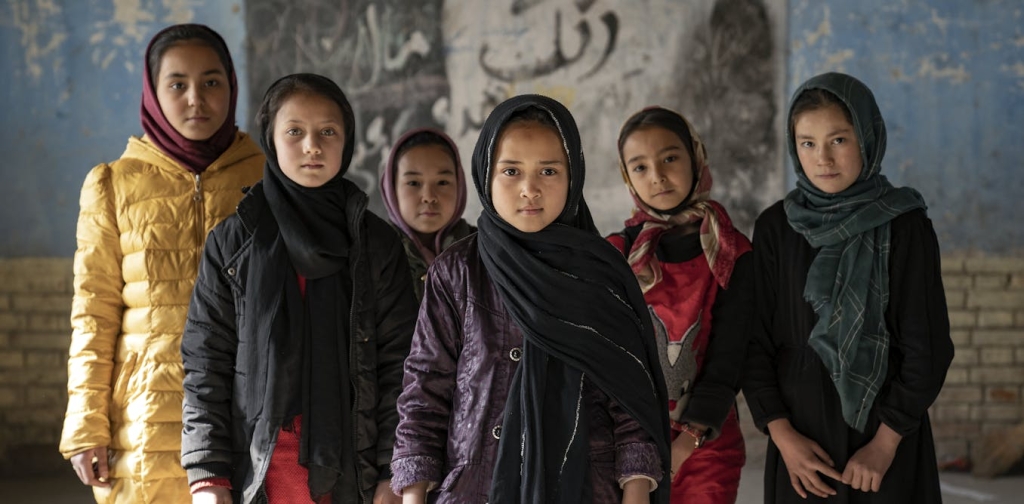

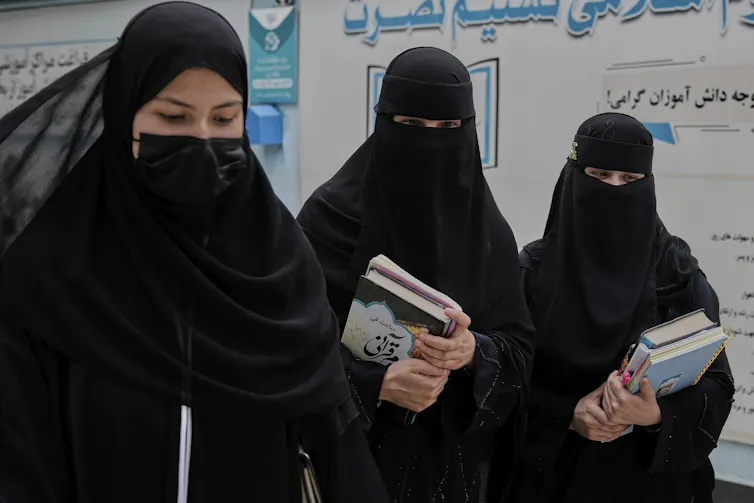
In August 2021, the Taliban recaptured Kabul and, within weeks, barred girls from attending school beyond Grade 6. The ban has not lifted.
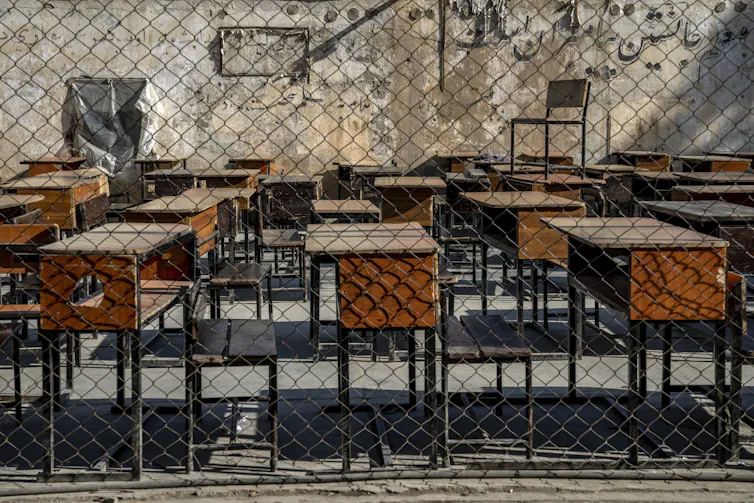
Afghanistan remains the only country in the world that formally bars girls and women from secondary and higher education. In the years since, Afghan women have also been banned from working across most sectors that once employed them, from the civil service to national and international aid organizations.

About 2.2 million adolescent girls have been barred from secondary school for nearly 1,800 days. A 2026 UNICEF analysis projects Afghanistan will lose up to 20,000 women teachers and 5,400 health-care workers by 2030, with the restrictions already costing the country an estimated $84 million US a year.
Since September 2025, Taliban forces have also barred Afghan women, including United Nations staff, from entering UN offices. In January 2026, women civil servants lost even the reduced pay they had received since 2021 for staying home.
I watched a version of this happen once before, as a young girl in 1996, the last time the Taliban took Kabul.
What strikes me most about this second ban isn’t that it happened again. It’s that the world’s failure this time isn’t due to a lack of awareness. Everyone knows what’s happening to Afghan girls. The failure is that knowing has not carried any real cost for the Taliban.
What Afghan women have built
Within days of the takeover, Afghan women were in the streets of Kabul chanting “Bread, Work, Freedom,” a demand they have kept making since, at real personal risk. The defining rallying cry calls for basic human rights — education and employment in the face of systemic erasure from public life.
Read more: Iranian women risk arrest: Daughters of the revolution
Groups of Afghan women have organized protests throughout that time, even as participants have described arrests, torture and killings in response — reactions so severe they’ve forced much of their resistance work underground.
As recently as February 2026, girls were back on the streets of Kabul, still demanding education. But where protest has become too dangerous, Afghan women have built something quieter instead: informal networks of underground schools, run out of homes, that teach girls who would otherwise have no access to a classroom at all.
None of this resistance is happening because it’s easy or safe. It’s happening because no one else has done it for them, and it has to be done.
Alongside protest and underground schooling, Afghan women’s organizations have also taken on documentation. As of June 2026, researchers at Georgetown University’s Institute for Women, Peace and Security counted 264 Taliban decrees affecting human rights since 2021, 166 of which specifically target women and girls.
International response falls short
The main channel for international engagement with the Taliban is the UN-led Doha process. There have been multiple rounds of talks with Taliban representatives since 2023 in pursuit of Afghanistan’s eventual reintegration into the international community — normalized diplomatic relations, formal recognition of the Taliban government and the country’s return to standard participation in international institutions and trade.
At the Taliban’s insistence, women and Afghan civil society groups have been excluded from the main talks, meeting separately and on the sidelines instead. Sima Samar, former chairperson of the Afghan Independent Human Rights Commission, has argued that by accepting the Taliban’s terms for participation, the UN risks indirectly legitimizing the very policies it says it opposes.
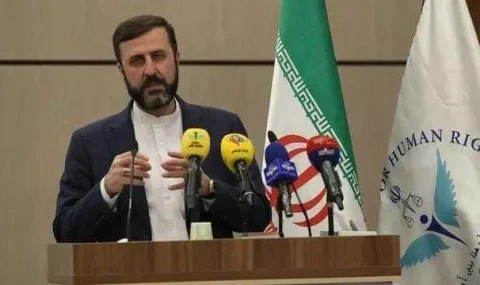
That risk is disputed within the UN itself. Georgette Gagnon, the UN’s Deputy Special Representative and Officer-in-Charge of the UN Assistance Mission in Afghanistan, argued the opposite case at that same session: that continued, principled but pragmatic engagement remains necessary even when progress is incremental.
That disagreement, playing out at the UN’s own podium, captures the trap Afghan women have been describing for years — statements of concern are issued regularly and they cost the Taliban nothing.
Global efforts
In September 2024, Australia, Canada, Germany and the Netherlands formally invoked Afghanistan’s obligations under CEDAW, the UN convention against discrimination against women that Afghanistan ratified in 2003. It is a genuinely significant initiative because it’s the first time any states have attempted to hold another accountable at the world’s highest court for gender discrimination.
But two years on, the case has still not reached the International Court of Justice (ICJ). Civil society’s own statement marking the initiative’s first anniversary has described it as an effort that may eventually culminate in an ICJ case, not one that has achieved it.
When the Netherlands and Canada pursued a similar case against Syria over torture, they moved through each stage without delay. Once negotiations stalled in 2022, they promptly requested arbitration. When Syria failed to engage within the required six-month window, they filed at the ICJ in 2023 and secured a binding order.
After invoking the same mechanism against Afghanistan, no equivalent milestone has been reached. Negotiations, if they have failed, have not visibly given way to a request for arbitration, and the case remains where it started.
Afghan women, and the states that made this commitment on their behalf, deserve the same procedural urgency that carried the Syria case through to a resolution.
The scale of what this inaction has allowed is well-documented.
Personal reflections
I recognize all of this because I lived a version of it once already.
In 1996, I was a young girl a few weeks from final exams when the Taliban took over Kabul. That night, with no electricity, we gathered around a radio and heard we were promoted to the next grade, but that schools were closing to girls until further notice.
At first, I didn’t understand what that meant. As a young student, I was excited about the cancellation of final exams, so I ran to tell my grandmother. Partway down a dark corridor, what it actually meant caught up with me: there would be no school next year. I sat down and cried.
But I was fortunate.
My parents moved my sister and me to Pakistan so we could keep studying, a decision many Afghan families could not afford. We could not either. It was my aunts and uncles living overseas who supported our studies.
Friends of mine were not able to finish school and, as far as I know, were married off instead. I went on to become the first woman to serve as a director, then deputy minister, then acting minister of mines and petroleum in the Afghan cabinet.
Those conditions changed for my generation. Nothing guarantees they will for this one — awareness alone will not accomplish that.
Afghan women have spent the last five years proving they have not accepted this ban as permanent. It is worth asking why the rest of the world has settled for so much less than that.











Comments are closed.