


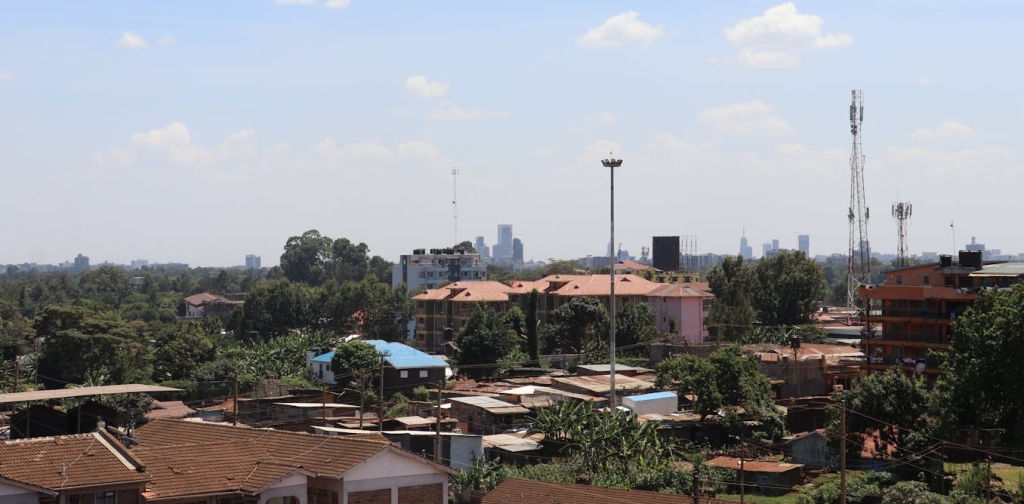

Nairobi’s transformation into a “world-class city” is both anticipated and celebrated in Kenya’s media. A new book, Peasants to Paupers: Land, Class and Kinship in Central Kenya, examines how the city’s expansion conceals profound social upheavals. These have root causes in the opportunities created by surging land values in rural areas, making it tempting for landowners to sell off their peasant plots. The author, economic and political anthropologist Peter Lockwood, offers a snapshot of his six-year book research project immersed in the fringes of the city.
What inspired your research focus on peri-urban Nairobi?
When I first visited a rural neighbourhood of smallholders in Kiambu county in December 2016, I could not have imagined it would lead to a long-term research stay, let alone a book! At the time, I was planning to carry out fieldwork for my PhD in Nyeri county, about 150km further into the central Kenya region. I wanted to research the lives of informal sector workers in Nyeri. To do this, I needed to learn the Kikuyu language.



My language teacher offered to place me with some of his family close to Nairobi in Kiambu, to learn by immersion. After moving onto their smallholding I realised that this was a much more interesting place than I could have imagined, so I shifted my research focus to Kiambu.
Kiambu is an important place to study because its rapid transformation from rural periphery into urban sprawl encompasses many of the inequalities and contradictions of Kenya today. If you travel out of northern Nairobi, you pass leafy suburbs and towering shopping malls before arriving among the rapidly growing townships of Kiambu. These are bustling places of commercial activity, where vehicles are constantly ferrying commuters, mechanics are working in the open, youth are chewing khat leaves in the shade.
If you travel even further north, this urban landscape soon gives way to the smallholdings and tea plantations beyond the old colonial boundary (raini in the local language). This geography speaks to the legacies of land dispossession under the British, and how it created a demographic of poor farmers, forced to work for cash in Nairobi.
In many ways, my book is about the encounter between skyrocketing land prices caused by Nairobi’s expansion and a terrain of land poverty that has its roots in British colonial rule, something that was never rectified after independence. The smallholdings allocated to Kiambu farmers by the British in the 1950s, which measured up to 2 hectares on average, have today become meagre plots of one hectare, if that.
This is because of Kikuyu inheritance practices, which have caused these plots to be subdivided even further across two or three generations since the 1950s. On the one hand, Kiambu’s smallholders are now approaching what we might call, after social anthropologist Tania Murray Li, “the end of the land”. At the same time, these smallholdings are becoming immensely valuable. Nairobi’s approach is driving their price upward, sowing tensions over them within families.
What did you seek to investigate and how?
After I settled in on my host’s smallholding in January 2017, the book’s topics emerged from the research context and the relationships I made through the family. People were talking about land sales, and the importance of holding onto “ancestral” land inherited from one’s parents. Some people in the neighbourhood were selling their smallholdings for large sums of money, creating tensions within their families over who got to keep these enormous cash windfalls.
In contrast, senior men from the area would stress the importance of holding on to this land. But unfolding events also shaped my perspective. The book is based on a long period of research, carried out from 2017 to 2022. By 2022, the same senior men who once preached land retention had begun to sell. I think this long-term perspective on the changing relationship between land markets and economic practice is a strength of the book.
Other topics include the gendered conflicts over land that this scenario is creating, where male inheritors try to “freeze out” their sisters from receiving land when parents die.
A central arc of the book is told through the predicament of a man I anonymise as “Mwaura”, the then 19-year-old son of my host family. Through following his story across the years of research, I examine how young people struggle to make good lives despite limited prospects for finding regular, decently paid work.
What were your main findings?
I could see how the very ideas that senior Kiambu men were clinging onto – of land and family – were being hollowed out by the opportunity to “get rich” from selling land.
One of the key arguments of the book is that precarious smallholders were not only selling out of a lack of options, but out of a sense of abandon, something I elaborate on in a recent article. I argue that land sales are informed by a profound hopelessness about the future – a sense among working-age Kikuyu men that working for low, piecemeal wages is not worth the trouble, and it is better to enjoy life in the present.
While their fathers sell their land, younger men in their 20s have lost belief that hard work will take them where they want to go in a setting where work simply does not pay. The idea of jipange (Kiswahili for “planning for oneself”) and lifting oneself out of poverty is often encountered in conservative discourse in Kenya. The book looks at how young men live with this “bootstraps” ideology while managing the hopelessness that comes from being land-poor and underemployed.
How do these findings matter?
Kiambu is on the periphery of a growing city, one where urbanisation is experienced through growing tensions within families over precious yet meagre plots of land. Human geographers have done much to explain the economics of urbanisation, but anthropologists can investigate the kinds of social tensions created by heating land markets.
The book’s attention to downward social mobility among young Kenyans is equally important. We have seen in recent years enormous youth protest in Kenya, driven by a rising cost of living and a profound sense of discontent with the country’s political system. Many of my young interlocutors joined the protests of 2024.
Kenyan graduates are struggling to find good jobs, while informal sector workers are struggling harder than ever. This book’s attention to hopelessness and alcoholism among Kiambu youth provides a stark warning. State intervention is desperately needed. As the late anthropologist James Ferguson argued, a universal basic income may be the only way to ameliorate these conditions but there is much to do politically to arrive at that.
I also believe Kenya needs a renewed discussion about the immense inequalities in access to land. It was no wonder to me that William Ruto’s so-called “Hustler Nation” presidential campaign in 2022 directed ire towards Kenya’s land-rich “dynasties” like the Kenyattas.























Comments are closed.