


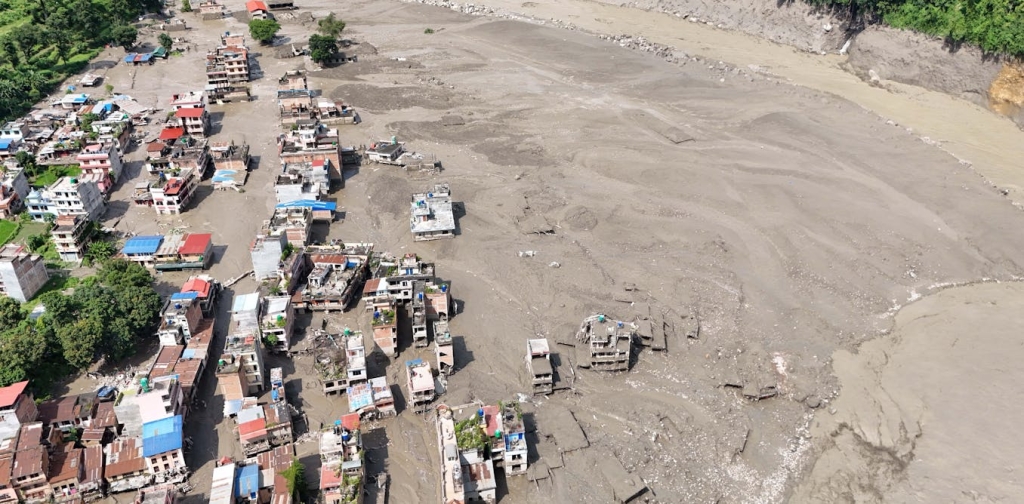

The cause of the huge floods and debris flow on the border between Nepal and Tibet, which has caused hundreds of deaths, appears to have been an ice avalanche – the result of a huge piece of a glacier collapsing and cascading down the mountain more than 1,000 metres to the valley floor. The Conversation asked Jonathan Bamber, a professor of glaciology at the University of Bristol, about the risks of glaciers melting faster than ever.
Is this region particularly at risk from glacier melt?
The greater Himalayan region, called High Mountains Asia (HMA), is often referred to as the third pole because it contains more glacier ice than anywhere outside the polar regions. Many of those glaciers lie along the northern border of Nepal and China, forming an east-west arc of the Himalayas. Tibet is an autonomous region of China.



Eight of the 14 peaks above 8,000m lie in Nepal. Its northern half is extremely mountainous and precipitous, making it susceptible to landslides, rockfalls and glacier-related hazards such as glacial lake outburst floods and ice cliff collapses. When glaciers flow over steep bedrock slopes, the ice fractures into what are called seracs: ice cliffs that are inherently unstable and break off from time to time.
Are glaciers melting more quickly now?
It should come as no surprise that in a warming world, ice melts faster. Since the start of the industrial revolution, typically taken to be 1850, the world has warmed by 1.4°C.

However, that warming is a global average and there are large regional variations. The Arctic has warmed by more than double that amount, and the Himalayan region has also warmed by more than the global average . The rate of warming has accelerated significantly over about the last four decades. As a consequence, glaciers around the world have been melting faster.
The most comprehensive assessment of glacier melting (called glacier mass balance) combines satellite observations with ground-based data to reconstruct melt rates from 1976-2024. They find that the rate is greater for the most recent decade compared with the long-term mean for every region except Iceland. For the HMA, the increase is about 25%. For the European Alps, it is more than double.
What are the consequences?
When glaciers melt, the primary consequence is the release of meltwater that flows, seasonally, into meltstreams which then feed into larger river systems. However, the glaciers lie on permafrost: ground that is permanently frozen to some depth. As this permafrost warms and thaws, the rock, ice and mud become unstable, resulting in rockfalls and destabilisation of ice in steep terrain.
In the case of the Nepal-Tibet disaster, imagine a block of ice some 600m wide and about 50m thick collapsing. That represents around half a million tons of ice crashing into the valley.
Serac collapses are more common during warmer periods, when surface melting weakens the ice. That is why mountaineers try to pass serac barriers at night or in the early morning, before the sun has warmed them.
A further consequence of glacier melt is the formation of lakes dammed by ice or moraines (debris left behind by glacier melt) at the glacier front. These lakes form glacial lake outburst floods that occur when the dam fails. Many trails in Nepal and India carry warning signs for these.
What else should nations be doing?
Increased glacier melting is one of many consequences of living in a warming world. The unprecedented wildfires across Spain and France, the heatwaves across Europe, more intense and common droughts are all consequences of a climate system that is out of equilibrium. The UK declared a climate emergency in 2019, as has the EU and a number of other states.
Progress has been made in reducing our dependency on carbon-intensive fossil fuels, but emissions are still increasing. One definition of an emergency is an existential threat that requires immediate action. Not enough has been done to tackle this yet, despite the encouraging words from many governments and states.
We have the know-how and technology to address the climate crisis. What is lacking is the political will and vision. If this is not forthcoming, melting glaciers are just one aspect of this human-made climate crisis, and the consequences will be devastating.




















Comments are closed.