


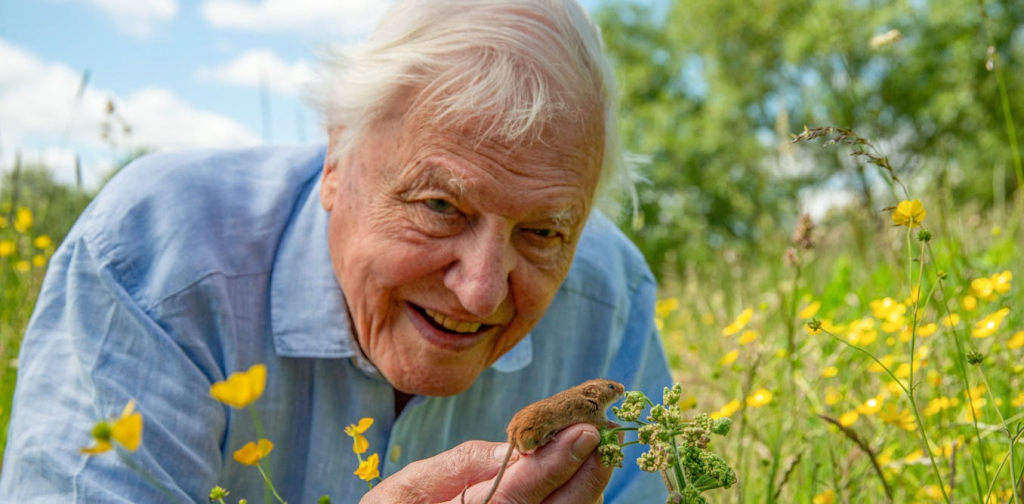

Sir David Attenborough has mastered the craft of storytelling. He has undoubtedly inspired generations of people around the globe to love and care for the natural world. And in doing so, he’s become one of the most recognisable – and most trusted – faces on our screens.
Now, he’s celebrating his 100th birthday and a lifetime of wildlife filmmaking. As part of The Conversation UK’s climate storytelling strand, four experts critique how he has influenced everything from conservation and documentary production to the communication of the biggest story of all – climate change.


Scientific insight
Ben Garrod, science broadcaster and Professor of Evolutionary Biology and Science Engagement at the University of East Anglia, has presented alongside Attenborough in several landmark documentaries. Here he reflects on Attenborough’s passion for furthering our scientific understanding of the natural world.
I once sat on a remote beach with Attenborough, near the very tip of South America. I can still clearly remember the warmth of the rounded, flat stones beneath me. We sat only a metre or so apart. We’d just spent the morning filming the excavation of the largest dinosaur ever discovered.
Over lunch, Attenborough had recalled we were close to a beach he’d filmed at years before, where grey whale mothers drew in close to shore with their calves to rub against the stone in the shallows to exfoliate their skin. As luck would have it, it was the perfect time of year and before long, there we were watching a mother and calf just a few metres offshore.

Facts and figures bubbled out of Attenborough excitedly, not at all like the calm and more measured way we’re all so used to. For those few minutes, he was childlike in his wonder and excitement at the scene in front of us and I marvelled at how he has not only maintained that love for the natural world for so long but how he has always so passionately shared it with the rest of us.
For a century now, Attenborough’s life has been intimately interwoven not only with humanity’s growing scientific understanding of the natural world but also its accelerating loss. Spanning over 70 years, Attenborough has been our most trusted and prolific mediator between scientific knowledge and the public.
His early landmark BBC series Life on Earth: A Natural History (1979) did something few academic texts ever could. It made the complexity of evolutionary biology accessible. Across his work, natural selection, adaptation, ecology and behaviour are not presented as intangible concepts but as organic processes shaping form, function and ultimately survival across the natural world.
In doing so, Attenborough helped normalise evolutionary thinking for hundreds of millions of viewers worldwide, embedding complex scientific principles into popular culture, right in our living rooms.
Central to his work has been a commitment to scientific accuracy. Attenborough’s programmes have been developed in close collaboration with academics and field researchers, ensuring narratives about animal behaviour, ecosystems and biodiversity reflect current evidence.
This relationship between science and storytelling has been crucial because rather than dumbing down complexity, Attenborough’s “everyday” approach demonstrates audiences can engage with content that could all too easily be written off as belonging to more academic and scientifically literate viewers.

The Insights section is committed to high-quality longform journalism. Our editors work with academics from many different backgrounds who are tackling a wide range of societal and scientific challenges.
Yet the tone of his work has changed. His early documentaries were characterised by a sense of abundance and discovery. Over time, as scientific evidence for biodiversity loss and climate change mounted, his work shifted accordingly. More recently, his documentaries increasingly shine a light on human impact, habitat destruction and extinction risk. This evolution of change in his own tone mirrors the science itself, highlighting Attenborough’s credibility as a communicator willing to adjust his message as the evidence demands.
Attenborough’s contribution to conservation has not come through activism alone. Research shows that an emotional connection to nature precedes any behavioural change. Attenborough has actively helped build the public conditions necessary for conservation policy and action by fostering wonder, curiosity and empathy for the natural world. His influence can be traced in the generations of scientists, conservationists and educators who cite his programmes as formative experiences.
For many, particularly those without access to wild spaces, Attenborough’s work provides an opportunity and gateway to encounter wild animals and remote ecosystems but also local habitats, helping give us all access to the wonder he perceives in the world around him.

As he turns 100, Attenborough’s legacy is surely inseparable from the global environmental challenges we now face. He has helped society understand not only how life evolved, but, more importantly, why it matters that we protect it now. In an era defined by ecological crisis, his work reminds us that scientific knowledge is most powerful when it connects people to the living world so strongly, it compels us to care enough to protect it, so that we might carry on his legacy and, just like him, act as stewards.
Natural history filmmaking
Jean-Baptiste Gouyon, Professor of Science Communication at the UCL Department of Science and Technology Studies, explains the impact Attenborough has had on natural history television.
In the early 1950s, television was taking off across Britain, but the BBC was still finding its visual voice. Its controller, Cecil McGivern, warned in June 1952 that there was “far too much emphasis…on the spoken word and far too little on the thing seen”. Most early television producers had come from BBC radio and initially made programmes that resembled radio with pictures.
Into this world stepped a young David Attenborough, unencumbered by a career in sound, ready to invent a new language for television and, in the process, reshape natural history filmmaking. At 26, he earned his first natural history credit as producer of The Coelacanth (1953), a 20-minute programme prompted by the capture of a live coelacanth “living fossil” fish off Madagascar.

Eschewing sensationalism, Attenborough tied the story to Darwin’s theory of evolution. This use of wildlife programmes to communicate scientific ideas became his trademark.
The programme blended prerecorded footage with live studio sequences featuring evolutionary biologist Julian Huxley, who used the coelacanth to illustrate life’s transition from sea to land.
With the Zoo Quest series (1954), Attenborough began reshaping wildlife television. For these programmes, he travelled to exotic places with staff from the London Zoo to capture animals for the collection. Each episode relied on prerecorded film linked by live studio sequences, allowing tighter narrative control. The hero in the films, shot by Charles Lagus, was Attenborough himself, who back in London also presented the studio sequences. By assuming all the roles of hero, producer, narrator and presenter, Attenborough became the central performer in the story.
From then on, Attenborough’s fluid on-screen performances gained him much acclaim. A very hard worker, he put much effort in producing highly detailed scripts, which left little to chance. Indeed, by the early 1960s, he had all but lost faith in live television, writing to a BBC colleague:
To begin with I got a tremendous kick out of the excitement of putting out programmes live. But it wore off after a bit and really, except for challenging interviews with lots of ‘immediacy’, I’m for film or some other sort of controlled recording process every time. It is so maddening to miss an effect because of some small mechanical hitch, as so often happens live.
Consistently high ratings encouraged others to emulate his method, and live formats became less fashionable. Film-based production also allowed programmes to be stockpiled, repeated and sold, supporting a more sustainable business model.
After Attenborough moved into BBC management in 1965, his goal was to turn natural history television into a science communication genre. He argued that it was “important” to move away from programmes that simply showcased the beauty of nature and instead engage viewers “to examine in a serious and critical way new trends and ideas in zoology”. Returning to hands-on programme-making a decade later, he embedded this vision in his magnum opus, Life on Earth (1979).
In the early 1950s, when Attenborough joined the BBC, natural history television had been mostly conceived of as a specialist genre catering for amateur naturalists to share in the aesthetic and emotional enjoyment of nature. By the 1980s, he had helped transform it into one of the most popular genres of TV programming and a powerful conduit for science communication. This influence continues in his later work, including Planet Earth II, Blue Planet II and Our Planet, which combine cinematic storytelling with urgent environmental themes.
As he celebrates his 100th birthday, Attenborough’s legacy endures, defining natural history television as one of the most powerful forms of science communication and inspiring generations to look at the living world with wonder and understanding.
Communicating research
Saffron O’Neill researches climate communication and public engagement. She explains the ways Attenborough has shaped climate communication techniques across the world.
Attenborough is one of the few voices on climate change that almost everyone is willing to listen to. Over seven decades, his work has transformed how scientific knowledge is communicated, combining advances in broadcasting with powerful storytelling.
Research by Climate Outreach in 2020 found that Attenborough is trusted by people across the political spectrum, from “progressive activists” to “backbone conservatives”. More than 95% of people surveyed recognise him and his programmes reach an exceptionally diverse audience, even in today’s competitive media landscape.
My colleague, PhD researcher Kate Holden, is exploring how young people engage with marine sustainability through online video, from traditional nature documentaries to YouTubers like MrBeast. Attenborough still stands out as an expert young people take seriously.
Part of his appeal lies in his willingness to meet audiences where they are, adapting to changing media habits. He joined Instagram in 2020 (breaking the Guinness World Record for the fastest time to reach one million followers) and has collaborated with Netflix to stream shows.
Attenborough has shown the power of the media to shape how we see the natural world. Although there is little evidence for the appealing notion that watching a documentary like Blue Planet II directly drives behavioural change (such as reducing peoples’ plastic consumption), nature documentaries can certainly drive both public and policy interest via increased media attention.
Engaging the public on climate and nature requires moving beyond a simple notion of “getting the message across” and towards recognising the complexity and power of storytelling. For this, Attenborough’s success is an invaluable model.
His programmes combine top-class storytelling with pioneering technology. The visual appeal of his richly crafted documentaries is matched by compelling stories about little-known species. His work forms a substantial archive of success – many of the most popular TV programmes of all time are his nature documentaries.
In a highly cited paper from 2007, a team led by environmental social scientist Irene Lorenzoni defined engagement with climate change. They claimed that: “It is not enough for people to know about climate change in order to be engaged; they also need to care about it, be motivated and able to take action.”

Early Attenborough programming focused on increasing peoples’ knowledge about the natural world and as part of this, implicitly providing a reason to care about it. Increasingly though, he has moved to a more explicit stance about the climate emergency and our moral and ethical duty to act. An analysis of Attenborough’s use of language carried out in the late 2010s demonstrates this. It shows how he now uses emotional appeals to action. During an appearance on the Outrage + Optimism podcast he said: “we have an obligation on our shoulders and it would be to our deep eternal shame if we fail to acknowledge that.”
When a communicator like activist Greta Thunberg makes an appeal to morality, it can polarise audiences. Attenborough’s broad popularity makes his message reach wider audiences. His trustworthiness, storytelling mastery and innovative use of technology helps explain why he continues to have such a lasting impact on science and environmental communication, seven decades after his first broadcast.
Speaking up about climate change
Chloe Brimicombe, Climate Scientist at the University of Oxford, explores whether Attenborough’s on-screen attention to the climate crisis could have started earlier.
In his early documentaries, Attenborough focused on the wonder of the natural world.
He did go on to warn of the dangers of how humans were damaging the environment, but much of his early messaging reflected the belief that climate change can be linked to overpopulation. This is not demonstrated by the evidence. In fact, the richest in society are the most polluting but the smallest population group.

However, in recent years his beliefs changed with the science and more of his films started to cover climate change directly. For example, Climate Change: The Facts in 2019 and Perfect Planet 2021.
Attenborough’s works are part of the culture of the UK and the world. In my own life Attenborough’s works have always been present. During my undergraduate degree at Aberystwyth University, I was shown Frozen Planet in a lecture about glaciers and ice sheets because my lecturer was featured in the series. That moment stuck with me as I started my career as a climate scientist.
During my PhD in environmental sciences at the University of Reading, my fellow researchers were all big fans of Attenborough and of what could be achieved through the power of documentary film-making. In 2025, I was lucky enough to attend the film premier of Ocean with David Attenborough, something I consider a once-in-a-lifetime opportunity.
As well as inspiring audiences with awe and wonder, documentaries can be an important way to communicate what is happening to our changing climate. They reach audiences that might not otherwise engage on the subject. Documentary making has drawn critique for focusing on a producer’s interest instead of capturing the scientific background behind a certain issue.
This has led to schemes such as the Wellcome Trust Public Engagement Scheme being setup to help bring scientists and documentary makers together.

In Attenborough’s A Life on Our Planet (2020), he talks about the changes he has seen in the natural environment and his concern for the future of the planet. In the film Ocean with David Attenborough, the 2025 premier took place just before the UN’s ocean summit in Nice, France. This helped lead to real policy discussions and changes. That includes supporting the global ocean’s treaty, a landmark international agreement which creates a network of protected ocean sanctuaries.
Attenborough may have been late in communicating specifically on climate change. But, in recent years he has changed to being a strong advocate. Now, it’s time to make sure that message is heard and acted upon so that the world’s wonders remain for many generations to come.
The climate crisis has a communications problem. How do we tell stories that move people – not just to fear the future, but to imagine and build a better one? This article is part of Climate Storytelling, a series exploring how arts and science can join forces to spark understanding, hope and action.


















Comments are closed.