


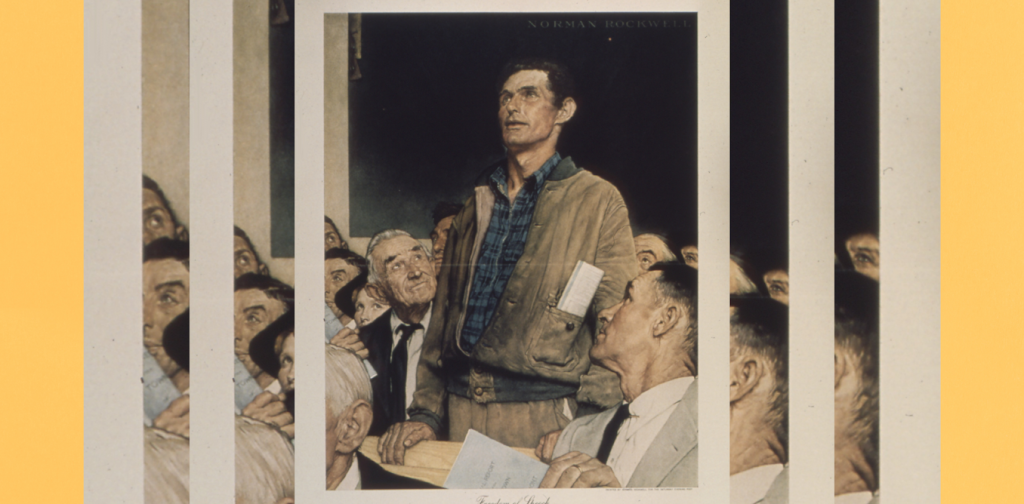

In the early 20th century, American anthropologist Franz Boas argued that being free just means being fully in harmony with your culture. The Inuit with whom he had done fieldwork saw themselves as incomparably free, even though he saw them as constrained by traditional rules.
But the opposite was also true: they saw his (freely chosen) decision to live among them as a strange cultural compulsion. For Boas, there is no absolute freedom: “We are free in so far as the limitations of our culture do not oppress us; we are unfree when we become conscious of these limitations and are no longer willing to submit to them.”



This idea sheds light on a puzzling aspect of free speech debates. Speech is never truly free: we are limited by grammar, context, politeness, style and genre. Controversies arise not because there are limits to what you can say, but because limits feel wrong. Limitations that follow your own inclinations feel sensible and natural – merely a question of hitting the right tone, avoiding some words in order to be convincing, impressive, civil or reasonable. Even free speech absolutists are polite to their mothers.
Cultures of free speech
This vision of free speech is disturbing, though. As Boas’s contemporary Bronislaw Malinowski pointed out – if freedom is just alignment on your culture, then a fully indoctrinated citizen of a totalitarian state would be entirely free.
But none of us live in just one culture. Our commitments are multiple, cross-cutting and conflicting, and there are dissidents even in totalitarian regimes. Dissidents are not outside culture, however. Their desire for free speech may reflect misalignment with official truth, but it is also rooted in other cultural and historical commitments and values.
In my new book, I argue that our free speech wars could be seen as a struggle between three main visions, each with its own notion of freedom.
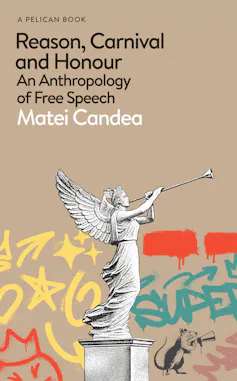
“Reason” envisions the rational exchange of opinions within the law. “Carnival” values free speech as a radical attack on established laws and orthodoxies. “Honour” is concerned with the bravery and honesty of truth-speakers doing their duty.
Carnival and honour
The real problem with Boas’s view is that it assumes freedom is just one kind of thing – being in line with your culture. His critics often think it is the opposite: thinking outside the box and being conscious of yourself as an individual rather than following the herd.
This idea is central to certain free speech stances: the more shocking or unconventional, the more one is a genuine free speaker. When French students took to the streets in May 1968, their most famous graffiti read “it is forbidden to forbid”. But this freedom as the absence of constraint is itself a cultural vision, with specific historical roots. It echoes medieval carnival where there was a suspension of all rules and the inversion of all propriety.
Yet when people break cultural rules, it is often in pursuit of another cultural ideal. The 17th century Quakers, for instance, were famously bold and unconventional speakers, often insulted and beaten for refusing to call people “sir” or observe common courtesies. Committed to speaking purely and truly in the eyes of God, they rejected deference as insincere flattery and worldly pride. They broke with propriety, but their freedom of speech was the very opposite of “it is forbidden to forbid”. Instead, it entailed saying less, not more, and was felt as an obligation.
Religious freedom-as-obligation might sound strange to secular ears, yet free speech is often experienced precisely in this way. Think of whistleblowers, martyrs and truth-speakers who might say, like Martin Luther did, “here I stand, I can do no other.” This is freedom as an honourable commitment to the truth.
Honour and reason
It also echoes the ancient Greek figure of the parrhesiast – the brave truth-speaker, like the orator speaking to an angry crowd. Parrhesia (truth telling) requires personal courage and a certain disrespect for conventions.
But the ancient Greeks also had isegoria – an equal right to speaking in public, a matter of law and formal equality. Isegoria required not individual courage but collective rules, civility and reasonable turn-taking.
Historian Teresa Bejan has argued this distinction echoes in contemporary no-platforming debates: no-platformed speakers see themselves as courageously saying what no one wants to hear; while no-platformers claim to equalise access to public speech by giving the marginalised their turn.
But we could also read it the other way: no-platformers are sometimes seen as bravely speaking out against the system, while critics of no-platforming wish that everyone would be a bit more civil and reasonable and listen to people they disagree with.
Counting to three
None of these modes of free speech are absolute. Reason implies standards of civility some speakers fall foul of. Carnival rarely gives voice to the enemy, to those deemed “powerful” or to the “establishment”. Honour is also the language of reparation, insult and offence.
Reason, carnival and honour are not mutually exclusive cultures. Rather they are “modes” of free speech – like modes of transport, each gets us there differently, with different costs and implications.
In a debate on free speech which is so often binary and polarised, counting to three can help us see that the hardest choices are not always between less and more free speech – they are about the kind of freedom we are reaching for and what limits it comes with.
This article features references to books that have been included for editorial reasons, and may contain links to bookshop.org. If you click on one of the links and go on to buy something, The Conversation UK may earn a commission.





















Comments are closed.