


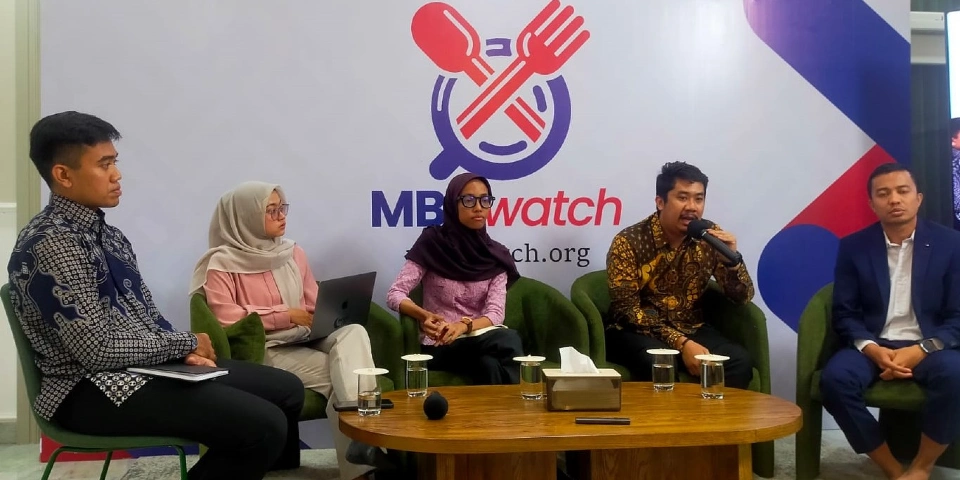

Recently, Media Wahyudi Askar, Director of Fiscal Policy at the Center of Economic and Law Studies (Celios), has been feeling uneasy. This is because almost every day, cases of poisoning due to consuming Free Nutritious Meals (MBG) are reported in the mass media.
A similar sentiment is shared by Dzatmiati Sari, a campaigner for Transparency International Indonesia (TII). As a woman and a mother with children, she often feels anxious whenever she sees schoolchildren suffering from MBG poisoning.



“I have children, and so do other mothers out there. Seeing children poisoned by MBG is heartbreaking,” she said.
Moreover, according to Dzatmiati, there have actually been many studies related to MBG conducted by a number of civil society organizations, published both before and after MBG was implemented. For example, a study by TII that examines the risk of corruption in the MBG program.
Read More: MBG Must Be Stopped: Poisoning Scandals, Gender Bias, And The Shadow Of The Military
Similarly, there are three studies conducted by Celios. One of them discusses alternative ideas with a specific target orientation. By channeling MBG only to those in need (infants, pregnant women, children suffering from malnutrition, and those from vulnerable families), there will be budget savings.
| Number | Category | Number of children (1) | Budget per day (2) = (1)* Rp 10000 | Budget per year (3) = (2)*43 weeks* 5 days | Budget per year + operational (4) = (3)* 4/3 |
| A | Estimated daily cost for all children 6-18 years | 58,83 million | 588,32 billion | 126,49 t trillion | 168,65 trillion |
| B | Number of pregnant women | 4,8 million | 48,00 billion | 10,32 trillion | 13,72 trillion |
| C | Daily cost estimate for children who stay in malnutrition household | 35,66 million | 356,56 billion | 76,66 trillion | 102,21 trillion |
| D | Estimated daily cost for all children in 3T areas | 2,21 million | 22,13 billion | 4,76 trillion | 6,34 trillion |
| E | Daily cost estimate for children with malnutrition in 3T areas | 1,53 million | 15,30 billion | 3,29 trillion | 4,39 trillion |
| F = C+D – E | Demographic data | 36,33 million | 363,39 billion | 78,13 trillion | 104,17 trillion |
| G = F+B | Target + pregnant women | 41,13 million | 411,39 billion | 88,45 trillion | 117,93 trillion |
| H= A-F | Allocation from MBG for all children (inappropriate subsidy) | 64,48 trillion | |||
| I | Efficiency budget of the President’s instruction (Presidential instruction -Inpres) No 1/ 2025 | 306,7 trillion | |||
| J | Allocation of the 2025 state budget for MBG | 71 trillion | |||
| K= G – J | Additional allocation for MBG | 46,93 trillion | |||
| L= I-K | Decree of the President No 1/2025 | 259,76 trillion | |||
MBG program funding projections. Source: Celios Research Report, February 10, 2025.
On the other hand, Media added that when the MBG program misses its target, it will sacrifice other sectors. Such as the education sector, because part of the MBG budget is taken from the education budget. The implication is that several campuses have already experienced a reduction in scholarship allocations for students.
“So there is a trade-off between social protection programs, which have even led to a 50 percent reduction in scholarships at universities. Added to this are problems of inefficiency in distribution and vulnerability to corruption. We have always said that MBG should be managed by the community, by schools, or by the smallest entities in society, because they are the ones who know the most about student health,” said Media.
However, the government has not responded to the solutions proposed by civil society.
“Sometimes we reach a point where we think, ‘Oh my goodness, this is what it means to be a citizen of Indonesia. We work so hard, and then we see another incident (of poisoning) on social media,’” said Dzatmiati.
Read More: The Banality Of State Violence, We Urgently Need Police Reform
Driven by the same concern, Celios, along with TII, Lapor Sehat, LBH Jakarta, Unitrendt, and Bareng Warga, agreed to create an MBG monitoring platform. The platform, named MBG Watch, is intended as a citizen movement to monitor and report on MBG as a substantial and meaningful evaluation database.
Even so, Media admitted that feelings of pessimism still lingered in her mind. After all, there was already a lot of data on students who had been poisoned, so what else was there? She kept asking her team this reflective question.
“By analyzing this data, are we on the right track? What if this doesn’t change anything?” said Media.
The media and its team collected data on MBG poisoning cases from the mass media. The data was then processed and analyzed daily. As of October 7, 2025, Celios recorded 9,413 victims of MBG poisoning. The available data shows an anomaly in July 2025. In that month, SPPG was forced to operate even though it was not yet ready to distribute MBG.
Even the data for October, despite it being only the 7th, already shows the number of victims reaching half of September’s total.
“If this is not stopped, it will likely continue to grow exponentially in the future. I think the big question for all of us is, what can we do? Well, this is the question we continue to seek answers to in civil society organizations,” explained Media.
Read More: From Obligation to Right: Rethinking “Sex as Duty” for Muslimah
Media admitted that his pessimism gradually faded as his friends in the movement continued to ignite his enthusiasm.
“Then we were encouraged by many friends in the movement. It’s time for us to divide up the tasks. Some are working at the grassroots level, advocating on the ground. Some are demonstrating in the streets. And some, with their knowledge of health and statistics, are also making the same efforts,” he said.
“Finally, we met, we talked, and in just three weeks we were able to complete the MBG Watch. So this is a collaboration with our friends in IT, economists, statisticians, corruption experts, and health experts,” he explained.
Irma Hidayana from Lapor Sehat explained that she learned from the Lapor Covid platform, which she founded and runs, that people who report must have a guarantee that their reports will be followed up. So there are benefits to be gained from reporting.
On the MBG Watch platform, reports submitted by the public will be followed up by forwarding them to the relevant agencies and demanding their resolution.
“We have had lengthy discussions with our initiator friends and what we can do. When the reports come in, we have to submit them to the relevant parties. Later, we will seek the appropriate authority in accordance with procedures and regulations,” she explained.
Read More: Indonesia’s Deadly Protests: Economic Chaos and Political Frustration
Irma did not deny that so far the media has reported extensively on MBG and the public has been vocal on social media about it. However, she believes that a monitoring platform such as MBG Watch is still necessary.
“We have been this vocal and there has been no change. So I think we shouldn’t tire ourselves out, let’s get even louder, even noisier, through any media. It can be through social media or friends in the mass media, please cover it as often as possible, and in accordance with what is happening on the ground, no matter how bad the situation is,” she explained.
“From an epidemiological perspective on disease spread, if we don’t get the actual data on the ground, then what is called data-driven policy, or evidence-based policy, will not solve the problem,” she added.
Learning from previous events, Irma explained that the data possessed by the government is usually sorted data. This means that it is data that they want to present.
However, data-driven or evidence-based policy requires data that reflects the situation on the ground. Based on this data, epidemiologists and biostatisticians can obtain figures that are close to reality, which can then be formulated and used to change or improve the morbidity rate due to toxic diarrhea. Ultimately, this could lead to the termination or evaluation and improvement of MBG.
Read More: Sexism in Student Arrests and Maternal Activism Mothers Defend Their Children’s Struggles
“We need to gather these figures from firsthand sources or primary data. But we can’t do it alone, so we need our friends to keep making noise,” said Irma.
From a public health perspective, Irma emphasized that the primary data we gather ourselves is extremely valuable as a basis for communicating the situation on the ground in order to change public policy.
Civil Society Rejects MBG
Widespread cases of MBG poisoning have prompted civil society to organize and stage protests demanding the termination of the MBG program. This was the case in Jakarta on October 1, 2025.
The community members of the Coalition Against MBG have declared their opposition to MBG. The program, which the government claims is a solution to stunting, has instead become a source of serious problems. Thousands of children suffered from mass poisoning between January and September 2025.
The Coalition assesses that the MBG program has proven to fail in fulfilling children’s rights to nutritious, healthy, and safe food. Instead of addressing nutritional issues, the MBG program has been managed in a centralized and militaristic manner, lacking transparency, and prone to rent-seeking practices. Therefore, the Coalition urges the government to halt this project and immediately return the responsibility for children’s nutrition to communities and local governments.
A similar action was held by women who are members of Suara Ibu Indonesia Yogyakarta (Indonesian Mothers’ Voice) through an urgent appeal to the government to stop the MBG program. The action was held at the UGM Roundabout in Yogyakarta on Friday (9/26/25).
Read More: Sexism in Student Arrests and Maternal Activism Mothers Defend Their Children’s Struggles
Suara Ibu Indonesia stated that the MBG program had claimed 7,119 lives due to poisoning as of September 25, 2025. The mothers and women banged pots as a sign of concern and to sound the alarm about a program that they considered chaotic and forced, even militaristic.
They demanded the cessation of the MBG program and called on the government to evaluate it. A pregnant woman participating in the protest also delivered a speech. Additionally, the protest featured performances by artists expressing their views through artistic performances.
The Indonesian Women’s Alliance (API) also voiced demands for the MBG to be stopped on Tuesday (7/10/25). API consists of more than 30 organizations comprising women, workers, people with disabilities, students, LGBTIQ+, journalists, human rights defenders, and pro-democracy activists.
API believes that the program, which is supposed to guarantee children’s rights to nutrition, health, and welfare, actually poses a serious danger. This is due to weak planning, supervision, and implementation standards in the field.
“Even though President Prabowo has summoned a number of ministers and the government has issued a Circular Letter on Accelerating the Issuance of Hygiene and Sanitation Certificates for SPPG under the MBG Program, we maintain that the MBG Program must be stopped, not improved,” said Dian Septi in a release received by Konde.co.
Read More: Period Pain for Women is Real, How to Deal With It?
API also assesses that the MBG policy is too forced and seems to be rushed into implementation without adequate infrastructure, supporting personnel, and quality control systems.
“As a result, children who should be protected have instead become victims of a reckless policy. Children have also had their right to learn safely and comfortably, as they normally would, taken away,” added Dian.
The API highlighted that the MBG menu was far from being nutritious. Instead of providing nutritious local food, the MBG provided processed foods such as burgers and spaghetti, which were far from being healthy and nutritious. In addition, the MBG packages also contained foods that were low in nutrition and high in sugar, such as dry foods, including biscuits.
Another issue highlighted by API is the lack of coordination between MBG implementers and local government agencies. As a result, when food poisoning strikes, local governments claim to have difficulty responding promptly.
In addition, the MBG implementation mechanism is considered opaque and closed, making it difficult for local governments to coordinate. This unaccountable mechanism exacerbates the MBG poisoning emergency in various places. API also highlights the dominant role of the military in the MBG program and the high potential for corruption.
Read More: Indonesia’s Deadly Protests: Economic Chaos and Political Frustration
For this reason, the Indonesian Women’s Alliance is urging four demands. First, stop the MBG program nationwide until there is a comprehensive evaluation of the system, distribution mechanism, and nutritional quality and food safety standards.
Second, form an independent investigation team to investigate cases of child casualties and take firm action against those responsible. Third, involve civil society organizations, health workers, and women’s communities in policy reform so that nutrition programs for children are truly safe, high-quality, and in the best interests of children.
Fourth, temporarily divert the MBG budget to strengthen school facilities, child health services, and family and community-based nutrition support.
“We emphasize that the right to nutrition and health should not be used as a political experiment. Indonesian children are not objects of policy trials, but rather the future generation of the nation whose rights to life, growth, and development must be guaranteed,” she concluded.





















Comments are closed.