


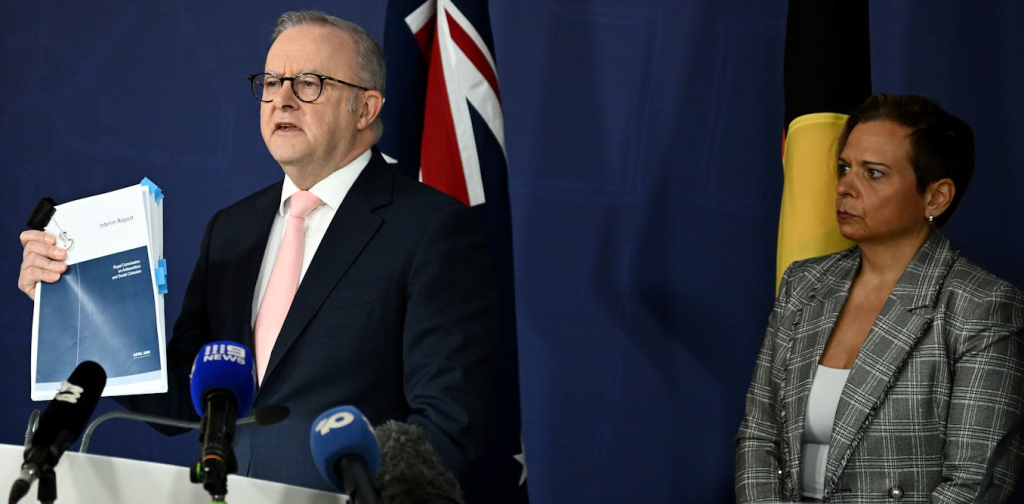

The interim report from the royal commission on antisemitism, set up after the Bondi massacre, leaves hanging more questions than it answers.
Perhaps no one should be surprised. The decision to have this report was a case of putting the cart before the horse.


Initially the government planned, after the December murder of 15 innocent people at a Jewish festival, to have a quick inquiry into whether federal agencies had adequate powers, processes and communications arrangements. That inquiry was to be done by former senior public servant Dennis Richardson.
Later, and reluctantly, Prime Minister Anthony Albanese was pushed into having a much wider royal commission into “antisemitism and social cohesion” under Virginia Bell. The Richardson review was folded into the commission. This didn’t go well and Richardson quit in March, declaring he had become a “fifth wheel” and “surplus to requirements”.
The merging of the review, with its end-of-April deadline, into the commission, has meant this interim report has been made before relevant figures have appeared before the commission, which only starts hearing evidence next week.
Given this apparently illogical timing, it would have made more sense to have extended the deadline for the interim report, to enable the commission to gain the full picture on key issues it canvasses. Undoubtedly the government would have granted extra time if the commission had requested it.
As it is, the interim report is thinner than one would wish, as Richardson predicted it would be when he quit.
Read more: Grattan on Friday: Dennis Richardson’s exit puts antisemitism royal commissioner under more pressure
Albanese at a news conference on Thursday seized on the commission’s conclusion that no legal or regulatory gap had been found that impeded “the ability for law enforcement, border control, immigration and security agencies to prevent or respond to” an attack of the kind that happened at Bondi.
The legal framework might be OK but how well or badly did agencies operate within it? Key answers to that are left for later.
“Important issues arising from the Bondi attack, including whether there was any failure to identify and act upon intelligence in the lead up to it, or in the allocation of police resources to the Chanukah event, will be addressed in hearings,” the report says.
“No conclusion in these respects can be reached on a review of the agencies’ documents alone and in the absence of according procedural fairness to any person or agency at risk of an adverse finding.”
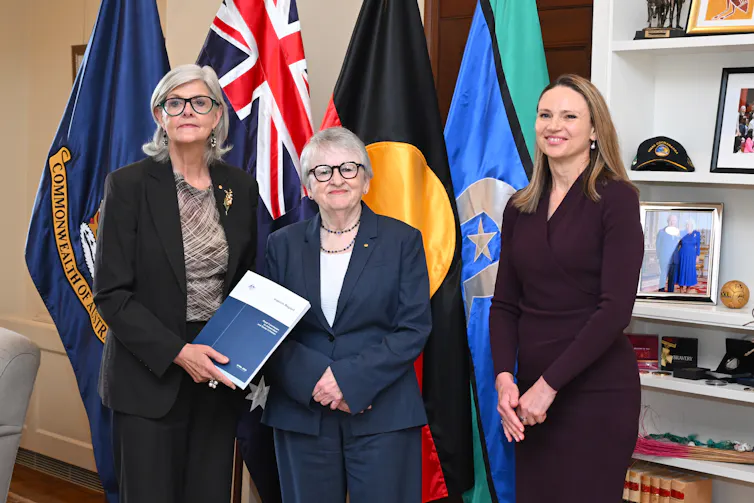
Precisely. But some hearings will have to be held in secret, the commission adds.
Much material about ASIO is classified in this report, including how it sets its priorities. The report gives year-by-year public statements from ASIO, which assess the various threats.
“It can be seen from the course of the Director-General of Security’s public statements from 5 August 2024 until late 2025 that ASIO publicly and repeatedly drew attention to the heightened risk of a terrorist attack and to an environment of ‘disturbing escalation’ of antisemitic incidents,” the report says.
“It will be necessary to investigate whether and how ASIO and other Commonwealth and state intelligence and law enforcement agencies understood and acted on those assessments of a probable attack; and to consider the adequacy of what was said to be ASIO’s ‘full use of our capabilities and powers’ in the context of ongoing antisemitic attacks.
“These are matters that will be explored in hearings.”
The report invites a lot of reading between the lines.
The commission does make the pointed observation, after reviewing classified material, that despite an overall increase in funding for the national intelligence community, “the proportion of funding allocated to counter-terrorism significantly declined across the NIC over the period from 2020 to 2025”.
Albanese was anxious to stress the government is acting quickly on the report’s recommendations, as far as they relate to Commonwealth responsibilities. Cabinet’s national security committee ticked off on them early Thursday morning.
Of the 14 recommendations, five are secret.
A big restraint referred to in the report is the criminal action against the surviving alleged Bondi offender. This means while some now-secret material may be released subsequently, that could be a long time away given how slowly the law proceeds. A relevant question is how much of a constraint the legal proceedings will put on the commission’s final report.
The report’s chapter about Commonwealth and state intelligence and law enforcement agency activities regarding Bondi is classified. “It should remain confidential until the finalisation of any criminal proceedings arising out of the Bondi attack. Thereafter a public version of the chapter should be released.”
Two recommendations go to the government’s gun buyback scheme, saying in essence it should be finalised as soon as possible. At present some jurisdictions are being recalcitrant or dragging their feet. Queensland on Thursday immediately repeated it would not be budging in its refusal to sign up to the gun buyback.
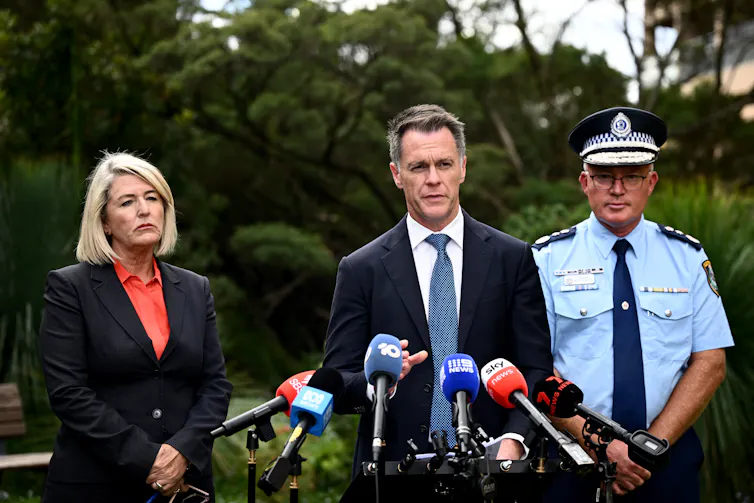
But, though given a lot of emphasis by the government, the gun issue is not the most important of the many challenges presented by the threats of terrorism and antisemitism.
Certain recommendations go to doing the very obvious. For example: “The Counter-Terrorism handbook should be updated promptly and then at least every three years”, and the Commonwealth Counter-Terrorism Coordinator’s role should be full-time.
The report also says the federal government “should consider whether National Security Committee ministers, including the Prime Minister, should participate in a counter-terrorism exercise, along with all National Cabinet members, within nine months of each federal election”.
At the sharp end of things, the commission recommends a more comprehensive approach by New South Wales police at high-risk Jewish events.
The commission observes, “the outbreak of hostilities between the United States and Israel and Iran in February 2026 is likely to have increased the risk of attacks directed at the Australian Jewish community”.
Public attention has been focused on how the war has exposed Australia’s vulnerability on fuel and other items coming through our supply lines, and its implications for inflation and economic growth. The commission’s grim warning is a reminder of the intensified danger of terrorism as another cost the Iran war poses.


















Comments are closed.