


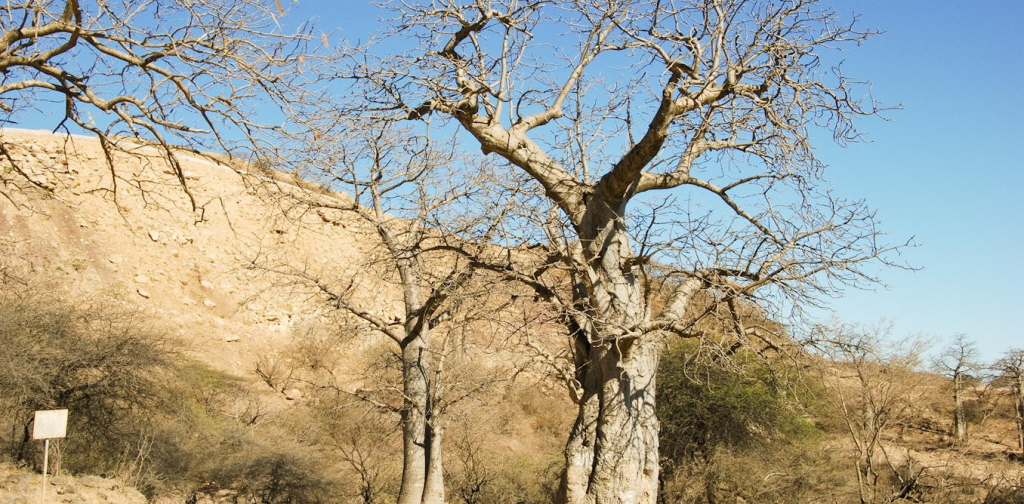

Baobabs aren’t supposed to fall. They can live for up to 2,500 years. Famous for their resilience, these huge trees have stood tall across Africa, weathering droughts and winds that flatten everything else.
A small population of 102 baobabs is also found in Oman on the south-eastern tip of the Arabian Peninsula, where baobabs were introduced over 1,500 years ago by traders from Africa.


However, several baobabs have recently collapsed and died in Oman, not from disease, drought or old age, but from infestation by a beetle that has suddenly proven deadly to baobab trees – the mango stem-borer (Batocera rufomaculata).

I’m a baobab ecologist who worked with two environmental scientists from Oman, Ali Salem Musallm Akaak and Mohammed Mubarak Suhail Akaak, to investigate how many trees had been infected by the beetle, how the infestation had affected the trees and how many had died as a result.
We surveyed 91 baobab trees in Oman and found that six had been killed by the beetle. A further 12 baobab trees were infested by the beetle’s larvae.
This is the first time that an insect has been found to kill adult baobab trees. The same beetle is known to damage and kill other species of trees.

Our findings have important implications for the conservation and management of baobabs throughout Africa. The mango-borer beetle has not been found in mainland Africa yet but it may become a new threat to baobabs if it disperses.
Our findings allow for early detection as well as research into effective ways to control the beetle before it spreads to Africa.
If the mango stem-borer were to reach mainland Africa, where the baobab is considered a keystone species, it could devastate both ecosystems and livelihoods. Baobabs have over 300 uses for people, including fibre made from the bark, food from the leaves and the fruit, which is harvested for its nutritious pulp and sold in local and global markets.
Meet the killer

The mango stem-borer is native to south-east Asia. Adults live for only two to three months, feeding on shoots and bark. During that time females can lay up to 200 eggs, cutting small slits in tree bark and sealing each egg inside.
The grubs or larvae spend almost a year hidden within the wood, tunnelling through the living tissue that carries water and nutrients. As they feed, they weaken the tree and eventually kill it.
This beetle has long been one of Asia’s most damaging fruit-tree pests. It attacks mango, jackfruit, mulberry and fig trees, often killing mature hosts. It spread to the Middle East, where it was first recorded in 1950 and has damaged fig plantations.

In 2021, an adult baobab in Wadi Hinna, a semi-arid valley in Oman’s Dhofar Mountains, collapsed and died. When researchers examined the fallen trunk, they discovered it was infested by mango stem-borer larvae.
By 2025, seven baobabs had died, and many more were infected, confirming that a seemingly innocuous fruit-tree pest had found a new host.
Read more: Madagascar’s ancient baobab forests are being restored by communities – with a little help from AI
The very qualities that make baobabs extraordinary survivors in dry climates also make them ideal nurseries for borer beetle larvae. Their stored water, soft trunks and nutrient rich tissue feed and protect larvae for nearly a year until they mature.
As the larvae feed, they hollow out the interior of the baobab, leaving the outer bark intact and the infestation hidden, until the stem suddenly collapses.
Battling the beetle

When the first deaths were recorded, Oman’s Environment Authority launched an emergency control programme with help from local communities and researchers.
Infested trees were treated with systemic insecticides, larvae were manually removed from trunks, and light traps were set to attract and kill adult beetles at night. Tree stems were also coated with agricultural lime and fungicide to deter further egg-laying.
These actions seem to have slowed the outbreak, but they are labour-intensive and feasible only for a small area. Across a continent, such methods would be impossible to maintain.
Read more: The secret life of baobabs: how bats and moths keep Africa’s giant trees alive
In Asia, scientists have identified natural enemies of the mango stem-borer, including parasitic mites and nematodes. These could be used as the base of a long-term biological control strategy.
My research argues that using biological control to stop the beetle reproducing must be developed as a priority before infestations cross into Africa.
Preventing a spread to Africa
Adult beetles can fly up to 14 kilometres in a single night, and global trade makes it easy for insects to cross borders unnoticed, hidden in plants and ornamentals destined for the agriculture and garden sector.
The beetle already occurs on islands such as Madagascar, Réunion and Mauritius. Baobab researchers do not know if the mango stem-borer has attacked the local baobab populations of Madagascar, where the trees are an indigenous plant.

Early detection and prevention are far cheaper, and far more effective, than trying to stop an outbreak once it begins. Stronger biosecurity inspections and other measures are needed at African ports and borders to stop the beetle crossing borders, particularly in shipments of wood and live plants.
Collaboration between research institutions, agricultural departments and the baobab industry will also help: sharing data, testing biological controls and setting up monitoring systems before further outbreaks occur.
A warning – and an opportunity
The death of baobabs in Oman is more than a localised problem. It’s a warning of what could happen elsewhere if the beetle spreads unchecked.
But it also offers a chance to prepare. If African countries act now, tightening biosecurity, supporting research and raising awareness, they can protect one of the continent’s most iconic and life-sustaining trees before this threat ever reaches African shores.




















Comments are closed.